- Plants
- ›Vascular Plants
- ›flowering plants
- ›monocots
- ›grasses, sedges, cattails, and allies
- ›grasses
- ›Panicums, Bluestems, Paspalums, and Allies
- ›bristle, rosette, and barnyard grasses, and allies
- ›Panicinae
- ›Panicum
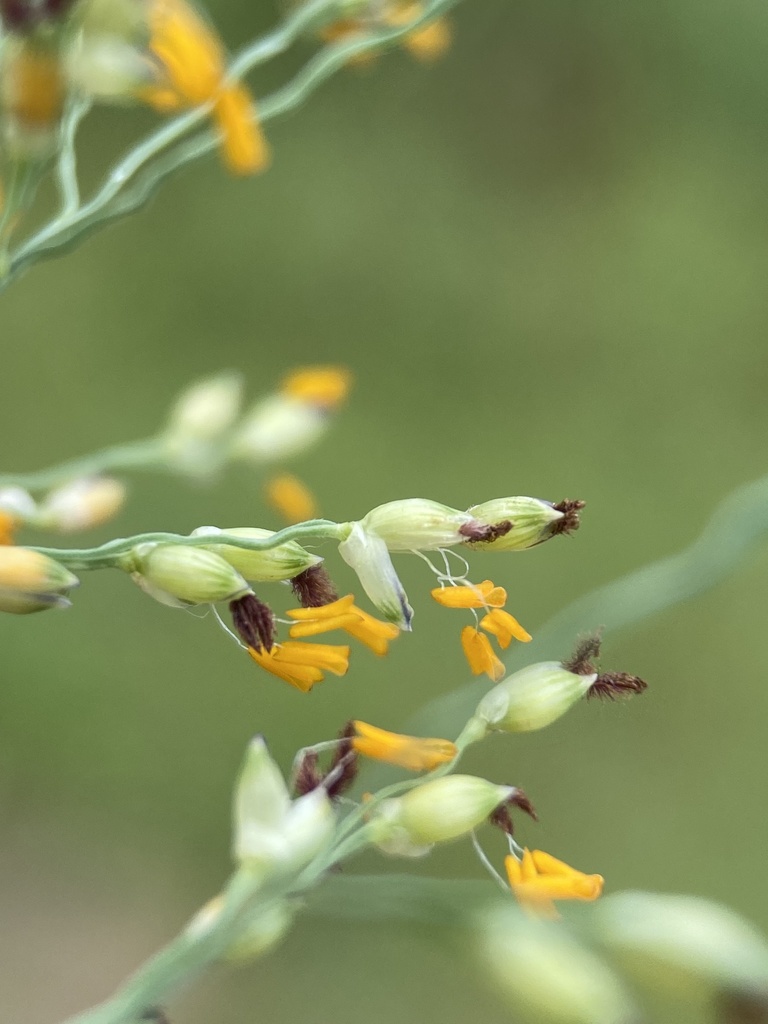
Torpedo grass
Panicum repens
Panicum repens is a species of grass known by many common names, including torpedo grass, creeping panic, panic rampant, couch panicum, wainaku grass, quack grass, dog-tooth grass, and bullet grass. Its exact native range is obscure. Sources suggest that the grass is native to "Africa and/or Asia", "Europe or Australia", "Eurasia", "Australia", "Europe, Asia, and Africa", or other specific regions, including the Mediterranean, and Argentina. It is present in many places as an introduced species and often a noxious weed. It has been called "one of the world's worst weeds."
From the article Panicum repens on Wikipedia (CC BY-SA), quoted section by section
Range & habitat
This grass grows throughout the world in tropical and subtropical areas. It was introduced to the United States in seed for forage grasses and probably in ballast water from ships. It was also imported by the United States Department of Agriculture to grow as a forage grass for cattle. It was deliberately planted throughout South Florida and it easily escaped cultivation, eventually becoming "one of the most serious weeds in Florida," spreading to more than 70% of the waterways in the state. In Lake Okeechobee, it has invaded more than 16,000 acres of marsh. It displaces native plants, growing colonially in thick, monotypic stands. Dense mats or stands of the grass cause hypoxia in the water. Torpedograss management in flood-control systems costs an estimated US$2 million per year. The plant is established in sandy coastal habitat on the United States' Gulf Coast, such as beaches and dunes, from Florida to Texas, where it occurs with beach plants such as turtleweed (Batis maritima), saltgrass (Distichlis spicata), marsh fimbry (Fimbristylis spadicea), largeleaf pennywort (Hydrocotyle bonariensis), and dwarf saltwort (Salicornia bigelovii). It grows on many barrier islands. It grows in many types of wetland habitat, in and out of the water. It grows in freshwater marshes, salt marshes, mud flats, wet prairies, tide pools, bogs, and lakesides. …
Wikipedia: “Habitat”
How it is grown
The grass spreads primarily via its rhizome. It has been noted to grow 1.3 cm (0.51 in) in length per day. The stems and rhizomes also produce tillers. The rhizome can endure drying and flooding. Dry or wet conditions may reduce the number of shoots produced by the rhizome, but they do not kill it. The rhizome can disperse when parts of it break off and drop onto the substrate elsewhere, anchoring and putting up new shoots. The plant survives and sprouts after herbicide application, grazing, cutting, plowing or disking, and burning. The grass rarely reproduces by seed. It has been noted to reproduce by seed in Portugal, but does not do so in the United States, and it was described as "incapable of fruiting" in Japan. Seeds are sometimes observed but they are apparently rarely viable, with many studies describing zero germination. The grass has been widely planted as forage for cattle because it is so hardy, withstanding grazing and trampling, and it can be made into hay. However, it is not one of the more palatable or nutritious grasses. It is also good for erosion control because it binds the soil. Indeed, it is still recommended for planting along shorelines to stabilize them.
Wikipedia: “Propagation”
Where it lives
Recorded sightings
—
geo-referenced records in GBIF, from museums, herbaria and field observers.
Drag the globe to turn it. Dots are where records exist, not a range map; darker means more records.
In the stacks
Searching the stacks…
Every page naming Panicum repens in the Biodiversity Heritage Library →
This page is assembled live from iNaturalist, GBIF, Wikipedia, the Source Library and the Internet Archive. It is not yet part of the hand-edited codex. iNaturalist taxon 166096.