- Plants
- ›Vascular Plants
- ›flowering plants
- ›Dicots
- ›Sunflowers, Bellflowers, Fanflowers, and Allies
- ›Sunflowers, Daisies, Asters, and Allies
- ›Asteroideae
- ›Sunflowers and Allies
- ›Cockleburs, Ragweeds, and Wild Quinines
- ›Parthenium
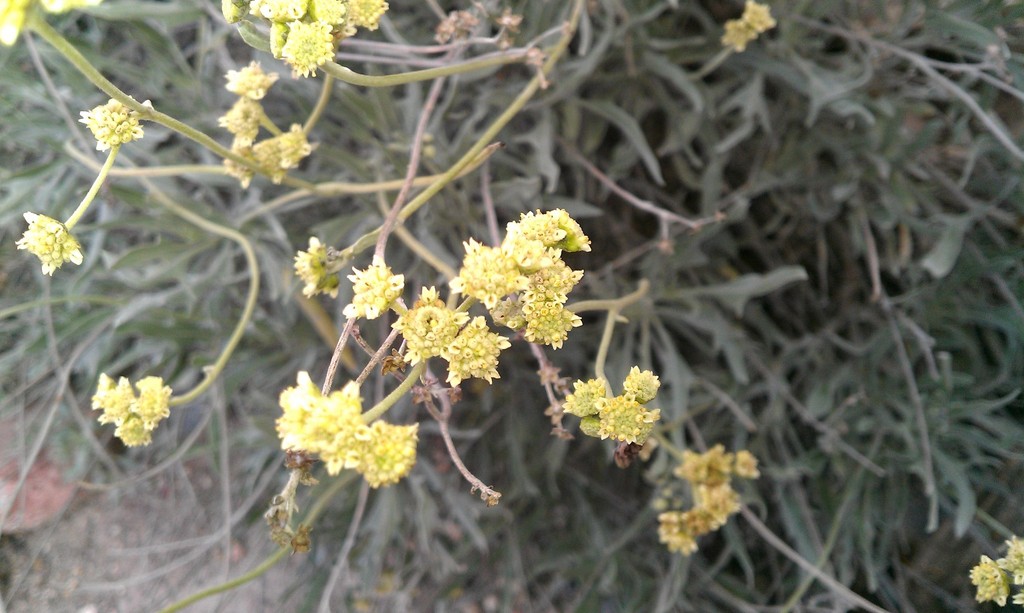
guayule
Parthenium argentatum
Parthenium argentatum, commonly known as the guayule ( or , as in Spanish), is a perennial woody shrub in the family Asteraceae that is native to the rangeland area of the Chihuahuan Desert; including the southwestern United States and northern Mexico. It was first documented by J.M. Bigelow in 1852 through the Mexican Boundary Survey and was first described by Asa Gray. Natural rubber, ethanol, non-toxic adhesives, and other specialty chemicals can be extracted from guayule. An alternative source of latex that is hypoallergenic, unlike the normal Hevea rubber, can also be extracted. While Castilla elastica was the most widely used rubber source of Mesoamericans in pre-Columbian times, guayule was also used, though less frequently. The name "guayule" derives from the Nahuatl word ulli/olli, "rubber".
From the article Parthenium argentatum on Wikipedia (CC BY-SA), quoted section by section
Description
Guayule grows in rocky, limestone desert areas in full sun. The plant's outer branches and leaves are covered in fine silvery hairs called trichomes, and yellow-white flowers grow from stems at the top of the plant. The densely haired leaves are covered with white wax to help prevent drying. The plant has an extensive root system, which lends to its drought resistance. One taproot extends down, while lateral roots extend from the taproot to the side. In some plants, lateral roots are longer than the taproot while in other plants, the opposite is true. U.S. indigenous populations of guayule occur in the Trans Pecos region of southwestern Texas. It can also be found in the low desert regions of Arizona, New Mexico, and some parts of Southern California and the Mexican states of Zacatecas, Coahuila, Chihuahua, San Luis Potosí, Nuevo León, and Tamaulipas and is able to be cultivated in similar climates around the world.
Wikipedia: “Description and range”
In human culture
In the 1920s, the plant saw a brief and intense amount of agricultural research when the Intercontinental Rubber Company in California produced 1400 tons of rubber after South American Leaf Blight decimated the Brazilian rubber industry. Guayule would again become a replacement for Hevea tree-produced latex during World War II when Japan cut off America's Malaysian latex resources. The war ended before large-scale farming of the guayule plant began, and the project was scrapped, as it was cheaper to import tree-derived latex than to crush the shrubs for a smaller amount of latex. Currently, PanAridus and Yulex are the only commercial producers of guayule natural rubber in the world. Yulex have partnered with Patagonia who are now making their Yulex wetsuit from Guayule derived plant stems in a 60/40 blend (60% guayule, 40% neoprene), reducing dependence on conventional neoprene. In 2011, Howard Colvin led a successful $6.9 million DOE-funded Biomass R&D Initiative to produce and test an all-guayule tire.
In October 2015, the Bridgestone Corporation announced the creation of the first tires made entirely of guayule rubber, having built an experimental farm and biorubber research center in Mesa, Arizona the previous year. The guayule is grown in Mesa and Eloy, Arizona. In 2022, IndyCar announced the use of eco-friendly guayule-derived rubber tires.
Hypoallergenic properties. …
Wikipedia: “History”
Where it lives
Recorded sightings
—
geo-referenced records in GBIF, from museums, herbaria and field observers.
Drag the globe to turn it. Dots are where records exist, not a range map; darker means more records.
In the stacks
Searching the stacks…
Every page naming Parthenium argentatum in the Biodiversity Heritage Library →
This page is assembled live from iNaturalist, GBIF, Wikipedia, the Source Library and the Internet Archive. It is not yet part of the hand-edited codex. iNaturalist taxon 166156.