- Plants
- ›Vascular Plants
- ›flowering plants
- ›Dicots
- ›pepper plants, birthworts, and allies
- ›pepper plant family
- ›Peperomia
- ›Peperomia
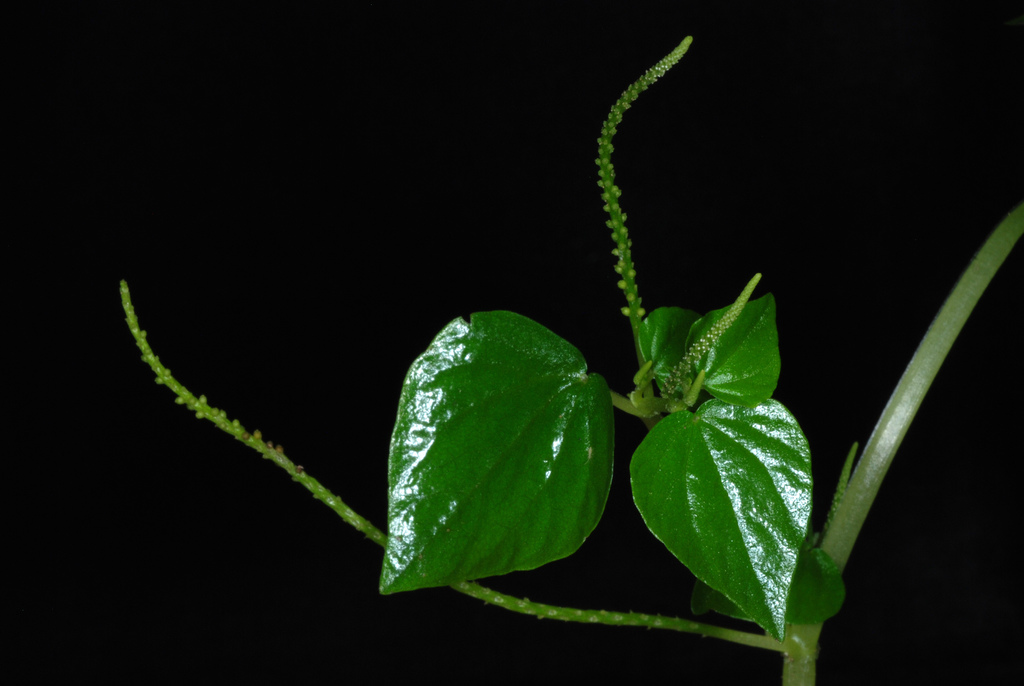
Pepper elder
Peperomia pellucida
Peperomia pellucida (also known by common names pepper elder, shining bush plant, and man to man) is an annual, shallow-rooted herb, usually growing to a height of about 15 to 45 cm (6 to 18 inches), it is characterized by succulent stems, shiny, heart-shaped, fleshy leaves and tiny, dot-like seeds attached to several fruiting spikes. It has a mustard-like odor when crushed. The family Piperaceae comprises about a dozen genera and around 3000 species. The genus Peperomia
From the article Peperomia pellucida on Wikipedia (CC BY-SA), quoted section by section
Range & habitat
Flowering year-round, the plant is found in various shaded, damp habitats all over Asia and the Americas. It grows in clumps, thriving in loose, humid soils and a tropical to subtropical climate.
Wikipedia: “Habitat”
At the table
Peperomia pellucida has been used as a food item as well as a medicinal herb. Although mostly grown for its ornamental foliage, the entire plant is edible, both cooked and raw.
Wikipedia: “Uses”
In medicine
The analgesic properties of the plant seem to be related to its effect on prostaglandin synthesis. It may have potential as a broad spectrum antibiotic, as demonstrated in tests against Staphylococcus aureus, Bacillus subtilis, Pseudomonas aeruginosa, and Escherichia coli. Chloroform extracts from dried leaves of P. pellucida have been shown to exhibit antifungal activity against Trichophyton mentagrophytes in vitro. Anti-inflammatory activity (in paw edema) and analgesic activity has been demonstrated in rats and mice. Although the plant can cause asthma-like symptoms in patients with known hypersensitivity reactions to the species, no clinical data have yet been reported on human toxicity.
Wikipedia: “Pharmacology”
Where it lives
Recorded sightings
—
geo-referenced records in GBIF, from museums, herbaria and field observers.
Drag the globe to turn it. Dots are where records exist, not a range map; darker means more records.
In the stacks
Searching the stacks…
Every page naming Peperomia pellucida in the Biodiversity Heritage Library →
This page is assembled live from iNaturalist, GBIF, Wikipedia, the Source Library and the Internet Archive. It is not yet part of the hand-edited codex. iNaturalist taxon 166494.