- Plants
- ›Vascular Plants
- ›flowering plants
- ›Dicots
- ›borages
- ›borage family
- ›baby blue eyes, Phacelias, and waterleaves
- ›Phacelia
- ›Phacelia
- ›Cosmantha
- ›Cosmantha
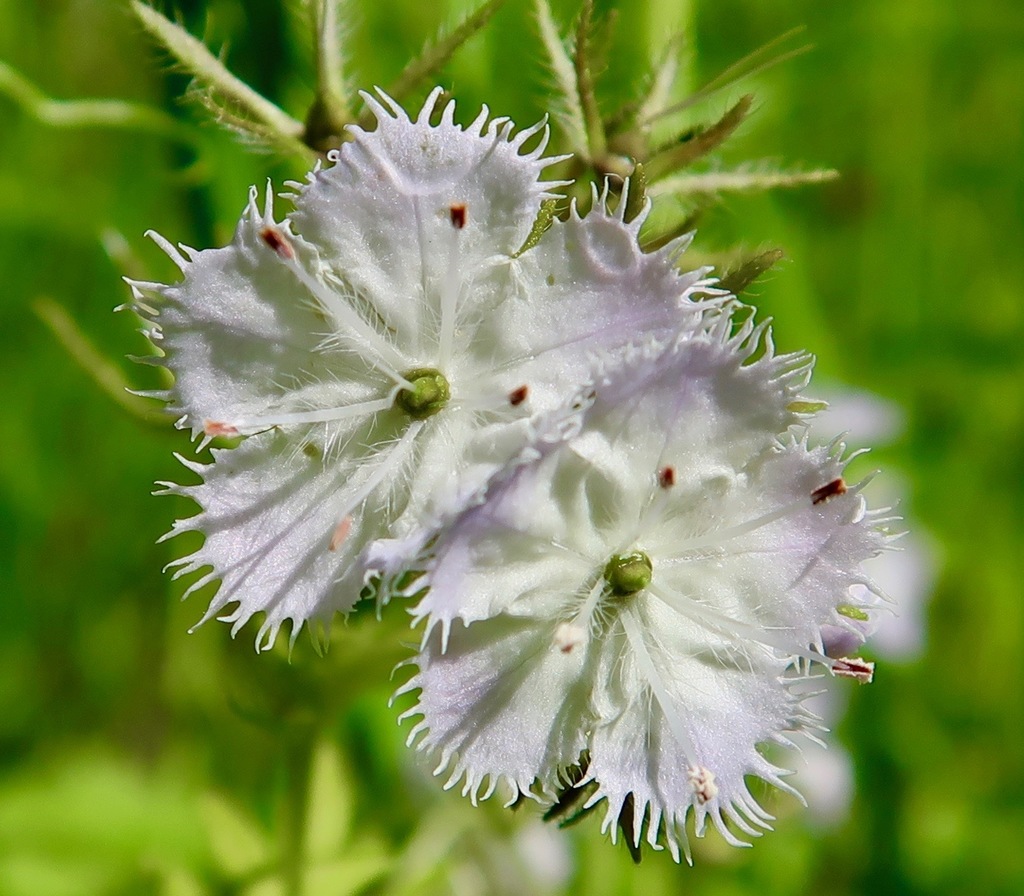
Miami Mist
Phacelia purshii
Phacelia purshii, common name Miami mist, is a spring flowering annual forb with blue flowers, which is native to eastern and central North America. It is native to the Appalachian Mountains and adjacent regions from Alabama to Pennsylvania, with additional populations in the Tennessee/Ohio Valley, the mid-section of the Mississippi Valley (Illinois, Missouri, Arkansas) and the Great Lakes region (Ohio, Michigan, Ontario, etc.). It grows in floodplain forests and alluvial clearings.
From the article Phacelia purshii on Wikipedia (CC BY-SA), quoted section by section
Description
P. purshii is a delicate plant that grows to 30–45 centimetres (12–18 in) tall with slender, branching stems. Its leaves are alternate, have many sharply pointed lobes and are up to 8 centimetres (3 in) long. The lower leaves on the plant have a petiole, while the upper leaves are sessile. The inflorescence is a loose scorpioid cyme (the axis is curved like the tail of a scorpion), with 8 to 30 flowers. Flowers are light blue, violet, lavender, or nearly white with pale centers, and they have 5 fringed lobes.
Range & habitat
It is native to the Appalachian Mountains and adjacent regions from Alabama to Pennsylvania, with additional populations in the Tennessee/Ohio Valley, the mid-section of the Mississippi Valley (Illinois, Missouri, Arkansas) and the Great Lakes region (Ohio, Michigan, Ontario, etc.). It grows in floodplain forests and alluvial clearings.
Wikipedia: “Distribution and habitat”
What it does
The flowers bloom in the early spring, from April to June. They attract a variety of bees and butterflies.
Wikipedia: “Ecology”
In human culture
The genus name Phacelia is from the Greek word for "cluster", referring to the grouping of the flowers. The specific epithet purshii honors the German botanist Frederick Traugott Pursh, who claimed to discover the plant. The common name Miami mist probably refers to the Miami people who lived in the Great Lakes region and the appearance of the flowers when they grow to cover large areas.
Wikipedia: “Etymology”
Where it lives
Recorded sightings
—
geo-referenced records in GBIF, from museums, herbaria and field observers.
Drag the globe to turn it. Dots are where records exist, not a range map; darker means more records.
In the stacks
Searching the stacks…
Every page naming Phacelia purshii in the Biodiversity Heritage Library →
This page is assembled live from iNaturalist, GBIF, Wikipedia, the Source Library and the Internet Archive. It is not yet part of the hand-edited codex. iNaturalist taxon 166605.