- Plants
- ›Vascular Plants
- ›flowering plants
- ›Dicots
- ›Heathers, Balsams, Primroses, and Allies
- ›phlox family
- ›Phlox
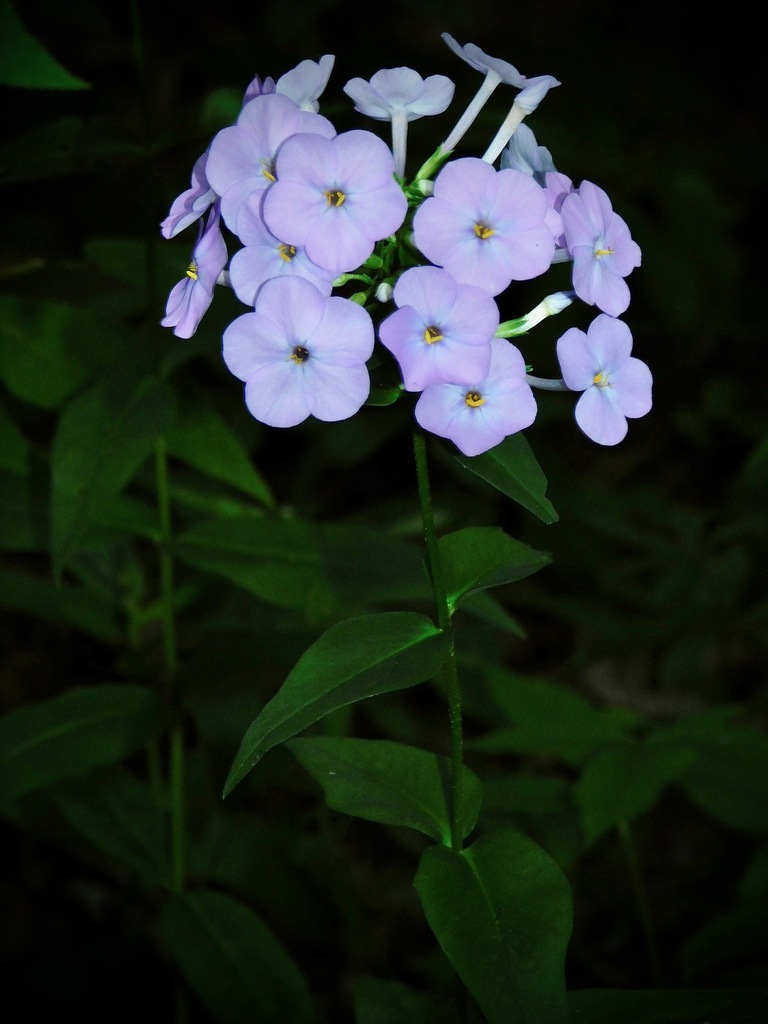
thickleaf phlox
Phlox carolina
Phlox carolina, the thickleaf phlox, is a species of flowering plant in the family Polemoniaceae. It is an herbaceous perennial growing to 1.2 m (4 ft) tall by 45 cm (18 in) wide, with leaves to 13 cm (5 in) long, and purple or pink flowers in summer.
The specific epithet carolina refers to its native habitat in the eastern United States. It grows in woodland edges and openings. Flowers attract bees, hummingbirds, and butterflies.
From the article Phlox carolina on Wikipedia (CC BY-SA), quoted section by section
Description
Phlox carolina grows from 1 to 5 feet tall, typically 2 to 3 feet tall, and 1 to 2 feet wide at maturity. It is a herbaceous perennial. Phlox carolina flowers from May to late June, flowering indeterminately throughout the season. The flowers are less than one inch in length and are pink, purple, or white. They are located in bunches or a dome shape at the top of the plant. The inflorescence of Phlox carolina is panicle-shaped with a fragrant scent. The leaf type of Phlox carolina is simple with an opposite arrangement, an entire margin, and a lanceolate to ovate shape. They are 1 to 4 inches long. The stem is red and is pubescently haired. The fruit is capsule-shaped and fully matured in summer.
Range & habitat
Phlox carolina is native to the southeastern United States from Florida to Indiana west to east and from North Carolina to Texas north to south. It tends to grow in open forested areas, forest edges, roadsides, and clearings. It can also be found in gardens as an ornamental plant. Phlox carolina grow in moist habitats and can grow in loam, clay, sand, or high-nutrient soil. It thrives in soil pH below 6.8. It is heat tolerant and grows in full sun or partial shade. Phlox carolina grows in hardiness zones 5a to 9b. Phlox carolina is considered to be critically imperiled in West Virginia.
Wikipedia: “Distribution and habitat”
At the table
Phlox carolina is often used as an ornamental plant in gardens, and it serves as a pollinator plant that attracts bees, hummingbirds, and butterflies. It serves as a food source for small mammals such as Cottontail Rabbits. Phlox carolina is often used as a reference in gene studies to count the differing number of chromosome that differing species contain. Phlox carolina has 14 diploid chromosomes. Phlox carolina is also used as a Tall Phlox for studies on mechanical aspects of hybridization success in relation to height, as taller phlox species have longer pollen tubes and larger pollen grains than short phlox species.
Wikipedia: “Uses”
Where it lives
Recorded sightings
—
geo-referenced records in GBIF, from museums, herbaria and field observers.
Drag the globe to turn it. Dots are where records exist, not a range map; darker means more records.
In the stacks
Searching the stacks…
Every page naming Phlox carolina in the Biodiversity Heritage Library →
This page is assembled live from iNaturalist, GBIF, Wikipedia, the Source Library and the Internet Archive. It is not yet part of the hand-edited codex. iNaturalist taxon 166690.