- Plants
- ›Vascular Plants
- ›flowering plants
- ›Dicots
- ›Heathers, Balsams, Primroses, and Allies
- ›phlox family
- ›Phlox
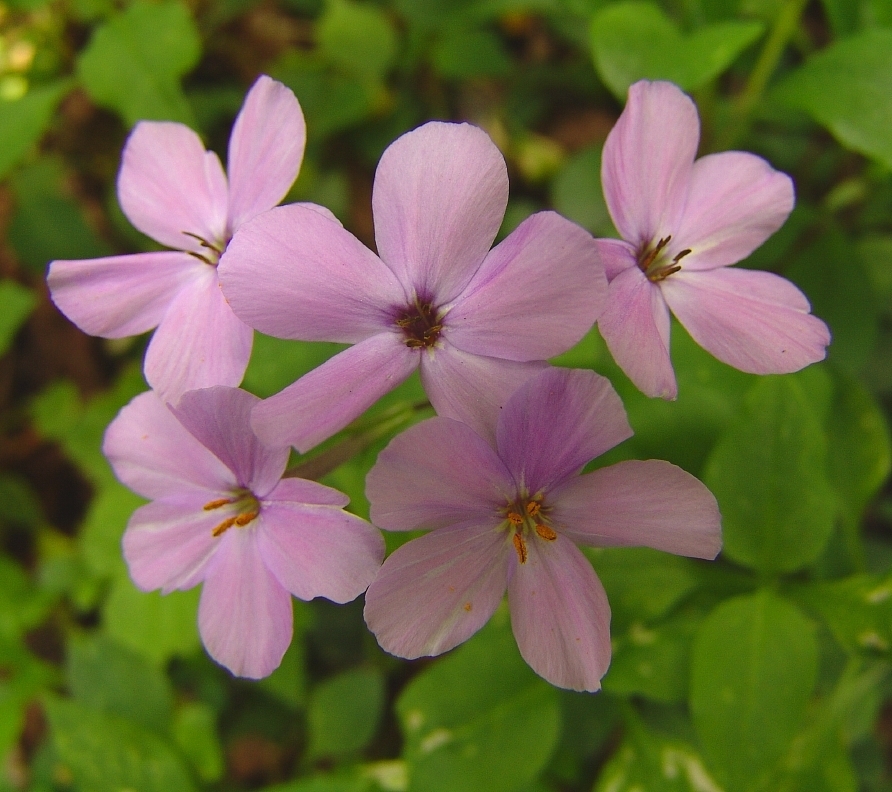
creeping phlox
Phlox stolonifera
Phlox stolonifera (creeping phlox or moss phlox) is a species of flowering plant in the family Polemoniaceae. It is a perennial herbaceous plant that is native to the eastern United States. It occurs in woodlands and stream banks in the vicinity of the Appalachian Mountains from Pennsylvania south to northern Georgia. Naturalized populations occur as far north as Québec, Canada.
Its flowers are pale purple, pink, or white, 2–2.5 cm (0.79–0.98 in) in diameter, with a five-lobed corolla and yellow stamens, which are borne on stems that are 15–25 cm (6–10 in) tall. They lack the central band of color that is present in the flowers of the related Phlox subulata.
From the article Phlox stolonifera on Wikipedia (CC BY-SA), quoted section by section
Description
The creeping phlox flowers typically have 5 petals, but there could also be 6 or 7 petals. They range from pale blue and violet to purple and vibrant.
Wikipedia: “Characteristics”
At the table
Creeping Phlox is widely used as a groundcover. Its trailing growth habit and dense mat-like foliage help suppress weed growth and prevent soil erosion on slopes or in areas where grass may not thrive.
Wikipedia: “Uses”
Where it lives
Recorded sightings
—
geo-referenced records in GBIF, from museums, herbaria and field observers.
Drag the globe to turn it. Dots are where records exist, not a range map; darker means more records.
In the stacks
Searching the stacks…
Every page naming Phlox stolonifera in the Biodiversity Heritage Library →
This page is assembled live from iNaturalist, GBIF, Wikipedia, the Source Library and the Internet Archive. It is not yet part of the hand-edited codex. iNaturalist taxon 166724.