- Plants
- ›Vascular Plants
- ›flowering plants
- ›monocots
- ›grasses, sedges, cattails, and allies
- ›grasses
- ›Pooideae
- ›needlegrasses and allies
- ›Piptochaetium
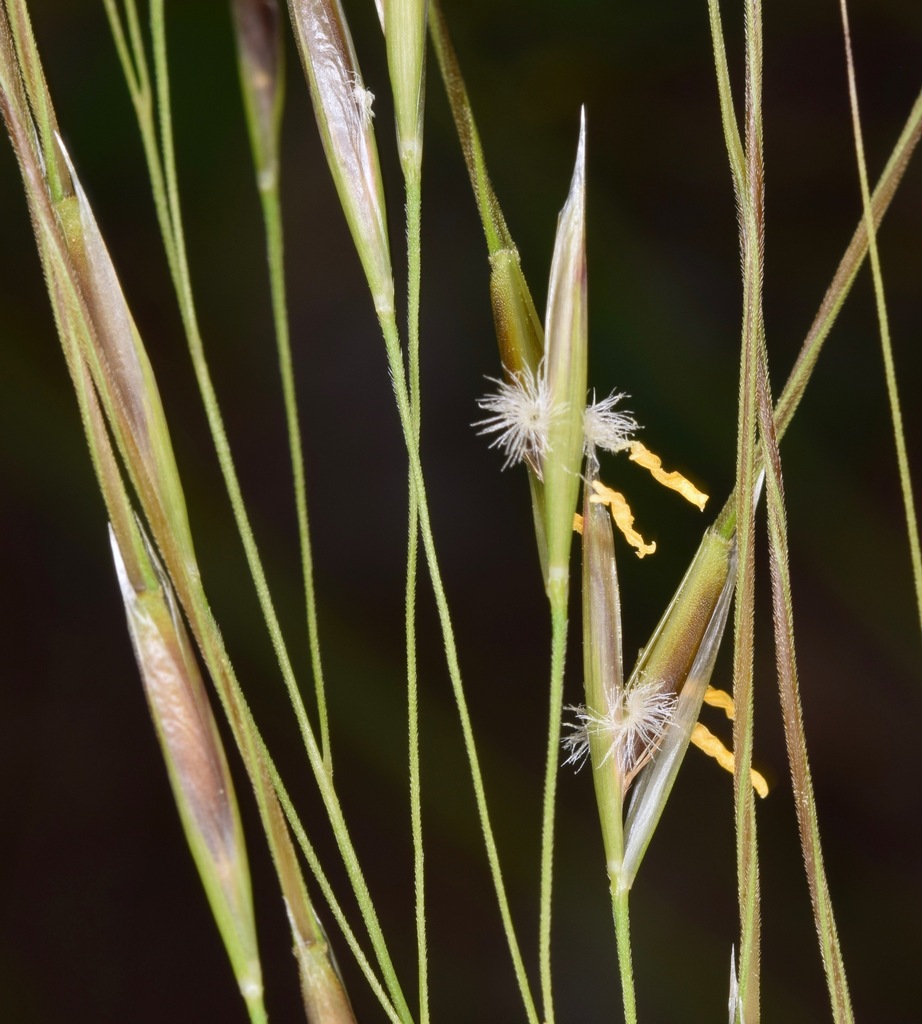
Blackseed Needlegrass
Piptochaetium avenaceum
Stipa avenacea - renamed Piptochaetium avenaceum, and commonly called black oat grass, blackseed needle grass or blackseed speargrass, is a perennial bunchgrass native to Eastern North America. It is a member of the grass family Poaceae.
From the article Piptochaetium avenaceum on Wikipedia (CC BY-SA), quoted section by section
Description
Piptochaetium avenaceum, Black oat grass, consists of fine leaf texture that appear to be bristle-like. Its leaves are long and elongate, reaching up to 3 feet (0.91 m) in height. The plant is easily recognizable when flowering or fruiting. It can be identified by its open inflorescences, which are thin and usually cannot be seen from a distance. The branches within these inflorescences are very thin and thus can create effects of spikelets that appear to be floating in mid air. It also consists of awns, which are hairlike projections containing multicellular organisms that obtain nutrients through photosynthesis. The awns can twist and un-twist in circumstances depending on the humidity and temperature of the area, which is required for them in order to thrive within soil. They also protrude from individual flowers in the flowering clusters, which tend to develop between late spring and early summer (normally April to June). Panicles also exist within this species where it rises above the plant's rolled and thread-like leaves. It contains slender open branches, a few narrow scales and spikelets that consist of one flower. The ripened flowering heads within the spikelet remain on the grass usually until autumn, in which the awns tend to bend and twist, spreading widely from the scales. The seeds are formed as sharp needles. …
Range & habitat
Piptochaetium avenaceum is commonly found in the eastern United States, within various types of habitats, which include:
grasslands deciduous hardwood hammocks, thickets, and dry woods. upland woodlands and forests (such as dryer oak woodlands). savannas and clearings. rocky slopes and outcrops. The species distribution is mostly found in the eastern United States. It is found in the Great Lakes region of the U.S. Midwest and Ontario, Canada, and the shortgrass prairies of the south-central U.S. as well. The range has been documented in: Alabama; Pennsylvania; Rhode Island, New York and Florida, North and South Carolina; Georgia; Michigan; Illinois; Oklahoma, and other states adjacent to these.
Wikipedia: “Distribution”
Where it lives
Recorded sightings
—
geo-referenced records in GBIF, from museums, herbaria and field observers.
Drag the globe to turn it. Dots are where records exist, not a range map; darker means more records.
In the stacks
Searching the stacks…
Every page naming Piptochaetium avenaceum in the Biodiversity Heritage Library →
This page is assembled live from iNaturalist, GBIF, Wikipedia, the Source Library and the Internet Archive. It is not yet part of the hand-edited codex. iNaturalist taxon 166900.