- Plants
- ›Vascular Plants
- ›flowering plants
- ›Dicots
- ›Mustards, Capers, and Allies
- ›Spider Flower Family
- ›Polanisia
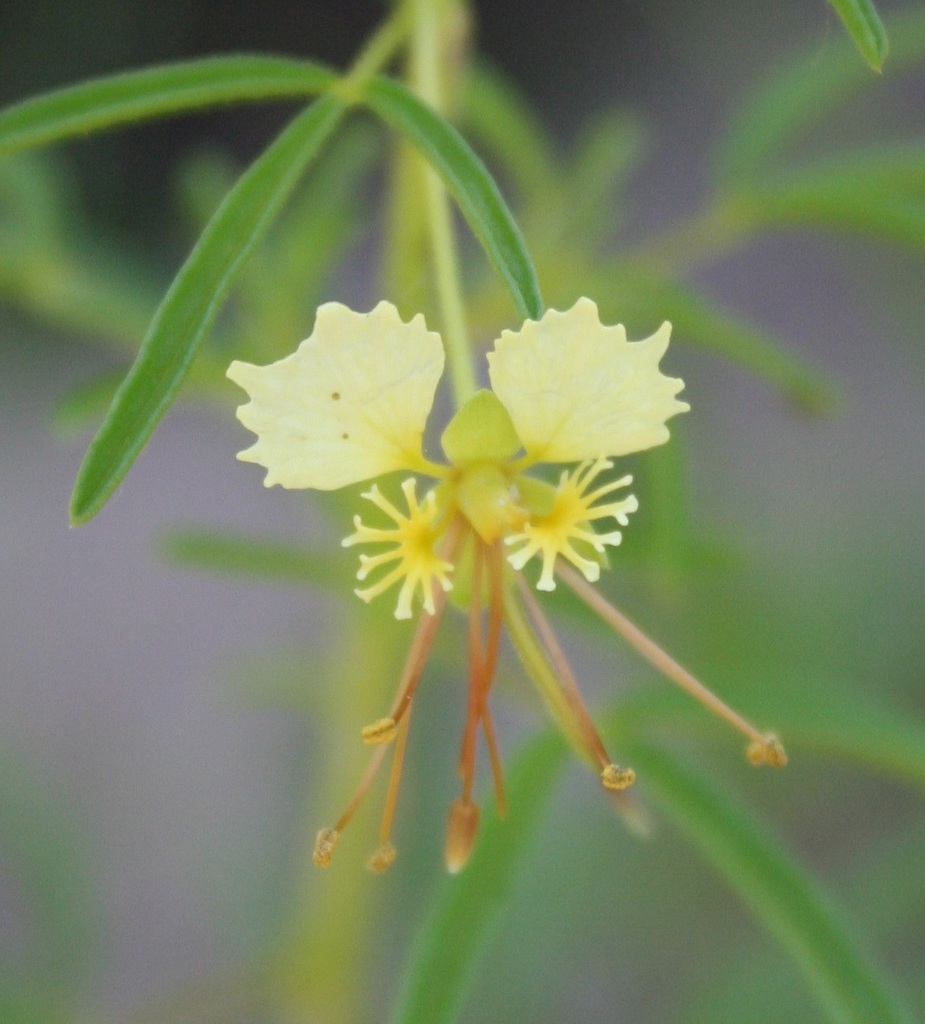
Sandhill Clammyweed
Polanisia erosa
Polanisia erosa is a sticky, 10–60 cm (3.9–23.6 in) high annual herbaceous species of flowering plant in the Cleome family, Cleomaceae, known by the common named large clammyweed and sandhill clammyweed. It has narrow clover-like leaves, and cream-coloured, frilly flowers with a yellowish centre, looking a bit like a small butterfly or a set of elk antlers. It naturally occurs in dry and sandy habitats in Texas and adjacent parts of Arkansas, Louisiana and Oklahoma.
From the article Polanisia erosa on Wikipedia (CC BY-SA), quoted section by section
Description
Large clammyweed is a sticky, unscented annual herb of 10–60 cm (3.9–23.6 in). It has branched or unbranched, green or purple stems with seated glands and glandular hairs. The 0.3–1.5 mm (0.012–0.059 in) long, green or purple leaf stalks are often at an angle with the leaf blade. The leaf blade consists of three narrow, 0.9–3.5 cm (0.35–1.38 in) long and only 1–2 mm (0.039–0.079 in) wide, somewhat fleshy leaflets, the right and left halves more or less folded towards each other (or conduplicate) with entire margins, a needle-like tip, the underside of the leaf with many, and the upper side with few glands. The bilaterally symmetrical flowers are set in gland-covered racemes that are initially 1–3 cm (0.39–1.18 in) long but that keep growing to 6–8 cm (2.4–3.1 in) when fruits are ripe. Each individual flower is subtended by a bracts consisting of one or three entire bractlets, which have an oval shape and are 7–15 mm (0.28–0.59 in) long. The stalk of the individual flower is 1−2.3 cm (0.4-0.9 in) long. The four deciduous, eventually deflected, green to purple coloured, hairless sepals are lanceolate to inverted egg-shaped, 2.5–3.5 mm (0.1–0.14 in) long and 0.8–1.3 mm (0.03–0.05 in) wide, with entire margins and a pointy tip. The four petals are mostly creamy white, oblong-ovate, consist of a more yellowish straight and narrow claw and a wide plate. …
Range & habitat
Large clammyweed naturally occurs in Texas and adjacent parts of Arkansas, Louisiana and Oklahoma, where it can be found in fields, prairies, sandy hillsides and open woodland.
== References ==
Wikipedia: “Distribution and habitat”
Where it lives
Recorded sightings
—
geo-referenced records in GBIF, from museums, herbaria and field observers.
Drag the globe to turn it. Dots are where records exist, not a range map; darker means more records.
In the stacks
Searching the stacks…
Every page naming Polanisia erosa in the Biodiversity Heritage Library →
This page is assembled live from iNaturalist, GBIF, Wikipedia, the Source Library and the Internet Archive. It is not yet part of the hand-edited codex. iNaturalist taxon 167152.