- Plants
- ›Vascular Plants
- ›Ferns
- ›Adder's-tongues, Fork Ferns, and Allies
- ›fork and chain ferns
- ›fork and chain ferns
- ›Psilotum
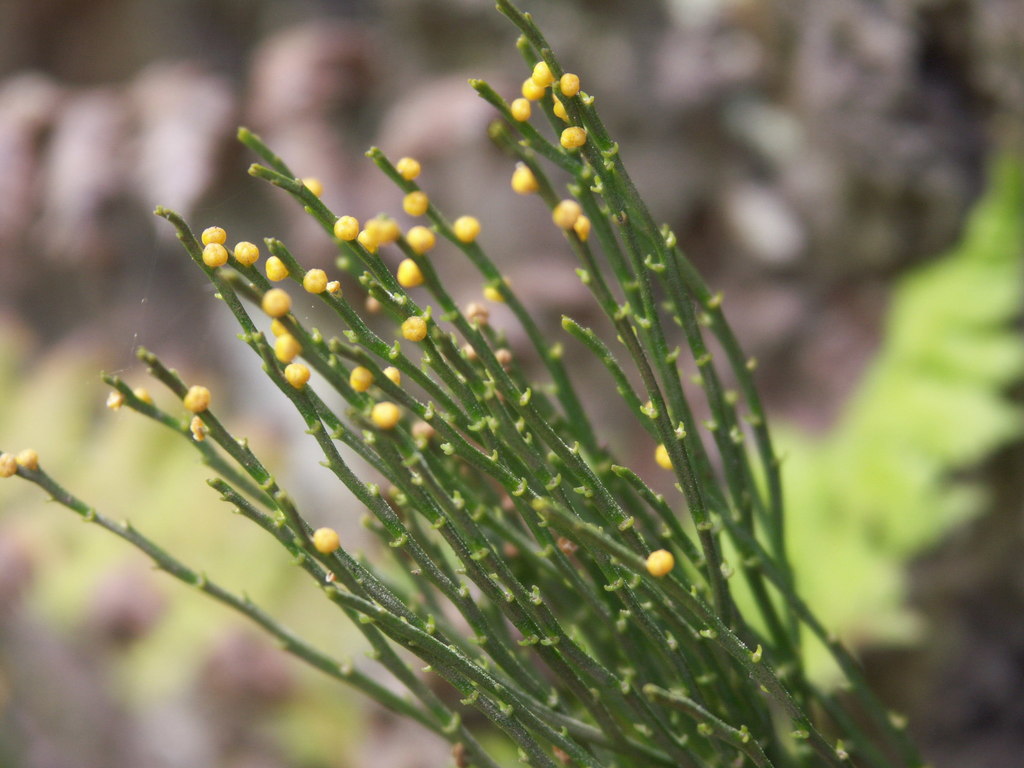
skeleton fork fern
Psilotum nudum
Psilotum nudum, commonly known as the whisk fern, is a species of fern in the order Psilotales. Like the other species in this order, it lacks roots and instead possesses underground rhizomes. It reporduces by spores.
Psilotum nudum means "bare naked" in Latin, because it lacks (or seems to lack) most of the organs of typical vascular plants as a result of evolutionary reduction. The leaves are not actually absent but greatly reduced.
From the article Psilotum nudum on Wikipedia (CC BY-SA), quoted section by section
Description
Psilotum nudum lacks true roots and has greatly reduced leaf appendages known as enations. It is green, with sporangia that produces spores. Whisk ferns have Y shaped stems. In regard to the reproduction of Psilotum nudum they use spores. In both the typical form and an appendageless varient, synagia (spore-bearing reproductive structure) may occur at the tips of the aerial axes. Additional, Psilotum nudum can reproduce vegetatively through small, multicellular structures known as gemmae. Gemmae contains starch reserves and help in the development of new rhizomes. For underground axes (or central stem), research has shown that they have similarly equal dimeters of 2 to 3 mm in an uncrowded conditions, while the diamter is 0.7 to 3.5mm in crowded conditions. The central stem transport water and minerals throughout the plant.
Range & habitat
P. nudum is found in tropical Africa, Central America, tropical and subtropical North America, South America, tropical Asia, Australia, Hawaii, southern Japan, Lord Howe Island, New Zealand, with a few isolated populations in SW Europe ("Los Alcornocales", Spain, Cádiz province). Although most weeds are flowering plants, P. nudum is an unusual example of a weed because it is both nonflowering and rootless. In tropical areas, this plant is often epiphytic, whilst in more temperate areas, such as south-eastern Australia, it is usually found growing in rock crevices. Thousands of people per day walk by these plants at the Sydney Opera House forecourt.
Wikipedia: “Distribution”
At the table
The plant, which grows wild in southern Japan, was once much cultivated in Japanese gardens as an ornamental plant. Slightly over 100 garden varieties were given fantastic names. Called matsubaran ("pine-needle orchid") in Japanese, it was one of the noble plants in the Edo period (1603–1867).
The species is naturally found on all the main Hawaiian Islands. Known locally as Moa because of its chicken feet like stems, the Hawaiians collected large quantities of the spores and used them like talcum powder, under the loincloth to prevent chafing. The spores were also used medicinally as a purge. Children would play a game called 'moa nahele' or cockfighting with the branch stems. Twigs of the Moa were interlocked and the players pulled on the ends. The loser's twig broke and the winner crowed like a rooster. The species is still often used in making traditional Hawaiian leis. Its common name, whisk fern, alludes to its use in the past as a small broom, made by tying a handful of its branches together. It is sometimes found in cultivation (either accidentally, as a weed in greenhouses, or deliberately, in the form of a number of cultivars). It may prove to be a good source of antimicrobial chemicals.
Wikipedia: “Cultivation and uses”
Where it lives
Recorded sightings
—
geo-referenced records in GBIF, from museums, herbaria and field observers.
Drag the globe to turn it. Dots are where records exist, not a range map; darker means more records.
In the stacks
Searching the stacks…
Every page naming Psilotum nudum in the Biodiversity Heritage Library →
This page is assembled live from iNaturalist, GBIF, Wikipedia, the Source Library and the Internet Archive. It is not yet part of the hand-edited codex. iNaturalist taxon 167517.