- Plants
- ›Vascular Plants
- ›flowering plants
- ›Dicots
- ›beeches, oaks, walnuts, and allies
- ›beech family
- ›Quercus
- ›Quercus
- ›Quercus
- ›Stellatae
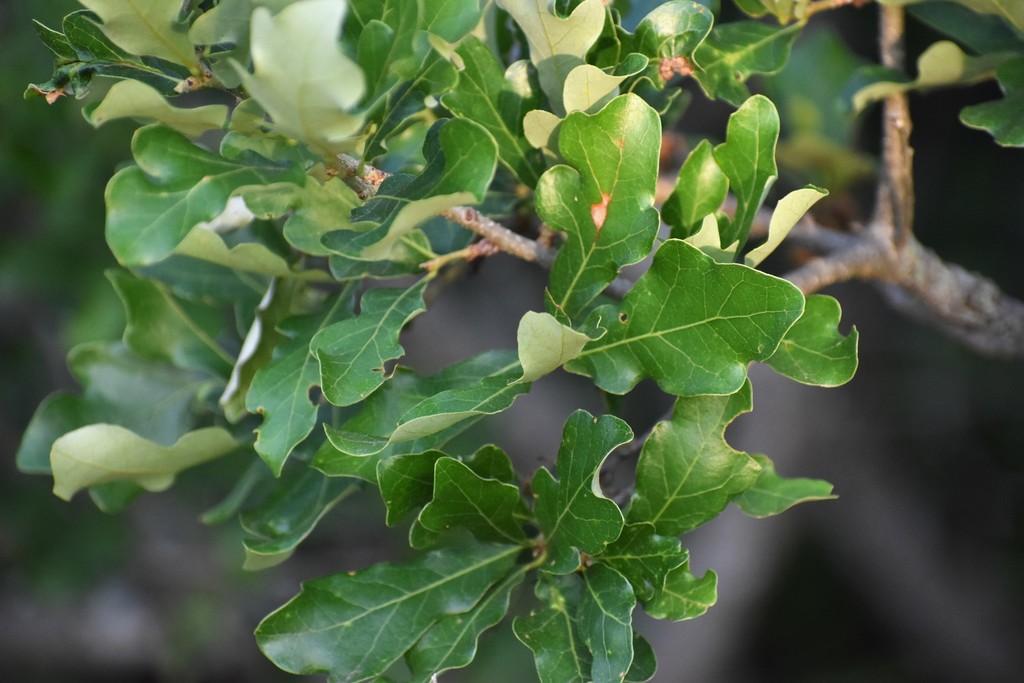
bastard oak
Quercus sinuata
Quercus sinuata, the bastard oak, bastard white oak, or Durand oak, is a North American species of oak. It is native to northern Mexico (Coahuila, Nuevo León, and Tamaulipas) as well as to the southeastern and south-central United States (from Texas and Oklahoma to the Carolinas).
From the article Quercus sinuata on Wikipedia (CC BY-SA), quoted section by section
Description
Quercus sinuata is a deciduous tree up to 20 metres (67 feet) tall. Leaves are narrow, with shallow rounded lobes. It tends to grow in wet habitats, such as on river bluffs, river bottoms, and flatwoods, and generally over basic substrates, such as mafic rocks, shells, or calcareous sediment. There are two varieties, with morphologically intermediate forms sometimes occurring where their ranges overlap:
Quercus sinuata var. breviloba (Torr.) C.H.Mull. – Texas, Oklahoma, Mexico Quercus sinuata var. sinuata – Alabama, Arkansas, Florida, Georgia, Louisiana, Mississippi, Carolinas, Texas
Range & habitat
Quercus sinuata var. breviloba is native to central and north central Texas, south central and southwest Oklahoma, and to Coahuila, Nuevo León, and Tamaulipas in northern Mexico. Quercus sinuata var. sinuata is native to the south-central and southeastern United States from central Texas and southwestern Arkansas to the Carolinas. Their respective ranges intersect in the Hill Country of central Texas, where streams flowing through dry, brushy limestone hills create a mosaic of wet and well drained habitats.
Wikipedia: “Distribution and habitat”
Where it lives
Recorded sightings
—
geo-referenced records in GBIF, from museums, herbaria and field observers.
Drag the globe to turn it. Dots are where records exist, not a range map; darker means more records.
In the stacks
Searching the stacks…
Every page naming Quercus sinuata in the Biodiversity Heritage Library →
This page is assembled live from iNaturalist, GBIF, Wikipedia, the Source Library and the Internet Archive. It is not yet part of the hand-edited codex. iNaturalist taxon 167668.