- Plants
- ›Vascular Plants
- ›flowering plants
- ›Dicots
- ›Soapberries, Cashews, Mahoganies, and Allies
- ›Cashew Family
- ›cashews, sumacs, and allies
- ›Rhus
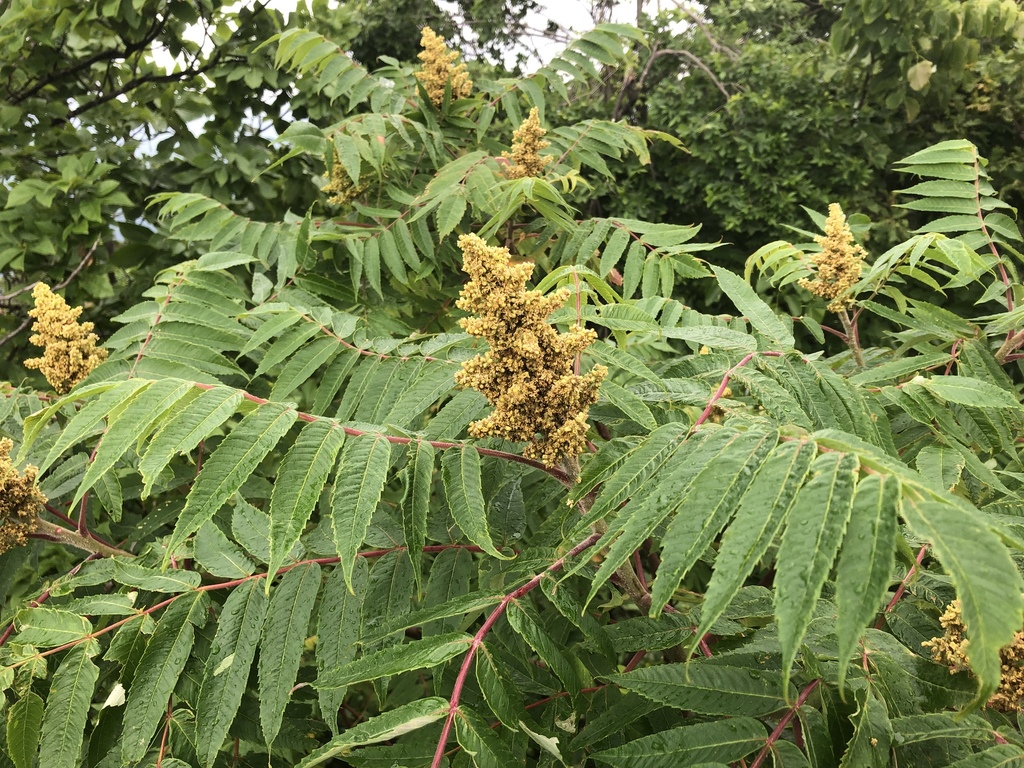
staghorn sumac
Rhus typhina
Rhus typhina, the staghorn sumac, is a species of flowering plant in the family Anacardiaceae, native to eastern North America. It is primarily found in southeastern Canada, the northeastern and midwestern United States, and the Appalachian Mountains, but it is widely cultivated as an ornamental throughout the temperate world. It is an invasive species in some parts of the world.
From the article Rhus typhina on Wikipedia (CC BY-SA), quoted section by section
Description
Rhus typhina is a dioecious, deciduous shrub or small tree growing up to 5 m (16 ft) tall by 6 m (20 ft) broad. It has alternate, pinnately compound leaves 25–55 cm (10–22 in) long, each with 9–31 serrate leaflets 6–11 cm (2+1⁄4–4+1⁄4 in) long. Leaf petioles and stems are densely covered in rust-colored hairs. The velvety texture and the forking pattern of the branches, reminiscent of antlers, have led to the common name "stag's horn sumac". Staghorn sumac grows as female or male clones. Small, greenish-white through yellowish flowers occur in dense terminal panicles, and small, green through reddish drupes occur in dense infructescences. Flowers occur from May through July and fruit ripens from June through September in this species' native range. Infructescences are 10–20 cm (4–8 in) long and 4–6 cm (1+1⁄2–2+1⁄4 in) broad at their bases. Fall foliage is brilliant shades of red, orange and yellow. Fruit can remain on plants from late summer through spring. It is eaten by many birds in winter. Staghorn sumac spreads by seeds and rhizomes and forms clones often with the older shoots in the center and younger shoots around central older ones. Large clones can grow from ortets in several years. In late summer some shoots have galls on leaf undersides, caused by the sumac leaf gall aphid, Melaphis rhois. The galls are not markedly harmful to the tree.
At the table
The fruits of sumacs are edible. They can be soaked and washed in cold water, strained, sweetened and made into a lemonade-like drink called sumac-ade. The drink extract can also be used to make jelly. The shoots can be peeled and eaten raw. The fruit was found to have certain natural antioxidant and antimicrobial properties. All parts of the staghorn sumac, except the roots, can be used as both a natural dye and as a mordant. The plant is rich in tannins and can be added to other dye baths to improve light fastness. The leaves may be harvested in the summer and the bark all year round. The timber provides high chatoyance, with an average value above 20 PZC.
Wikipedia: “Uses”
How it is grown
Staghorn sumac is an ornamental plant which provides interest throughout the year; though its vigorous suckering habit makes it unsuitable for smaller gardens. It can grow under a wide array of conditions, but is most often found in dry and poor soil on which other plants cannot survive. Some landscapers remove all but the top branches to create a "crown" effect in order to resemble a small palm tree. Numerous cultivars have been developed for garden use, of which the following have gained the Royal Horticultural Society's Award of Garden Merit:
Rhus typhina 'Dissecta' (cutleaf staghorn sumac) Rhus typhina Radiance = 'Sinrus'
Wikipedia: “Cultivation”
In human culture
The Latin specific epithet typhina is explained in Carl Linnaeus and Ericus Torner's description of the plant with the phrase "Ramis hirtis uti typhi cervini", meaning "the branches are hairy like antlers in velvet".
Wikipedia: “Etymology”
Where it lives
Recorded sightings
—
geo-referenced records in GBIF, from museums, herbaria and field observers.
Drag the globe to turn it. Dots are where records exist, not a range map; darker means more records.
In the stacks
Searching the stacks…
Every page naming Rhus typhina in the Biodiversity Heritage Library →
This page is assembled live from iNaturalist, GBIF, Wikipedia, the Source Library and the Internet Archive. It is not yet part of the hand-edited codex. iNaturalist taxon 167829.