- Plants
- ›Vascular Plants
- ›flowering plants
- ›Dicots
- ›Gentians, Dogbanes, Madders, and Allies
- ›madder family
- ›Rubioideae
- ›Spermacoceae
- ›Richardia
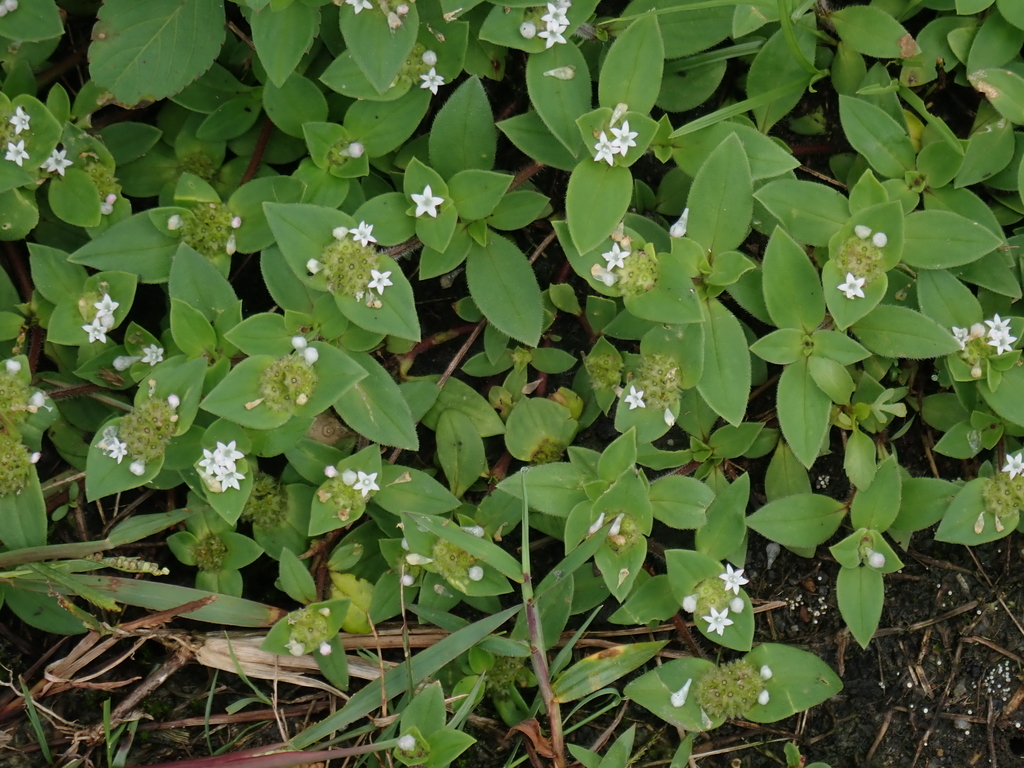
Tropical Mexican Clover
Richardia brasiliensis
Richardia brasiliensis is a species of flowering plant in the coffee family known by the English common names tropical Mexican clover, Brazilian calla-lily, white-eye, and Brazil pusley. In Brazil it is known as poaia branca. It is native to South America. It is an introduced species and sometimes an invasive weed in many other places, including Sub-Saharan Africa, India, Australia, Hawaii, Indonesia, Japan, and Thailand. It is a weed of citrus groves in Florida.
From the article Richardia brasiliensis on Wikipedia (CC BY-SA), quoted section by section
Description
This plant may be an annual or perennial which grows from a deep root. The branching stems grow up to 40 centimeters (16 in) long and lie prostrate or grow upright. The oppositely arranged leaves are oval with pointed or rounded tips and can grow to be 6.5 cm long and 2.4 cm wide. The inflorescence is a cluster of up to 20 flowers, or sometimes more, up to 15 mm in diameter accompanied by 2 pairs of small, wide leaves underneath. The petals are white or rose-pink. The mature fruit is a schizocarp with three mericarps.
What it does
Richardia brasiliensis serves as a host for nematodes and bacteria that cause disease and damage to crops. Nematodes harbored in its roots cause dry rot in yams. In brassica fields, this plant hosts bacteria that cause black rot. As well as damaging pests, it can also host beneficial mites as a natural form of pest control.
Wikipedia: “Ecology”
At the table
In Brazil this plant is used medicinally as an antiemetic and for diabetes. In traditional medicine, it is also used for anti-hemorrhoids, deworming and for treating eczema and burns. In Brazil, it is considered important to food, decoration, and pharmaceuticals.
Wikipedia: “Uses”
In human culture
The name Richardia comes from Richard Richardson, an English physician, while Brasiliensis indicates Brazil, the country of origin.
Wikipedia: “Etymology”
Where it lives
Recorded sightings
—
geo-referenced records in GBIF, from museums, herbaria and field observers.
Drag the globe to turn it. Dots are where records exist, not a range map; darker means more records.
In the stacks
Searching the stacks…
Every page naming Richardia brasiliensis in the Biodiversity Heritage Library →
This page is assembled live from iNaturalist, GBIF, Wikipedia, the Source Library and the Internet Archive. It is not yet part of the hand-edited codex. iNaturalist taxon 167940.