- Plants
- ›Vascular Plants
- ›flowering plants
- ›Dicots
- ›pinks, cactuses, and allies
- ›knotweed family
- ›Polygonoideae
- ›Docks, Sorrels and Rhubarbs
- ›Rumex
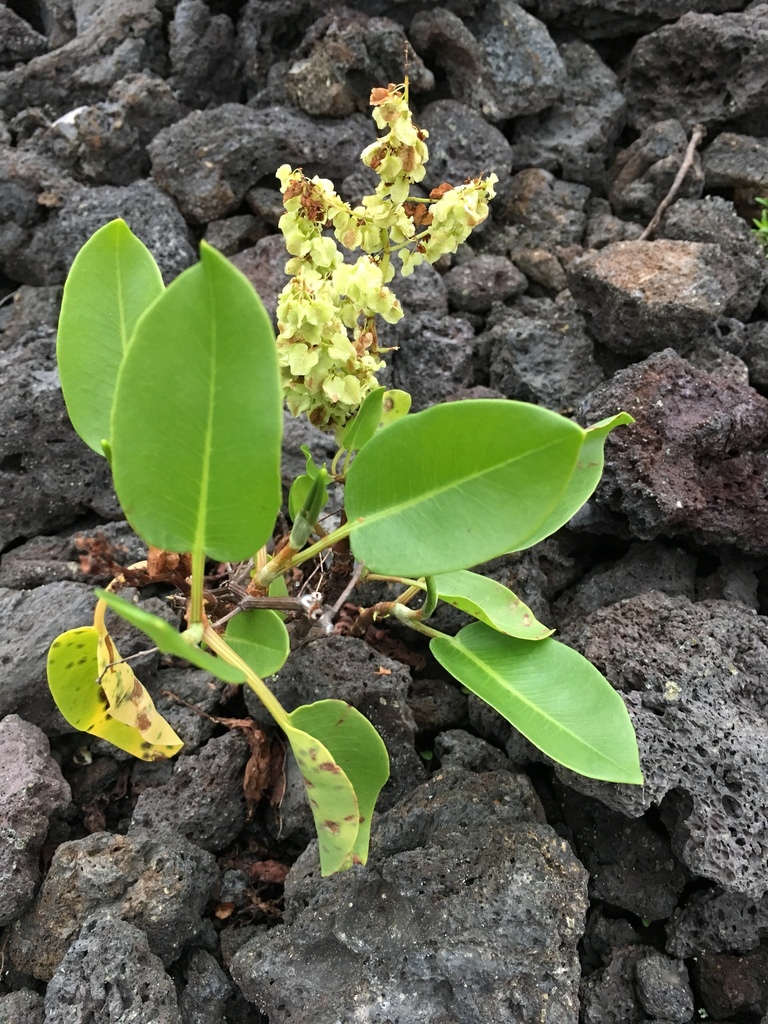
lava dock
Rumex skottsbergii
Rumex skottsbergii, or more commonly known as lava dock, is a shrub of the genus Rumex. The genus comprises approximately 200 species all derived from a single species and are therefore monophyletic. Furthermore, Rumex skottsbergii is endemic to Hawaii, where it is known as pāwale. Pāwale are commonly found in open lava fields that are at low elevations which range from 460-1300m. A similar plant in this genus is Rumex giganteus. Their similarity lies between their erect nature and leaves. However, the difference lies in their inflorescences. The inflorescences is described as being a cluster of flowers from the main stem axis .
From the article Rumex skottsbergii on Wikipedia (CC BY-SA), quoted section by section
Description
Rumex skottsbergii can be identified through their green, narrow, compact inflorescences, erect nature and small leaves. Their stems are usually stiffly erect with 7-10dm long and glabrous. Rumex skottsbergii can also be identified through their unisexual flowers and medium-sized yellowish greenish branched inflorescences; their outer tepals are also a distinguishable trait found within this genus.
Range & habitat
Rumex skottsbergii are found in Hawaii and are species that flourish in low elevation and open lava fields.
Wikipedia: “Distribution”
At the table
Rumex skottsbergii was used for medicinal purposes and was used to treat a childhood's diseases known as pāʻaoʻao and constipation. The childhood disease would cause physical weakening.
== References ==
Wikipedia: “Uses”
Where it lives
Recorded sightings
—
geo-referenced records in GBIF, from museums, herbaria and field observers.
Drag the globe to turn it. Dots are where records exist, not a range map; darker means more records.
In the stacks
Searching the stacks…
Every page naming Rumex skottsbergii in the Biodiversity Heritage Library →
This page is assembled live from iNaturalist, GBIF, Wikipedia, the Source Library and the Internet Archive. It is not yet part of the hand-edited codex. iNaturalist taxon 168252.