- Plants
- ›Vascular Plants
- ›flowering plants
- ›Dicots
- ›Mints, Plantains, Olives, and Allies
- ›Mint Family
- ›Nepetoideae
- ›Mentheae
- ›Melissas and sages
- ›Salvia
- ›Sclarea
- ›Aethiopis
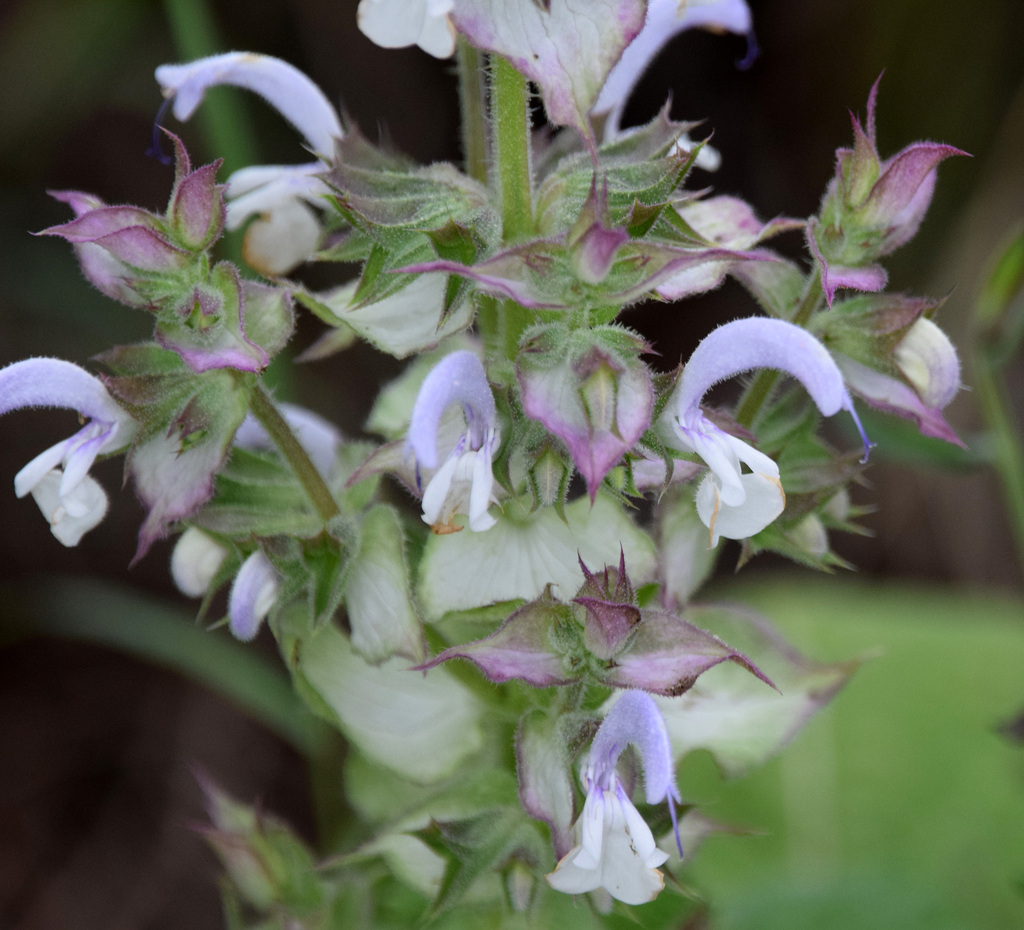
Clary
Salvia sclarea
Salvia sclarea, the clary or clary sage (clary deriving from Middle English clarie, from Anglo-Norman sclaree, from Late or Medieval Latin sclarēia meaning clear), is a biennial (short-lived) herbaceous perennial in the genus Salvia. It is native to the northern Mediterranean Basin and to some areas in north Africa and Central Asia. The plant has long been cultivated as an herb and is currently grown for its essential oil.
From the article Salvia sclarea on Wikipedia (CC BY-SA), quoted section by section
Description
Salvia sclarea reaches 3 to 4 ft (0.91 to 1.22 m) in height, with thick, square stems covered in hairs. The leaves are approximately 1 ft (0.30 m) long at the base, and .5 ft (0.15 m) long higher up on the plant. The upper leaf surface is rugose, and covered with glandular hairs. The flowers are in verticils, with between two and six flowers in each verticil, and are held in large colorful bracts that range in color from pale mauve to lilac or white-to-pink with a pink mark on the edge. The lilac or pale-blue corolla is approximately 1 in (2.5 cm), with the lips held wide open. The cultivar S. sclarea 'Turkestanica' bears pink stems, petiolate leaves, and white, pink-flecked blossoms on spikes that grow up to 30 inches (76 cm) tall.
At the table
The distilled essential oil of Salvia sclarea is used widely in perfumes (most often as a supporting note) and as a muscatel-like flavoring for vermouths, wines, and liqueurs. The aroma is described as "fresh, herbal, tea, weedy, dry, sage, spicy". It is also used in aromatherapy. In the United States, this oil is mostly produced on a large scale in and around Bertie County in northeastern North Carolina.
Wikipedia: “Uses”
In human culture
The plant’s medicinal uses are described as far back as the 4th century BCE, in the writings of Theophrastus, as well as in the 1st century CE writings of Dioscorides and Pliny the Elder). Clary seeds have a mucilaginous coat, which is why some centuries-old herbal guides recommend placing a seed into the eye of someone with a foreign object in it so that it could adhere to the object and make it easy to remove. This practice is noted by Nicholas Culpeper in his Complete Herbal (1653), who referred to the plant as "clear-eye". It has also long been used as an additive to wine and beer. In 16th-century Germany elderflower-infused clary was added to Rhine wines to make a more potent beverage known as Muscatel.
Wikipedia: “History”
Where it lives
Recorded sightings
—
geo-referenced records in GBIF, from museums, herbaria and field observers.
Drag the globe to turn it. Dots are where records exist, not a range map; darker means more records.
In the old herbals & bestiaries

Commentaries on the Six Books of Pedanius Dioscorides on Medical Matter
Pietro Andrea Mattioli · 1565 · p.1059

Latin Herbal with German Synonyms
1484 · p.171

Latin Herbal
1484 · p.143

Herbarius
1485 · p.144

Latin Herbal with German Synonyms
1486 · p.144

The Great Herbary with all the figures of the herbs
1532 · p.175

Notable Commentaries on the History of Plants
Leonhart Fuchs · 1542 · p.603

Notable Commentaries on the History of Plants
Leonhart Fuchs · 1542 · p.602

Book of Herbs
Hieronymus Bock (Tragus) · 1546 · p.74

Notable Commentaries on the History of Plants
Leonhart Fuchs · 1549 · p.601

Notable Commentaries on the History of Plants
Leonhart Fuchs · 1549 · p.600

On the Names of Plants
Hieronymus Bock (Tragus) · 1552 · p.121
In the stacks
Searching the stacks…
Every page naming Salvia sclarea in the Biodiversity Heritage Library →
This page is assembled live from iNaturalist, GBIF, Wikipedia, the Source Library and the Internet Archive. It is not yet part of the hand-edited codex. iNaturalist taxon 168396.