- Plants
- ›Vascular Plants
- ›flowering plants
- ›Dicots
- ›carrots, ivies, and allies
- ›carrot family
- ›Saniculoideae
- ›Saniculeae
- ›Sanicula
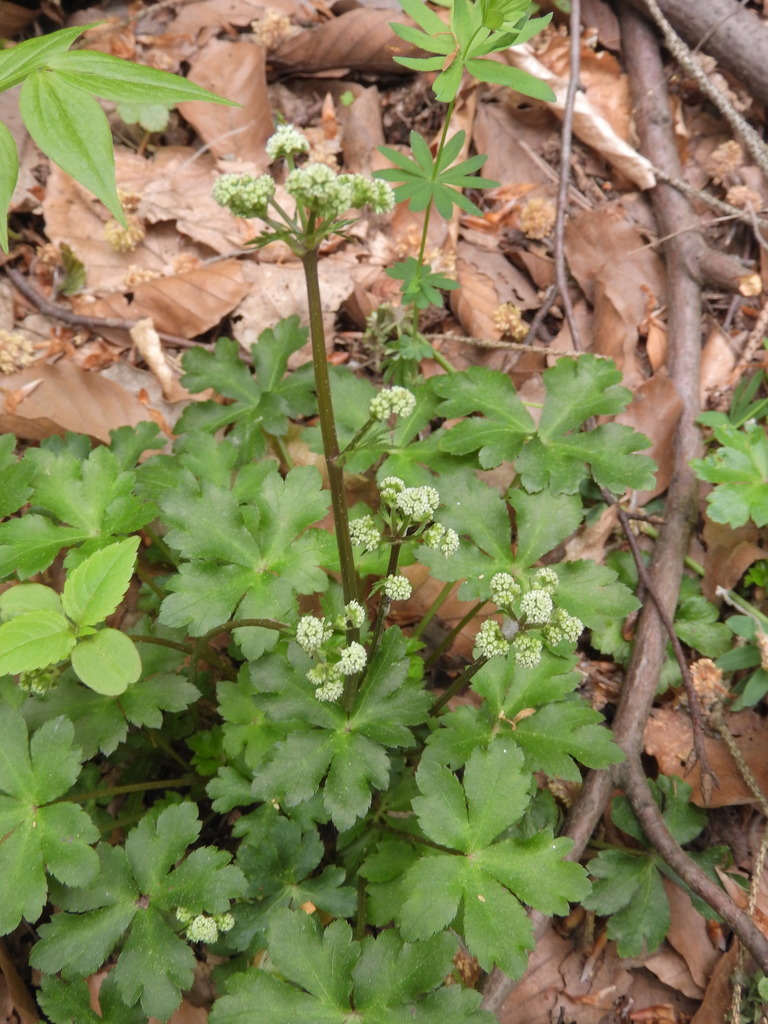
wood sanicle
Sanicula europaea
Sanicula europaea, the sanicle or wood sanicle, is a perennial plant of the family Apiaceae.
It has traditionally been a favoured ingredient of many herbal remedies, and of it was said "he who has sanicle and self-heal needs neither physician nor surgeon".
From the article Sanicula europaea on Wikipedia (CC BY-SA), quoted section by section
Description
Sanicula europea L. grows to 60 cm high and is glabrous with coarsely toothed leaves. The pinkish flowers are borne in tight spherical umbels and are followed by bristly fruits which easily attach to clothing or animal fur and are thus easily distributed. The leaves are lobed and glossy, dark green.
At the table
Sanicula europaea was used in Europe for healing wounds and cleaning. Filtered leaf extracts of sanicula europaea have shown some antiviral properties, inhibiting the replication of type 2 Human parainfluenza viruses (HPIV-2). Infusions of sanicle, made with water or wine, were commonly used in France to cure dysentery, ulcers and kidney injuries. To this list Culpeper added that sanicle heals tumours in any part of the body, and alleviates gonorrhoea, bowel pain and more. The roots have been used in the traditional Austrian medicine internally (as tea) or externally (as ointment) for treatment of disorders of the skin, respiratory tract, locomotor system, gastrointestinal tract, and infections.
Wikipedia: “Uses”
In human culture
Sanicula comes from sanus, Latin for "healthy", reflecting its use in traditional remedies.
Wikipedia: “Etymology”
Where it lives
Recorded sightings
—
geo-referenced records in GBIF, from museums, herbaria and field observers.
Drag the globe to turn it. Dots are where records exist, not a range map; darker means more records.
In the old herbals & bestiaries

Living Images of Plants
Otto Brunfels · 1532 · p.90

Living Images of Plants
Otto Brunfels · 1532 · p.87

Book of Herbs
Hieronymus Bock (Tragus) · 1546 · p.418

Notable Commentaries on the History of Plants
Leonhart Fuchs · 1549 · p.702

Commentaries on the Six Books of Pedanius Dioscorides on Medical Matter
Pietro Andrea Mattioli · 1565 · p.1191
In the stacks
Searching the stacks…
Every page naming Sanicula europaea in the Biodiversity Heritage Library →
This page is assembled live from iNaturalist, GBIF, Wikipedia, the Source Library and the Internet Archive. It is not yet part of the hand-edited codex. iNaturalist taxon 168412.