- Plants
- ›Vascular Plants
- ›flowering plants
- ›Dicots
- ›Mints, Plantains, Olives, and Allies
- ›Mint Family
- ›Nepetoideae
- ›Mentheae
- ›balms, mints, and thymes
- ›Satureja
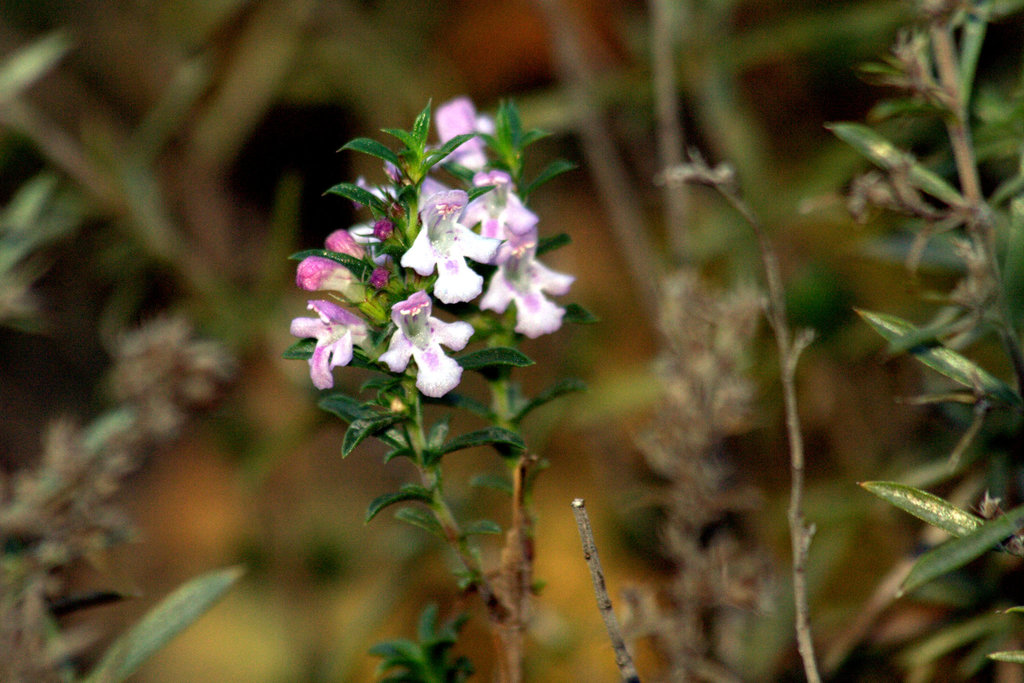
Winter Savory
Satureja montana
Satureja montana (winter savory or mountain savory), is a perennial, semi-evergreen herb in the family Lamiaceae, native to warm temperate regions of southern Europe, the Mediterranean, and Africa. It has dark green, leaves and summer flowers ranging from pale lavender, or pink to white. While the closely related plant, summer savory (Satureja hortensis L.) is an annual plant.
From the article Winter savory on Wikipedia (CC BY-SA), quoted section by section
Description
It grows to between 10 and 40 cm (4 and 16 in) tall. The leathery, dark green leaves are opposite, oval-lanceolate or needle-like, 1–2 cm long and 5 mm broad. The flowers appear in summer, between July and October, and range from pale lavender or pink to white. The flowers are smaller than summer savoury flowers. It contains carvacrol, a monoterpenoid phenol. The herb was first published by Carl Linnaeus in his book Species Plantarum on page 568 in 1753. The Latin specific epithet montana refers to mountains or coming from mountains, leading to the common name 'mountain savory'.
Range & habitat
Satureja montana is native to temperate areas between Europe, the Mediterranean, and Africa. It has been naturalised in Great Britain. It can be found growing in old walls, on dry banks and rocks on hillsides, or rocky mountain slopes, usually on calcareous or alkaline soils.
Wikipedia: “Distribution and habitat”
At the table
There is evidence of its use about 2000 years ago by the ancient Romans and Greeks. Winter savory is easy to grow and can be used as a culinary herb garden edging plant. It requires six hours of sun per day and well-draining soil. In temperate climates it becomes dormant in winter, putting out leaves on the bare stems in the spring. While dormant, it should not be cut back; stems which appear dead will leaf-out again. Winter savory is hardy and has a low-bunching habit. It is hardy to USDA Zone 4 and can be propagated from softwood cuttings. Winter savory is used as a companion plant for beans, keeping bean weevils away, and is also planted with roses to reduce mildew and aphids. S. montana 'Nana' is a known dwarf cultivar. S. montana 'Prostrate White' is a small white flowered form. S. montana is also a honey plant, with savory honey being a regional product from Abruzzo in Italy.
Wikipedia: “Cultivation and uses”
In medicine
Winter savory may have been used in ancient traditional medicine, possibly in the treatment of bee stings. The plant is harvested when flowering in the summer for use fresh or dried.
Wikipedia: “Traditional uses”
Where it lives
Recorded sightings
—
geo-referenced records in GBIF, from museums, herbaria and field observers.
Drag the globe to turn it. Dots are where records exist, not a range map; darker means more records.
In the old herbals & bestiaries

In the stacks
Searching the stacks…
Every page naming Satureja montana in the Biodiversity Heritage Library →
This page is assembled live from iNaturalist, GBIF, Wikipedia, the Source Library and the Internet Archive. It is not yet part of the hand-edited codex. iNaturalist taxon 168442.