- Plants
- ›Vascular Plants
- ›flowering plants
- ›Dicots
- ›Legumes, Milkworts, and Allies
- ›Legumes
- ›Peacock Flower Subfamily
- ›Cassieae
- ›Cassiinae
- ›Senna
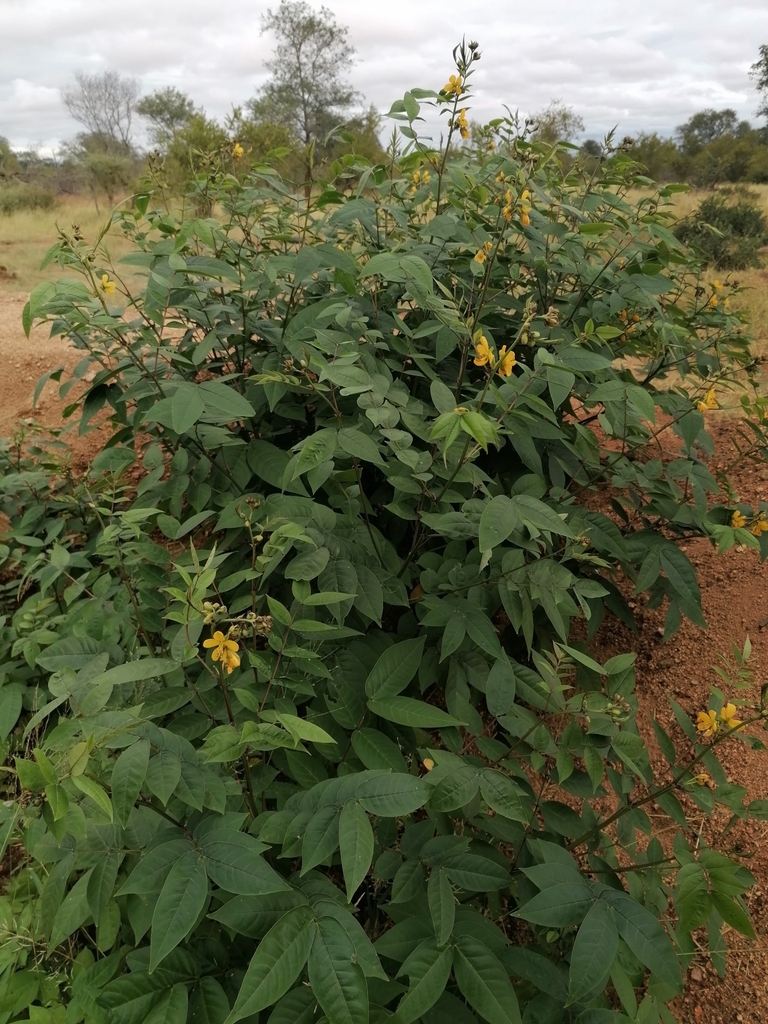
Coffee Senna
Senna occidentalis
Senna occidentalis, commonly known as coffee senna, styptic weed, or septicweed, is a species of flowering plant in the family Fabaceae and is native to the southern United States of America, Mexico and South America. It is a shrub with pinnate leaves, with three to seven pairs of broadly elliptic to egg-shaped leaflets, and yellow flowers arranged in groups of two to four, with six fertile stamens in each flower. It is an aggressive, pantropical weed.
From the article Senna occidentalis on Wikipedia (CC BY-SA), quoted section by section
Description
Senna occidentalis is a foetid shrub that typically grows to a height of 1–2 m (3 ft 3 in – 6 ft 7 in) and has softly-hairy branches and stems. Its leaves are pinnate, 150–170 mm (5.9–6.7 in) long on a petiole 20–40 mm (0.79–1.57 in) long, with three to seven pairs of broadly elliptic to egg-shaped leaflets 50–70 mm (2.0–2.8 in) long and 30–40 mm (1.2–1.6 in) wide, spaced 15–30 mm (0.59–1.18 in) apart. There is a sessile glands near the base of the petiole. The flowers are yellow and arranged on the ends of branchlets and in upper leaf axils in groups of two to four on a peduncle 2–5 mm (0.079–0.197 in) long, each flower on a pedicel 10–15 mm (0.39–0.59 in) long. The petals are up to 10 mm (0.39 in) long and there are six fertile stamens, the anthers varying in length from 4 to 6 mm (0.16 to 0.24 in) long, and four staminodes. Flowering occurs all year, and the fruit is a cylindrical pod 120–180 mm (4.7–7.1 in) long, about 3 mm (0.12 in) wide and slightly curved.
Range & habitat
Coffee senna is native to the southern United States of America, Mexico and South America, but is an aggressive, pantropical weed. In Australia it is widespread but scattered in the north of Western Australia, the Northern Territory, South Australia, Queensland and New South Wales.
Wikipedia: “Distribution and habitat”
Toxicity
Senna occidentalis seeds contain anthraquinones (AQs) such as Rhein, Emodin, Aloe-emodin, Chrysophanol, and Physcion, which have been linked to hepatomyoencephalopathy in children. The cytotoxicity of these AQs correlates with their binding affinity to serum albumin, with Rhein showing the highest toxicity and binding affinity. The plant is reported to be poisonous to cattle, because it contains a known toxic derivative of anthraquinone called emodin, and the seeds contain chrysarobin (1,8-dihydroxy-3-methyl-9-anthrone) and N-methylmorpholine. The plant also has some poisonous characteristics to humans if enough of it is taken. Emodin and Aloe-emodin exhibited strong binding affinities to DNA, which is associated with their high cytotoxic potential. Rhein was found to oxidize glutathione (GSH) significantly, contributing to its toxic effects, while Physcion and Chrysophanol showed minimal interactions with DNA, correlating with their lower toxicity. This suggests that the toxicity of AQs from the seeds is significantly influenced by their interaction with proteins and DNA, leading to adverse health effects. …
Where it lives
Recorded sightings
—
geo-referenced records in GBIF, from museums, herbaria and field observers.
Drag the globe to turn it. Dots are where records exist, not a range map; darker means more records.
In the old herbals & bestiaries

In the stacks
Searching the stacks…
Every page naming Senna occidentalis in the Biodiversity Heritage Library →
This page is assembled live from iNaturalist, GBIF, Wikipedia, the Source Library and the Internet Archive. It is not yet part of the hand-edited codex. iNaturalist taxon 168847.