- Plants
- ›Vascular Plants
- ›flowering plants
- ›Dicots
- ›Legumes, Milkworts, and Allies
- ›Legumes
- ›Faboideae
- ›Sesbanieae
- ›Sesbania
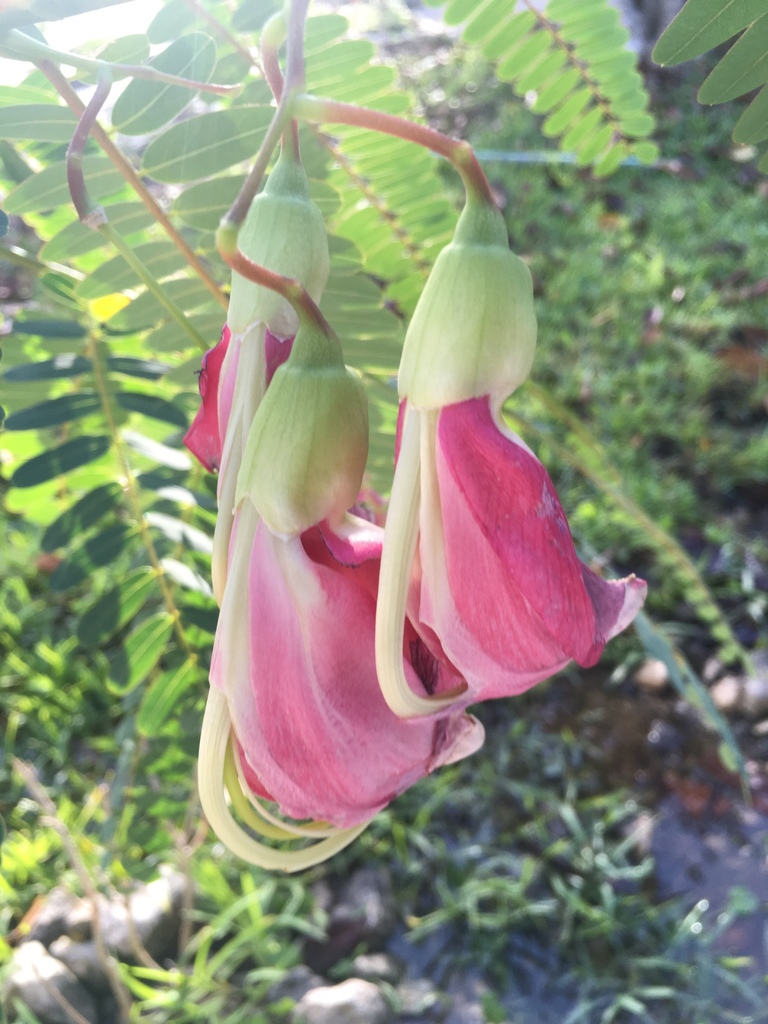
Agati
Sesbania grandiflora
Sesbania grandiflora, common names vegetable hummingbird, katurai, agati, agastya, agasya, kathurumurunga and West Indian pea, is a leguminous tree of family Fabaceae native to Malesia, including Malaysia, New Guinea, and the Philippines. It is widely distributed globally in equatorial regions. The flowers are eaten in Southeast and South Asia.
From the article Sesbania grandiflora on Wikipedia (CC BY-SA), quoted section by section
Description
Sesbania grandiflora is a leguminous tree of family Fabaceae. It is fast-growing and soft-wooded, and it grows to heights of 5–20 metres (16–66 feet). The leaves are regular and rounded, and grow to 15–30 cm (6–12 in) long, with leaflets in 10–20 pairs or more and an odd one. The flowers white, red or pink and are oblong, 1.5–10 cm (1–4 in) long in lax, with two to four flower racemes. The calyx is campanulate and shallowly two-lipped. These flowers have mild fragrance too. The fruits, or seed pods, look like flat, long, thin green beans. They are slender, falcate or straight, and 30–45 cm (12–18 in) long, with a thick suture, and each contains approximately thirty 8 mm (0.3 in) seeds. The tree thrives under full exposure to sunshine and is extremely frost sensitive.
Range & habitat
It is native to Maritime Southeast Asia (Malaysia, Indonesia, Philippines, Brunei) to New Guinea. It is cultivated in many parts of South India and Southeast Asia. It grows where there is good soil and a hot, humid climate.
Wikipedia: “Distribution and habitat”
At the table
S. grandiflora has many traditional uses. Its flowers are 92% water, 7% carbohydrates, 1% protein, and contain no fat. In a reference amount of 100 grams (3.5 oz), the flowers supply 27 calories, and are a rich source of vitamin C (88% of the Daily Value, DV) and folate (26% DV).
Culinary. The flowers of S. grandiflora are eaten as a vegetable in Southeast Asia, including Java and Lombok in Indonesia, the Ilocos Region of the Philippines, Vietnam, Laos, and Thailand. In the Thai language, the flowers are called ดอกแค (dok khae) and are used in the cuisine both cooked in curries, such as kaeng som and kaeng khae, and raw or blanched with nam phrik. The flowers are also prominently used in Cambodian cuisine and are associated with the Bon Om Touk. The flower's stamen is generally discarded before use. In addition to raw and blanched, the flowers can also be battered and deep fried. In some parts of West Bengal in India the flowers are locally called Bok ful resembling the Egret bird from Heron family of birds. The flowers are a part of the Bengali cuisine as they are battered and fried and the fritters are served with meals. In many parts of India the flowers are called Agastya Phool because these flowers bloom in the month of Agastya (August) of Sharad Ritu (Autumn) as per Ayurveda and is used to prepare Pakora or dry curry. The leaves are also edible. …
Wikipedia: “Uses”
Where it lives
Recorded sightings
—
geo-referenced records in GBIF, from museums, herbaria and field observers.
Drag the globe to turn it. Dots are where records exist, not a range map; darker means more records.
In the stacks
Searching the stacks…
Every page naming Sesbania grandiflora in the Biodiversity Heritage Library →
This page is assembled live from iNaturalist, GBIF, Wikipedia, the Source Library and the Internet Archive. It is not yet part of the hand-edited codex. iNaturalist taxon 168863.