- Plants
- ›Vascular Plants
- ›flowering plants
- ›Dicots
- ›pinks, cactuses, and allies
- ›pink family
- ›Chickweed Tribe
- ›Stellaria
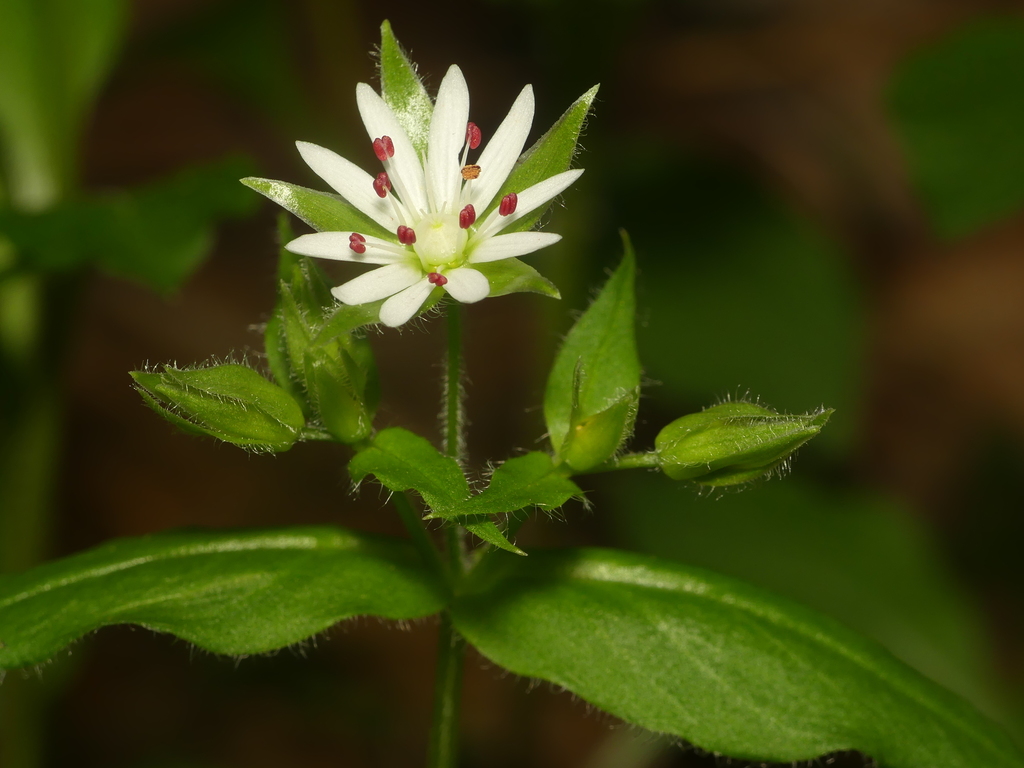
Tennessee Starwort
Stellaria corei
Stellaria corei, commonly known as Tennessee chickweed, star chickweed, Tennessee starwort, and Tennessee stitchwort, is a species of flowering plant native to parts of the eastern United States.
From the article Stellaria corei on Wikipedia (CC BY-SA), quoted section by section
Description
Stellaria corei is similar to Stellaria pubera, with which it can be confused. It is a spring flowering perennial growing from spreading rhizomes. The square stems are upright, branched, and range from 10–40 cm (3.9–15.7 in) long. The Leaves near the base of the plant have stems but the leaves near the ends of the stems may be subsessile (lacking stems). The entire margined leaves are elliptic in shape, with broadly lanceolate to ovate ends, and 1–5 cm (0.39–1.97 in) × 5–16 mm (0.20–0.63 in) in size. The leaf bases are cuneate. The flowers are produced in 3 to 7 flowered Inflorescences that are terminal cymes. The white Flowers are 10–16 mm (0.39–0.63 in) in diameter, with five narrowly triangular sepals. The ripe fruits are straw colored to pale brown capsules. The mature seeds are brown and around 2 mm (0.079 in) in diameter. The diploid chromosome count is 60.
Range & habitat
Stellaria corei grows in rocky woods, on bluffs, and in open woods. It is native to Alabama, Connecticut, Kentucky, Mississippi, North Carolina, Ohio, Pennsylvania, Tennessee, Virginia, West Virginia, and has been introduced to Idaho and New York.
== References ==
Wikipedia: “Habitat and range”
Where it lives
Recorded sightings
—
geo-referenced records in GBIF, from museums, herbaria and field observers.
Drag the globe to turn it. Dots are where records exist, not a range map; darker means more records.
In the stacks
Searching the stacks…
Every page naming Stellaria corei in the Biodiversity Heritage Library →
This page is assembled live from iNaturalist, GBIF, Wikipedia, the Source Library and the Internet Archive. It is not yet part of the hand-edited codex. iNaturalist taxon 169333.