- Plants
- ›Vascular Plants
- ›flowering plants
- ›Dicots
- ›Legumes, Milkworts, and Allies
- ›Legumes
- ›Faboideae
- ›Millettieae
- ›Tephrosia
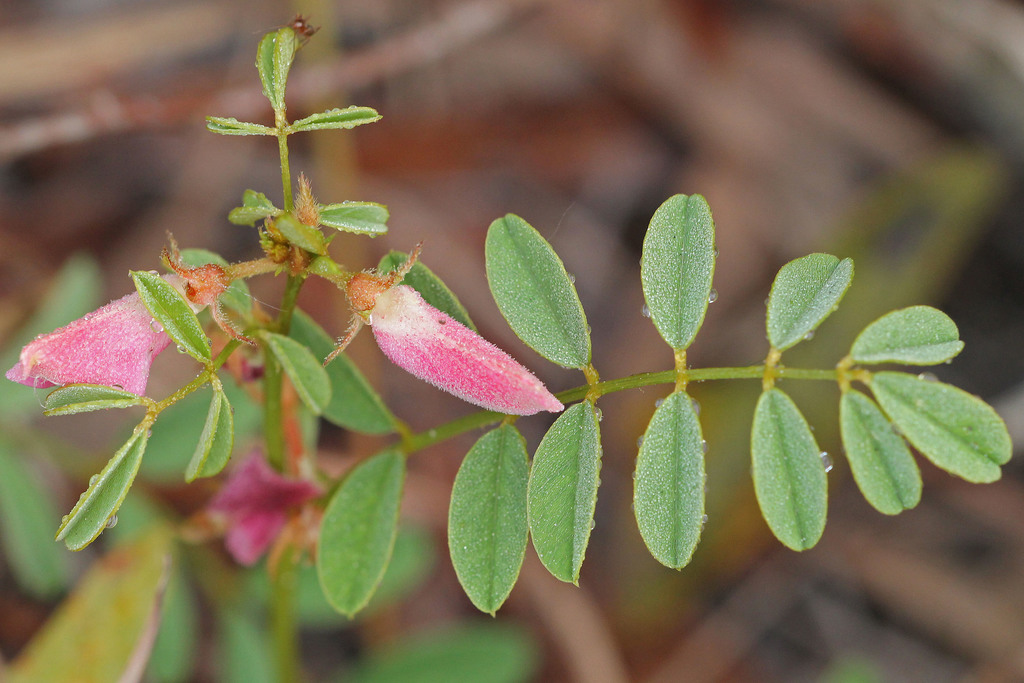
Florida hoarypea
Tephrosia florida
Tephrosia florida, commonly known as Florida hoarypea or Florida goat's-rue, is a species of perennial forb endemic to the southeastern region of the United States.
From the article Tephrosia florida on Wikipedia (CC BY-SA), quoted section by section
Description
Stems are prostrate to erect, reaching a length of up to 60 cm (24 in) and may be glabrous or strigulose. The leaves are odd-pinnate, ranging in length between 3 and 15 cm (1.2 and 5.9 in). Leaflets number between 7 and 19 (rarely 1 to 41), are cuneate-oblong or narrowly to widely elliptic in shape, reaching between 1 and 5 cm (0.4 and 2.0 in) in length. Principal inflorescence occurs opposite the leaves, and reach a length between 2 and 23 cm (0.8 and 9.1 in). The corolla are initially white to yellow in coloration, transitioning over time to pink and purple. T. florida flower from May through July. The legumes of T. florida range between 3 and 5 cm (1.2 and 2.0 in) in length and are sparsely to moderately pubescent, with trichomes 0.5 cm (0.2 in) or less in length.
Range & habitat
Tephrosia florida's native range occurs within the United States' coastal plain region, from North Carolina to Florida and stretching westward to Louisiana. This species may be found in habitats such as pine savannas and other pineland environments.
== References ==
Wikipedia: “Distribution and habitat”
Where it lives
Recorded sightings
—
geo-referenced records in GBIF, from museums, herbaria and field observers.
Drag the globe to turn it. Dots are where records exist, not a range map; darker means more records.
In the stacks
Searching the stacks…
Every page naming Tephrosia florida in the Biodiversity Heritage Library →
This page is assembled live from iNaturalist, GBIF, Wikipedia, the Source Library and the Internet Archive. It is not yet part of the hand-edited codex. iNaturalist taxon 169591.