- Plants
- ›Vascular Plants
- ›flowering plants
- ›Dicots
- ›Legumes, Milkworts, and Allies
- ›Legumes
- ›Faboideae
- ›Millettieae
- ›Tephrosia
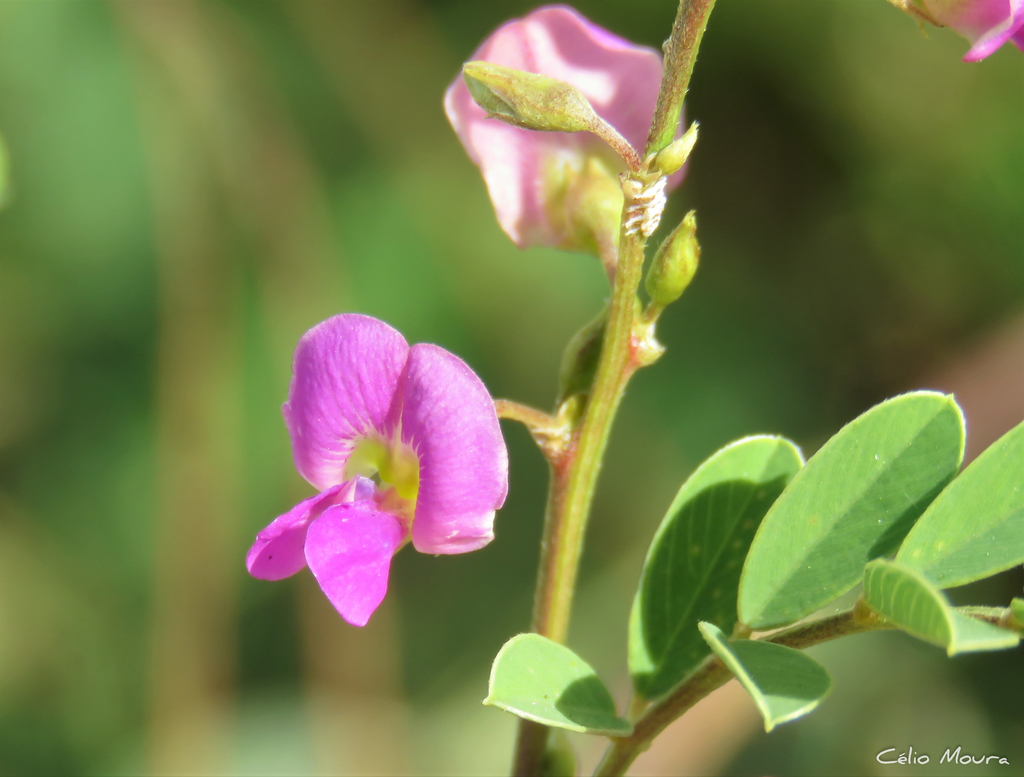
Purple Hoarypea
Tephrosia purpurea
Tephrosia purpurea is a species of flowering plant in the family Fabaceae. It grows in poor soils as a common wasteland weed and has a pantropical distribution. It is a type of legume native to south-western Asia (the Levant, Arabian Peninsula, Socotra, Iran, Pakistan, India and Sri Lanka) and north-eastern Africa (Egypt, Sudan, Ethiopia, Eritrea, Djibouti, Somalia).
The leaflets of the plant are obovate-oblong and equal-sided, and of a silky texture. The fruits (legumes) are typically 1 to 2 in (25 to 51 mm) long and contain six or seven brownish seeds. The species typically grows in areas where the soils are relatively deep, especially in semi-arid and wadi areas, and on terraces and slight inclines and hills.
From the article Tephrosia purpurea on Wikipedia (CC BY-SA), quoted section by section
Description
The plant's leaflets are obovate-oblong, somewhat wedge-shaped, equal-sided, and of a silky texture. The mid-rib is usually folded longitudinally, and they are characterized by parallel transverse veins. The fruits (legumes) are typically 1 to 2 in (25 to 51 mm) long and contain six or seven brownish seeds. The plant displays purple flowers during season; they are described as their most attractive in January. It typically grows to 45–50 cm (18–20 in) in height, and can grow on mountains with an altitude of over 3,000 ft (910 m). Both diploid (22 chromosomes) and tetraploid (44 chromosomes) cytotypes have been reported. The roots of Tephrosia purpurea are deep, penetrating soils to a depth of 3 metres or more, aiding the absorption of moisture from the soil. Moisture is stored in the cortex of the roots, which is protected by a thin periderm. Water storage in the cortex enables growth and reproduction during times of drought. This allows it to thrive in both arid and semi-arid conditions and to survive during winter and summer months at times of low rainfall. …
Range & habitat
The species is recorded in the north-eastern African nations of Djibouti, Egypt, Eritrea, Ethiopia, Somalia, and Sudan, the Western Asian nations of Iran, Israel, Jordan, Oman, Saudi Arabia, South Yemen, the United Arab Emirates, and Yemen (including the Yemeni island of Socotra), and the South Asian nations of India and Pakistan. Within India, it is documented in the western states of Gujarat, Maharashtra, and Rajasthan. The species, cited as a "leguminous desert forb", typically grows in areas where the soils are relatively deep, especially in semi-arid and wadi areas, and on terraces and slight inclines and hills. In Saudi Arabia, it has been found scattered among species such as Zilla spinosa, Rhanterium epapposum, Astragalus spinosus, Gymnocarpos decandrum, Achillea fragrantissima and Halothamnus bottae on the edges of desiccated lakes. It has been well documented in sources in Egypt and Sudan. In 1866, the Pharmaceutical Journal stated that it was found as a contaminant in Alexandrian senna, being found in cultivated fields in the valleys to the east and south of Assouan, in the Elephantine Islands, opposite Assouan, along the Nile, and Edfou and Hermonthis. …
Wikipedia: “Distribution and habitat”
In medicine
Tephrosia purpurea is also used in folk medicine and has some anti-bacterial properties. According to Ayurveda, the plant is anthelmintic, alexiteric, restorative, and antipyretic. The leaves and the root have been used in traditional medicinal on bronchitis, cough, earache, wounds and bone fractures by herbalists in countries such as Oman and the United Arab Emirates. The ground leaves of Tephrosia purpurea are also insufflated in cases of nasal congestion, or boiled with water to make eardrops. Powdered bark can be mixed with water and poured into the ears of camels with ticks, and powdered leaves have been made into a paste to be smeared on wounds. It has also been rubbed on limbs in conjunction with Fagonia indica and Ocomim basilicum of people affected with polio, without any effect. It is used in the treatment of leprosy, ulcers, asthma, and tumors, as well as diseases of the liver, spleen, heart, and blood. A decoction of the roots is given in dyspepsia, diarrhea, rheumatism, asthma and urinary disorders. The root powder is salutary for brushing the teeth, where it is said to quickly relieve dental pains and stop bleeding. An extract, termed 'betaphroline' (not a systematic name) is claimed to promote release of endorphins, and finds use in certain cosmetic preparations. African shepherds use crushed plants to make an antidotal beverage for animals bitten by snakes.
Wikipedia: “Ethnomedicine”
Toxicity
Tephrosia purpurea is cited as "unpalatable", although the seeds of the plant are reportedly a favourite of sandgrouse inhabiting the scrub-desert of northern Sudan, and the butterfly Colias croceus is known to feed on it. This has allowed it to colonize the landscape in parts of the Middle East which have been overgrazed, especially at lower altitudes. The species is known to be toxic to goats; a study published in the early 1980s revealed that 11 out of 12 goats died after 1 to 40 days of daily oral dosing of Tephrosia purpurea shoots (fresh or dried), and that they displayed adverse reactions to ingesting it such as dyspnoea, weakness of the limbs and joints causing instability in movement, changes in fat composition, catarrhal enteritis, and hemorrhage in the heart, lungs, and intestinal mucosa. Rotenoids extracted from the seeds of the plant also caused complete mortality in Aphis craccivora, when applied at a concentration of 0.1% for 48 hours.
Where it lives
Recorded sightings
—
geo-referenced records in GBIF, from museums, herbaria and field observers.
Drag the globe to turn it. Dots are where records exist, not a range map; darker means more records.
In the stacks
Searching the stacks…
Every page naming Tephrosia purpurea in the Biodiversity Heritage Library →
This page is assembled live from iNaturalist, GBIF, Wikipedia, the Source Library and the Internet Archive. It is not yet part of the hand-edited codex. iNaturalist taxon 169597.