- Plants
- ›Vascular Plants
- ›flowering plants
- ›monocots
- ›Spiderworts and Allies
- ›Spiderworts
- ›Commelinoideae
- ›Tradescantieae
- ›Spiderworts and relatives
- ›Tradescantia
- ›Campelia
- ›Rhoeo
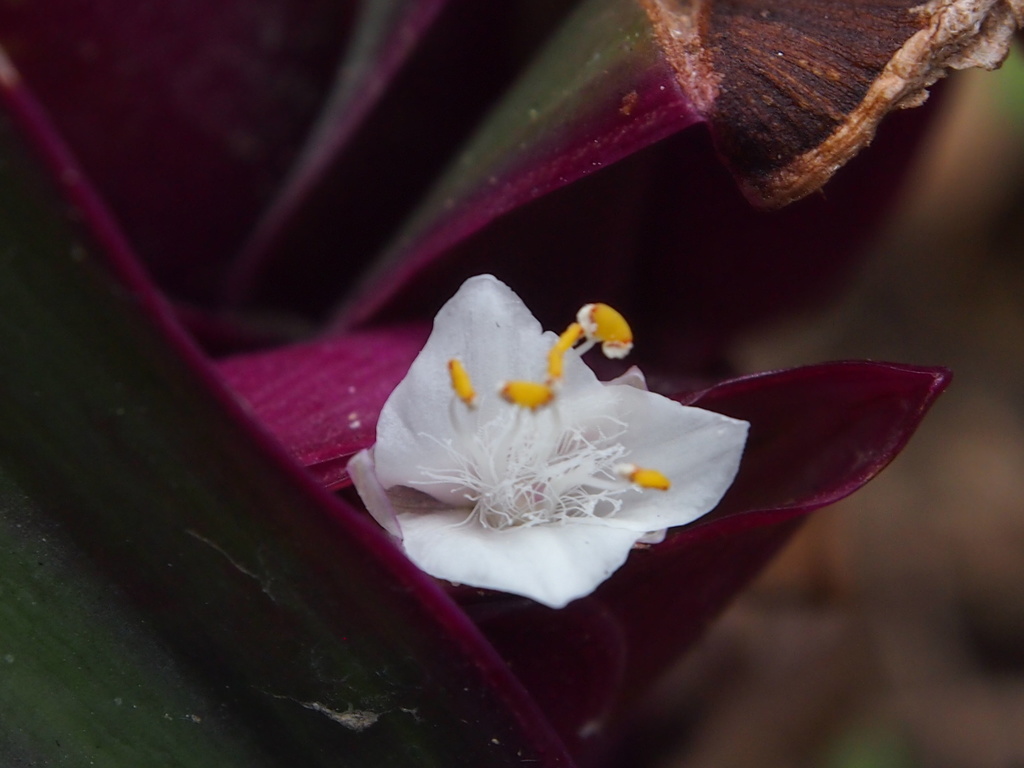
Moses-in-the-cradle
Tradescantia spathacea
Tradescantia spathacea, also called the oyster plant, boatlily or 'Moses-in-the-cradle', is a herb in the Commelinaceae family which was first described in 1788. It is native to Central America.
The plant's common name "Moses in the Cradle" is due to its small, white flowers within a boat-shaped, purple bract that resembles a cradle, which is a visual resemblance to the biblical story of Moses in the bulrushes, where he was placed in a basket.
From the article Tradescantia spathacea on Wikipedia (CC BY-SA), quoted section by section
Description
Tradescantia spathacea has fleshy rhizomes and rosettes of waxy lance-shaped leaves. Leaves are dark to metallic green above, with glossy purple underneath. These will reach up to 0.30 m (1 ft) long by 76 mm (3 in) wide. They are foliage plants that reach a height of around 0.30 m (1 ft). The short-stemmed perennial shrub grows in a dense clump and forms a rosette of thick, lanceolate or linear leaves, about 30 cm long and 7 cm wide, facing upward, which are dark green above and purple below. The color of the underside is due to certain pigments, anthocyanins. Some varieties, such as 'vittata', have longitudinal yellow stripes on the upper side of the leaf. The flowers are very small, white and clustered, arise in axillary cymes enclosed in purple, boat-shaped bracts (giving their common name, Moses-in-the-Cradle). The flowers appear from spring to autumn.
Range & habitat
It is native to Belize, Guatemala, and southern México (Chiapas, Tabasco, and the Yucatán Peninsula) and is widely cultivated as an ornamental houseplant; it has become naturalized in parts of coastal Southern California, Florida, Hawaii, Louisiana, Texas, and various Pacific and Indian Ocean islands.
Wikipedia: “Distribution”
How it is grown
They are hardy in USDA zones 9-12 and are also grown as ornamental houseplants. Its cultivar 'Sitara' has gained the Royal Horticultural Society's Award of Garden Merit. In Mexico, it is used in traditional medicine as a medicinal plant for sores and wounds, as well as an antiseptic and anti-inflammatory.
Wikipedia: “Cultivation”
Where it lives
Recorded sightings
—
geo-referenced records in GBIF, from museums, herbaria and field observers.
Drag the globe to turn it. Dots are where records exist, not a range map; darker means more records.
In the stacks
Searching the stacks…
Every page naming Tradescantia spathacea in the Biodiversity Heritage Library →
This page is assembled live from iNaturalist, GBIF, Wikipedia, the Source Library and the Internet Archive. It is not yet part of the hand-edited codex. iNaturalist taxon 169878.