Pain-in-the-back
Trema lamarckianum
Trema lamarckianum, Lamarck's trema, West Indian nettle tree, or pain-in-the-back is a plant species in the genus Trema of the family Cannabaceae. It is a small evergreen shrub that is native of Florida and the West Indies. It has several common names such as pain-in-back, cabrilla and Lamarck trema. It is 6 m tall growing all year.
From the article Trema lamarckianum on Wikipedia (CC BY-SA), quoted section by section
Description
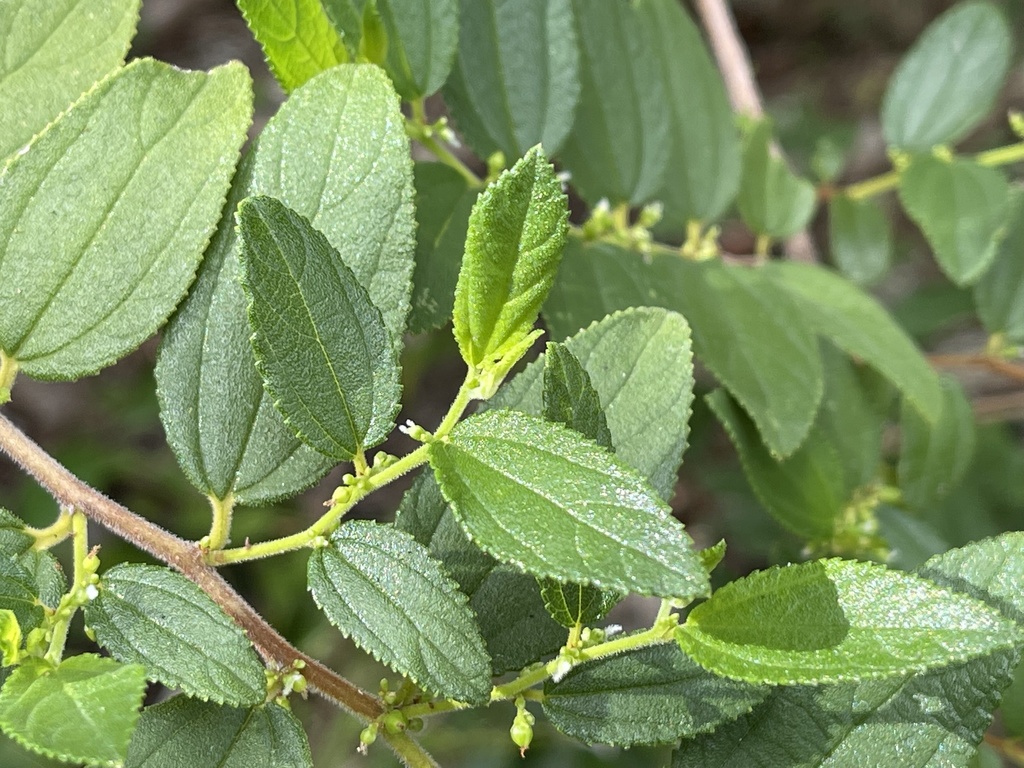
The plant is mainly supported by its roots which are lateral, rigid but flexible. It usually has one main stem and it is covered by bark of brownish grey color with small lenticels over inner bark of pinkish-brown color. The species is monopodial, in which the main stem continually maintains to produce the branches and some of those become thicker and develop into the main branches for older plants. The leaves are alternate and they are connected to twigs by 8 to 10 m long of petioles. Their blades are approximately 2-4(-6) × 2-2.5(-3) cm ovate-lantiolate, green color and have rough surfaces.
Wikipedia: “Morphology”
Range & habitat
The native regions where Trema lamarckianum occurs include Florida in North America, West Indies, Bermuda, Grand Cayman and the Bahamas.
Wikipedia: “Distribution”
What it does
Trema lamarckianum is considered a pioneer species and can grow in a wide range of disturbed areas, even those whose ground is predominately sedimentary or igneous rocks. The areas in Puerto Rico where this species grows has an annual rainfall between 1200 and 3000 mm. It does not like shade and usually grows in areas whose vegetation is primarily herbs and shrubs. They can be found growing on road cuts, unsteady slopes and landslidesareas, disrupting work at these sites.
Wikipedia: “Habitat and ecology”
Where it lives
Recorded sightings
—
geo-referenced records in GBIF, from museums, herbaria and field observers.
Drag the globe to turn it. Dots are where records exist, not a range map; darker means more records.
In the stacks
Searching the stacks…
Every page naming Trema lamarckianum in the Biodiversity Heritage Library →
This page is assembled live from iNaturalist, GBIF, Wikipedia, the Source Library and the Internet Archive. It is not yet part of the hand-edited codex. iNaturalist taxon 169901.