- Plants
- ›Vascular Plants
- ›flowering plants
- ›Dicots
- ›Roses, Elms, Figs, and Allies
- ›elm family
- ›Ulmus
- ›Ulmus
- ›Ulmus
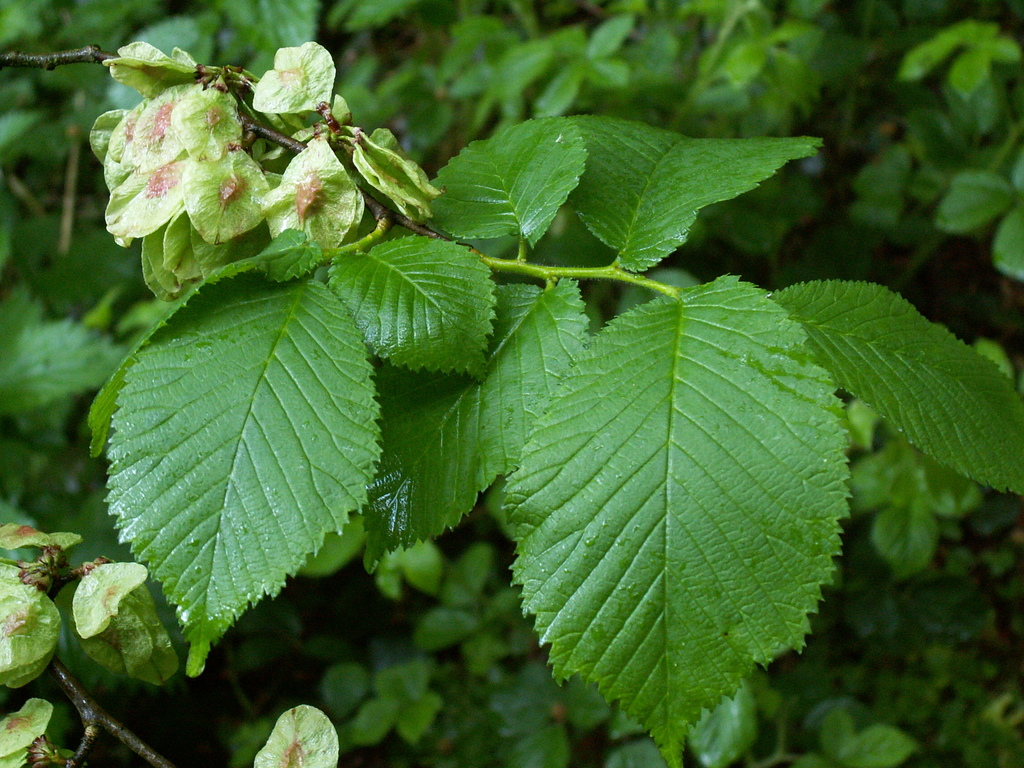
Wych Elm
Ulmus glabra
Ulmus glabra, the wych elm or Scots elm, has the widest range of the European elm species, from Ireland eastwards to the Ural Mountains, and from the Arctic Circle south to the mountains of the Peloponnese and Sicily, where the species reaches its southern limit in Europe; it is also native to the Caucasus region and parts of Western Asia (Turkey, Syria and Iran). A large deciduous tree, it is essentially a montane species, growing at altitudes up to 1,500 m (5,000 ft), preferring sites with moist soils and high humidity. The tree can form pure forests in Scandinavia and occurs as far north as latitude 67°N at Beiarn Municipality in Norway. It has been successfully introduced as far north as Tromsø and Alta in northern Norway (70°N). It has also been successfully introduced to Narsarsuaq, near the southern tip of Greenland (61°N).
The tree was by far the most common elm in the north and west of the British Isles and is now acknowledged as the only indisputably British native elm species. Owing to its former abundance in Scotland, the tree was occasionally (primarily historically) known as Scots elm; Loch Lomond is said to be derived from the Gaelic Lac Leaman, interpreted by some as 'Lake of the Elms', 'leaman' being the genitive plural form of leam or lem, 'elm'.
From the article Ulmus glabra on Wikipedia (CC BY-SA), quoted section by section
Description
The type sometimes reaches heights of 40 m (130 ft), typically with a broad crown where open-grown, supported by a short bole up to 2 m (6.6 ft) diameter at breast height (DBH). Normally, root suckers are not seen; natural reproduction is by seed alone. The tree is notable for its very tough, supple young shoots, which are always without the corky ridges or 'wings' characteristic of many elms. The alternate leaves are deciduous, 6–17 cm (2.4–6.7 in) long by 3–12 cm (1.2–4.7 in) broad, usually obovate with an asymmetric base, the lobe often completely covering the short (<5 mm) petiole; the upper surface is rough. Leaves on juvenile or shade-grown shoots sometimes have three or more lobes near the apex. The perfect hermaphrodite flowers appear before the leaves in early spring, produced in clusters of 10–20; they are 4 mm across on 10 mm long stems, and being wind-pollinated, are apetalous. The fruit is a winged samara 20 mm long and 15 mm broad, with a single, round, 6 mm seed in the centre, maturing in late spring. The roots can be of extraordinary length: one at Auchencraig, Larg, Ayershire, Scotland has roots which have been traced for a length of 110 metres from the trunk.
In medicine
In 18th century France, the inner bark of Ulmus glabra, orme pyramidale, had a brief reputation as a panacea; "it was taken as a powder, as an extract, as an elixir, even in baths. It was good for the nerves, the chest, the stomach — what can I say? — it was a true panacea." It was this so-called "pyramidal elm bark" about which Michel-Philippe Bouvart famously quipped "Take it, Madame... and hurry up while it [still] cures." It still appeared in a pharmacopeia of 1893.
Wikipedia: “Medicine”
How it is grown
The wych elm is moderately shade-tolerant, but requires deep, rich soils as typically found along river valleys. The species is intolerant of acid soils and flooding, as it is of prolonged drought. Although rarely used as a street tree owing to its shape, it can be surprisingly tolerant of urban air pollution, constricted growing conditions, and severe pollarding. As wych elm does not sucker from the roots, and any seedlings are often consumed by uncontrolled deer populations, regeneration is very restricted, limited to sprouts from the stumps of young trees. The resultant decline has been extreme, and the wych elm is now uncommon over much of its former range. It is best propagated from seed or by layering stooled stock plants, although softwood cuttings taken in early June will root fairly reliably under mist. Wych elm was widely planted in Edinburgh in the 19th century as a park and avenue tree, and despite losses, it remains abundant there, regenerating through seedlings. It was introduced to New England in the 18th century, and in the 19th century to Canada (as U. montana at the Dominion Arboretum, Ottawa), where a few old specimens survive, and to Australia.
Wikipedia: “Cultivation”
In human culture
The word "wych" (also spelled "witch") comes from the Old English wice, meaning pliant or supple, which also gives definition to wicker and weak. Jacob George Strutt's 1822 book, Sylva Britannica, attests that the wych elm was sometimes referred to as "wych hazel", a name now applied to the unrelated genus Hamamelis, commonly called "witch hazels".
Wikipedia: “Etymology”
Where it lives
Recorded sightings
—
geo-referenced records in GBIF, from museums, herbaria and field observers.
Drag the globe to turn it. Dots are where records exist, not a range map; darker means more records.
In the stacks
Searching the stacks…
Every page naming Ulmus glabra in the Biodiversity Heritage Library →
This page is assembled live from iNaturalist, GBIF, Wikipedia, the Source Library and the Internet Archive. It is not yet part of the hand-edited codex. iNaturalist taxon 170056.