- Plants
- ›Vascular Plants
- ›flowering plants
- ›Dicots
- ›Mints, Plantains, Olives, and Allies
- ›bladderwort family
- ›Utricularia
- ›Utricularia
- ›Utricularia
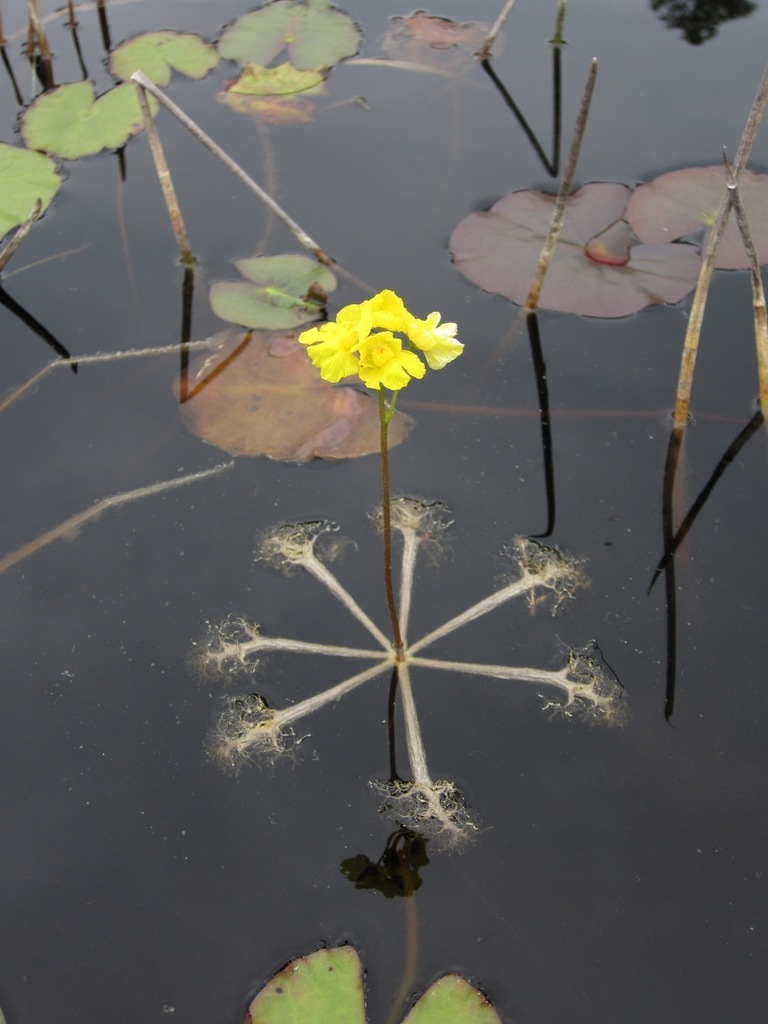
swollen bladderwort
Utricularia inflata
Utricularia inflata, commonly known as the swollen bladderwort, inflated bladderwort, or large floating bladderwort, is a large suspended aquatic carnivorous plant that belongs to the genus Utricularia. It is a perennial that is native to the southeastern coastal plains of the United States. It has often been confused with U. radiata, which is similar but smaller than U. inflata. Since 1980, U. inflata has been reported to exist in locations beyond its traditional range, such as the Adirondack Mountains in New York, southeastern Massachusetts, and in Washington State. Studies on the populations in the Adirondacks suggest that an introduction of U inflata. to a location where it naturalizes can lead to altered sediment chemistry by reducing the net primary productivity of native species. It is also listed by the state of Washington as a problematic species because of the dense mat-forming habit of this aquatic Utricularia. It is one of the few carnivorous plants that can be invasive.
From the article Utricularia inflata on Wikipedia (CC BY-SA), quoted section by section
Description
Utricularia inflata is one of the larger suspended aquatic species in the genus Utricularia. Like all aquatic Utricularia, U. inflata has no true roots or leaves. The filiform stolons are the main vegetative "stem" of the plant and can be up to one meter long or longer but are only 1–2 mm thick. The stolons are glabrous with 1–5 cm between branched divisions. Occasionally the stolons will produce floating air shoots at the water's surface and tuber-like organs in the substrate. Its filiform leaf-like structures appear to be additional branches off the main stolon and are tiny, filament-like structures that are not true leaves, though the terminology is often disputed among experts. The leaf structures are numerous and anywhere from 2–18 cm long, originating from the stolon base into two primary and unequal segments, which are further divided extensively into additional segments. The stalked, ovoid traps, 1–3 mm long, are produced on the latter leaf segments and are very numerous. In its native range, U. inflata, a perennial species, can begin to flower in January and may continue through June. In this phase of its growth it produces the most visible and noticeable morphological features of the species: a floating spoke-like whorl of spongy structures at the water's surface that support the inflorescences, often called a "float". U. …
Range & habitat
Utricularia inflata is native to the southeastern United States. Peter Taylor's 1989 taxonomic monograph listed the following states where native populations of this species have been located: Alabama, Arkansas, Delaware, Florida, Georgia, Kentucky, Louisiana, New Jersey, North and South Carolina, Tennessee, Texas, and Virginia. In addition to these states, the United States Department of Agriculture's online PLANTS database acknowledges populations in Connecticut, Maryland, Michigan, Mississippi, New York, Oklahoma, and Pennsylvania. The states of Maryland, Michigan, and New York have classified U. inflata as an endangered or threatened species while Tennessee has listed it as a species with "special concern". U. inflata inhabits aquatic environments such as lakes, ditches, and swamps from shallow to deep waters at low altitudes.
Wikipedia: “Distribution and habitat”
How it is grown
Utricularia inflata is one of the many Utricularia species that is cultivated by carnivorous plant enthusiasts. Because it requires no dormancy and due to its swift growth, it is one of the easier suspended aquatic species to cultivate. Barry Rice, author of Growing Carnivorous Plants, says that this species is the easiest suspended aquatic Utricularia that he has grown. Rice also mentions that U. inflata has been used as an aid in the cultivation of particularly difficult species, such as Aldrovanda vesiculosa, that are much more sensitive to high nutrient concentrations. When growing these species together, U. inflata will grow rapidly in the presence of higher nutrients, which allows A. vesiculosa to enjoy the conditions it thrives in. Rice, the Washington Department of Ecology, and the United States Geological Survey's Nonindigenous Aquatic Species information resource all indicate that cultivation of this species is suspected as the most likely source of its introduction into Horseshoe Lake in Washington. The spread from lake to lake in Washington is probably the result of waterfowl moving from lake to lake and carrying plants or propagules with them.
Wikipedia: “Cultivation”
In human culture
Utricularia inflata was first named and described by Thomas Walter in 1788. U. radiata has often been mistaken for U. inflata because of their similar morphology and overlapping distribution. In the past, U. radiata has been misidentified as U. inflata or placed at the rank of variety. U. radiata was first identified by Alvan Wentworth Chapman in 1860 as U. inflata var. minor and noted that it was "in every way smaller" than U. inflata. John Kunkel Small in 1903 was the first to elevate U. inflata var. minor to the species level under the name U. radiata. Further studies of the two taxa were mixed on how to treat them. In 1950, Merritt Lyndon Fernald treated them as two varieties of the same species while Henry Gleason considered them to be different, but allied species in 1952. In 1962, Grady Reinert and R. K. Godfrey further supported the separation of the two taxa into different species. Peter Taylor's authoritative monograph of the genus in 1989 solidified the distinctiveness of the two species.
Wikipedia: “Botanical history”
Where it lives
Recorded sightings
—
geo-referenced records in GBIF, from museums, herbaria and field observers.
Drag the globe to turn it. Dots are where records exist, not a range map; darker means more records.
In the stacks
Searching the stacks…
Every page naming Utricularia inflata in the Biodiversity Heritage Library →
This page is assembled live from iNaturalist, GBIF, Wikipedia, the Source Library and the Internet Archive. It is not yet part of the hand-edited codex. iNaturalist taxon 170086.