- Plants
- ›Vascular Plants
- ›flowering plants
- ›Dicots
- ›Sunflowers, Bellflowers, Fanflowers, and Allies
- ›Sunflowers, Daisies, Asters, and Allies
- ›Vernonioideae
- ›Vernonieae
- ›Vernoniinae
- ›Vernonia
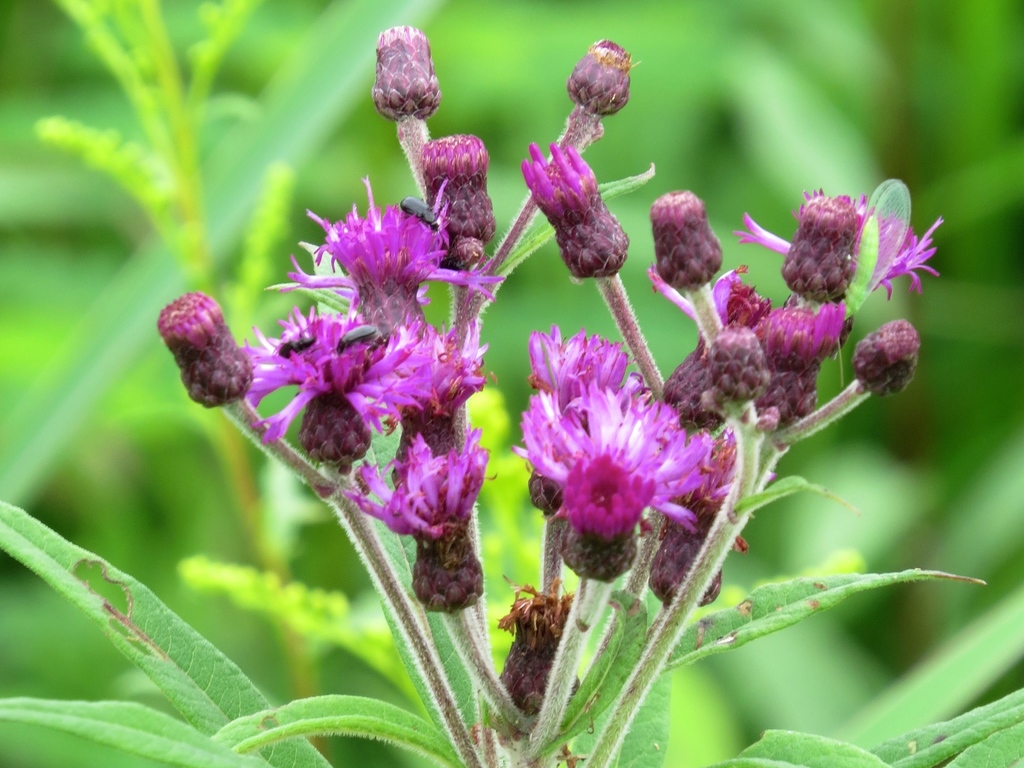
Missouri Ironweed
Vernonia missurica
Vernonia missurica, the Missouri ironweed, is a species of purple colored perennial plant from Asteraceae family that can be found growing in the central United States.
From the article Vernonia missurica on Wikipedia (CC BY-SA), quoted section by section
Description
The plant is 90–150 cm (3–5 ft) in height and 90–120 cm (3–4 ft) in width, and in some cases can exceed up to 180 cm (6 ft). The leaves are dark green in color and alternating. The flowers of Vernonia missurica bloom in July and August and are magenta with reddish-brown bracts. Each flower head is 100–180 mm (4–7 in) in length and 15 mm (1⁄2 in) in diameter, with 30–60 disk florets. Vernonia missurica has a central stout stem that is covered with white hairs, and the flowers grow close to each other and have rayless heads. Stems are hairy and reddish-brown.
Range & habitat
Vernonia missurica is native to the central and east central United States namely Alabama, Arkansas, Georgia, Illinois, Indiana, Iowa, Kansas, Kentucky, Louisiana, Michigan, Mississippi, Missouri, Oklahoma, Tennessee, and Texas.
Wikipedia: “Distribution”
What it does
Vernonia missurica is typically visited by long-tongued bees, butterflies, and skippers. In the absence of these pollinators, the plant is capable of self-pollinating. It is pollinated by various bees such as members of the genus Bombus (bumblebees), the tribe Epeolini (epeoline cuckoo bees), the family Halictidae (halictid bees), and the genus Andrena (miner bees). Lepidoptera (butterflies), including those of the family Hesperiidae (skippers), are also frequent visitors. Some caterpillars feed on the plant, including the most common guests of Grammia parthenice (Parthenice tiger moth), Perigea xanthioides (red groundling), and Papaipema cerussata (ironweed borer moth). Herbivorous mammals avoid the plant due to its bitter taste.
== References ==
Wikipedia: “Ecology”
Where it lives
Recorded sightings
—
geo-referenced records in GBIF, from museums, herbaria and field observers.
Drag the globe to turn it. Dots are where records exist, not a range map; darker means more records.
In the stacks
Searching the stacks…
Every page naming Vernonia missurica in the Biodiversity Heritage Library →
This page is assembled live from iNaturalist, GBIF, Wikipedia, the Source Library and the Internet Archive. It is not yet part of the hand-edited codex. iNaturalist taxon 170182.