- Plants
- ›Vascular Plants
- ›flowering plants
- ›Dicots
- ›Gentians, Dogbanes, Madders, and Allies
- ›Dogbane Family
- ›Rauvolfioideae
- ›periwinkles, devil peppers and kin
- ›European periwinkles
- ›Vinca
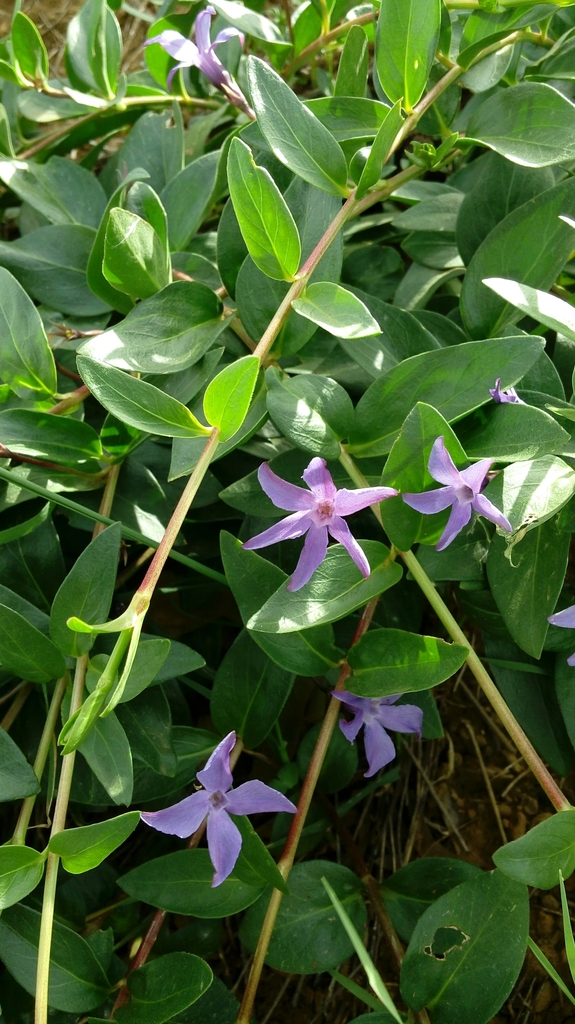
Herbaceous Periwinkle
Vinca herbacea
Vinca herbacea, with common name herbaceous periwinkle, is a flowering plant native to eastern and southeastern Europe, from Austria south to Greece, and east to the Crimea, and also in northern Western Asia, in the Caucasus and Alborz mountains.
From the article Vinca herbacea on Wikipedia (CC BY-SA), quoted section by section
Description
Vinca herbacea is a herbaceous perennial growing as a trailing vine, spreading along the ground and rooting along the stems to form clonal colonies, growing up to 10–20 centimetres (4–8 in) high. The leaves are opposite, lanceolate, 1–5 cm (1⁄2–2 in) long and 0.2–3 cm (1⁄8–1+1⁄8 in) broad, glossy green with an entire margin, and nearly sessile with only a very short petiole. The flowers are produced in late summer, blue-violet or occasionally white, 2.5–3.5 cm (1–1+1⁄2 in) diameter, with a five-lobed corolla.
Range & habitat
The plant is native to eastern and southeastern Europe, from Austria south to Greece, and east to the Crimea, and also in northern Western Asia, in the Caucasus and Alborz mountains, mainly in steppe habitats.
Wikipedia: “Distribution and habitat”
How it is grown
Vinca herbacea is occasionally grown as an ornamental plant in temperate climate gardens, as a rock garden plant.
Wikipedia: “Cultivation”
Where it lives
Recorded sightings
—
geo-referenced records in GBIF, from museums, herbaria and field observers.
Drag the globe to turn it. Dots are where records exist, not a range map; darker means more records.
In the stacks
Searching the stacks…
Every page naming Vinca herbacea in the Biodiversity Heritage Library →
This page is assembled live from iNaturalist, GBIF, Wikipedia, the Source Library and the Internet Archive. It is not yet part of the hand-edited codex. iNaturalist taxon 170230.