- Plants
- ›Vascular Plants
- ›flowering plants
- ›Dicots
- ›Legumes, Milkworts, and Allies
- ›Legumes
- ›Faboideae
- ›Wisterieae
- ›Wisteria
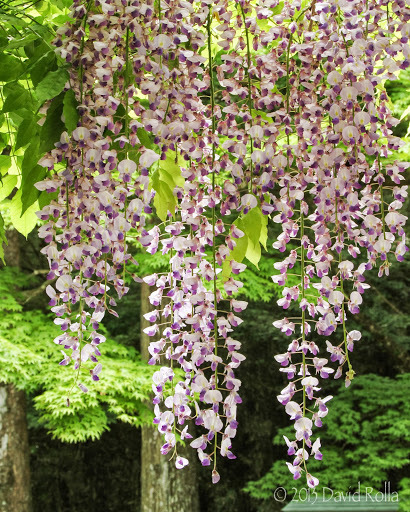
Japanese wisteria
Wisteria floribunda
Wisteria floribunda, common name Japanese wisteria (藤, fuji), is a species of flowering plant in the family Fabaceae, native to Japan. (Wisteriopsis japonica, synonym Wisteria japonica, is a different species.) Growing to 9 m (30 ft), Wisteria floribunda is a woody, deciduous twining climber. It was first brought from Japan to the United States in the 1830s. It is a common subject for bonsai, along with Wisteria sinensis (Chinese wisteria).
Japanese wisteria sports the longest flower racemes of any wisteria; Some of those cultivars can reach 2 m (7 ft) in length. These racemes burst into clustered white, pink, violet, or blue flowers in early- to mid-spring. The flowers carry a fragrance similar to that of grapes. The early flowering time of Japanese wisteria can cause problems in temperate climates, where early frosts can destroy the coming years' flowers. It will also flower only after passing from juvenile to adult stage, a transition that may take many years just like its cousin Chinese wisteria.
Where it lives
Recorded sightings
—
geo-referenced records in GBIF, from museums, herbaria and field observers.
Drag the globe to turn it. Dots are where records exist, not a range map; darker means more records.
In the stacks
Searching the stacks…
Every page naming Wisteria floribunda in the Biodiversity Heritage Library →
This page is assembled live from iNaturalist, GBIF, Wikipedia, the Source Library and the Internet Archive. It is not yet part of the hand-edited codex. iNaturalist taxon 170331.