- Plants
- ›Vascular Plants
- ›flowering plants
- ›monocots
- ›Agaves, Orchids, Irises, and Allies
- ›amaryllis, onions, and allies
- ›amaryllis subfamily
- ›Hippeastreae
- ›Hippeastrinae
- ›Zephyranthes
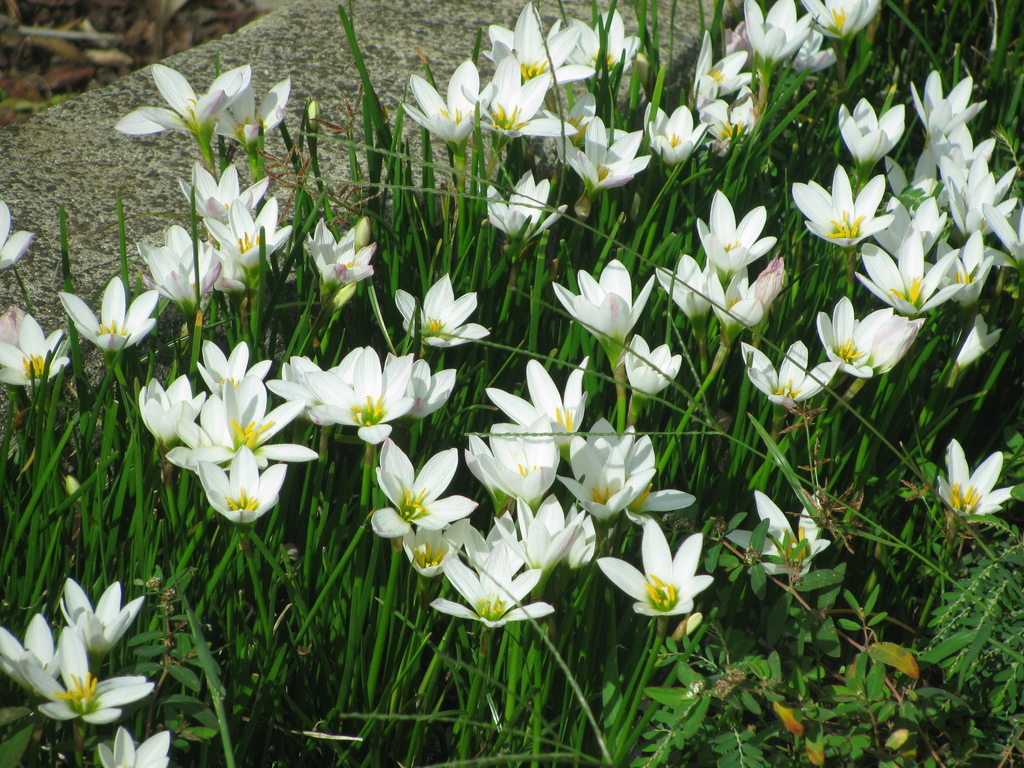
White rain-lily
Zephyranthes candida
Zephyranthes candida, with common names that include autumn zephyrlily, white windflower, white rain lily, and Peruvian swamp lily, is a species of rain lily native to South America including Argentina, Uruguay, Paraguay, and Brazil. The species is widely cultivated as an ornamental and reportedly naturalized in many places (South Africa, the Indian subcontinent, Zimbabwe, Seychelles, central and southern China, Korea, Nansei-shoto (Ryukyu Islands), Bhutan, Solomon Islands, Queensland, Nauru, Tonga, Society Islands, Mariana Islands, southeastern United States (from Texas to North Carolina), the Lesser Antilles, and Peru).
From the article Zephyranthes candida on Wikipedia (CC BY-SA), quoted section by section
Description
Leaves are a deep glossy green and measure 3 mm wide. Flowers, which bud late in August (when propagated in the Northern Hemisphere) at first resemble a new leaf, but emerge from their papery sheaves to a stunning whiteness; they are erect in perianth white and sometimes pinkish abaxially. The leaf-like bract is 1.8 to 4 cm. They grow best in full sun to part shade and require a medium wet soil. Propagation is done by dividing bulbs or offsets and from seed.
Where it lives
Recorded sightings
—
geo-referenced records in GBIF, from museums, herbaria and field observers.
Drag the globe to turn it. Dots are where records exist, not a range map; darker means more records.
In the stacks
Searching the stacks…
Every page naming Zephyranthes candida in the Biodiversity Heritage Library →
This page is assembled live from iNaturalist, GBIF, Wikipedia, the Source Library and the Internet Archive. It is not yet part of the hand-edited codex. iNaturalist taxon 170415.