- Plants
- ›Vascular Plants
- ›flowering plants
- ›Dicots
- ›beeches, oaks, walnuts, and allies
- ›beech family
- ›Quercus
- ›Quercus
- ›Quercus
Quercus
An oak is a hardwood tree or shrub in the genus Quercus of the beech family. They have spirally arranged leaves, often with lobed edges, and a nut called an acorn, borne within a cup. The genus is widely distributed in the Northern Hemisphere, with some 475 species, both deciduous and evergreen. Fossil oaks date back to the Middle Eocene. Molecular phylogeny shows that the genus is divided into Old World and New World clades, but many oak species hybridise freely, making the genus's history difficult to resolve.
Ecologically, oaks are keystone species in habitats from Mediterranean semi-desert to subtropical rainforest. They live in association with many kinds of fungi, including truffles. Oaks support more than 950 species of caterpillar, many kinds of gall wasp which form distinctive galls (roundish woody lumps such as the oak apple), and a large number of pests and diseases. Oak leaves and acorns contain enough tannin to be toxic to cattle, but pigs are able to digest them safely. Oak timber is strong and hard, and has found many uses in construction and furniture-making. The bark was traditionally used for tanning leather. Wine barrels are made of oak; these are used for aging alcoholic beverages such as sherry and whisky, giving them a range of flavours, colours, and aromas. The spongy bark of the cork oak is used to make traditional wine bottle corks. Almost a third of oak species are threatened with extinction due to climate change, invasive pests, and habitat loss.
5 branches of this group, most-observed first

Pedunculate Oak Complex
complexQuercus robur
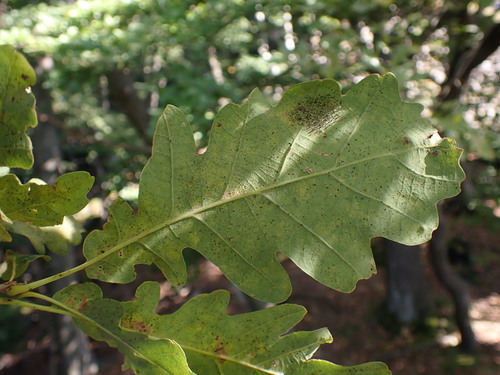
Quercus petraea
complexQuercus petraea

Quercus pubescens
complexQuercus pubescens
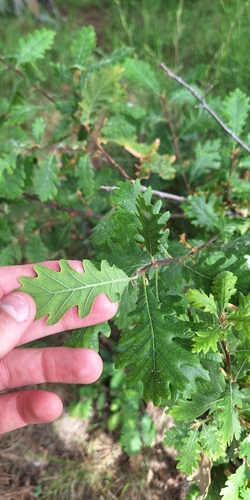
Quercus × streimii
hybridQuercus × streimii
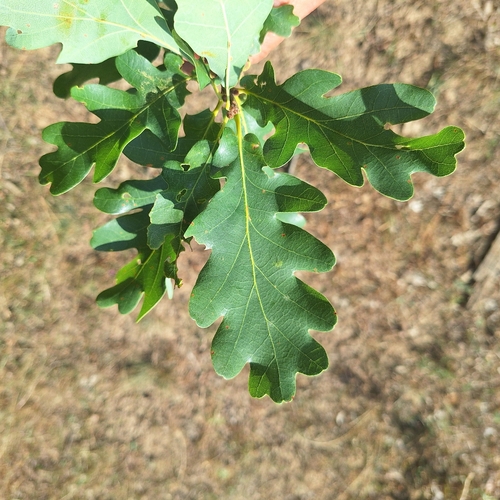
Quercus × pseudodalechampii
hybridQuercus × pseudodalechampii
Where it lives
Recorded sightings
—
geo-referenced records in GBIF, from museums, herbaria and field observers.
Drag the globe to turn it. Dots are where records exist, not a range map; darker means more records.
In the old herbals & bestiaries

Notable Commentaries on the History of Plants
Leonhart Fuchs · 1542 · p.263

Notable Commentaries on the History of Plants
Leonhart Fuchs · 1549 · p.261

Six Groups of the History of Plants
Rembert Dodoens · 1583 · p.832

Six Groups of the History of Plants
Rembert Dodoens · 1583 · p.832

Ortus sanitatis
1491 · p.45

De medicinali materia libri sex
Dioscorides · 1552 · p.155

Commentaries on the Six Books of Dioscorides
Pietro Andrea Mattioli · 1560 · p.239

Commentaries on the Six Books of Dioscorides
Pietro Andrea Mattioli · 1560 · p.242

Discourses on the Six Books of Dioscorides
Dioscorides; Pietro Andrea Mattioli (comm.) · 1568 · p.1266

History of Rare Plants of Pannonia
Carolus Clusius · 1576 · p.19

History of Rare Plants Observed in Pannonia
Carolus Clusius · 1583 · p.18

History of Rare Plants
Carolus Clusius · 1601 · p.33
In the stacks
Searching the stacks…
Every page naming Quercus in the Biodiversity Heritage Library →
This page is assembled live from iNaturalist, GBIF, Wikipedia, the Source Library and the Internet Archive. It is not yet part of the hand-edited codex. iNaturalist taxon 1709094.