 NL·0236
Herbarium of the Nature Library
- Name
- Paracheirodon innesi
- Family
- Acestrorhamphidae
- Native to
- Western Amazon blackwater and clearwater streams of Peru, Colombia and Brazil (Putumayo and upper Solimões area)
- Habitat
- Blackwater streams, Forest creeks, Flooded forest
Neon tetra
Paracheirodon innesi
Also calledNeon (Portuguese/Spanish) · Néon-tetra (Portuguese) · Neonsalmler (German)
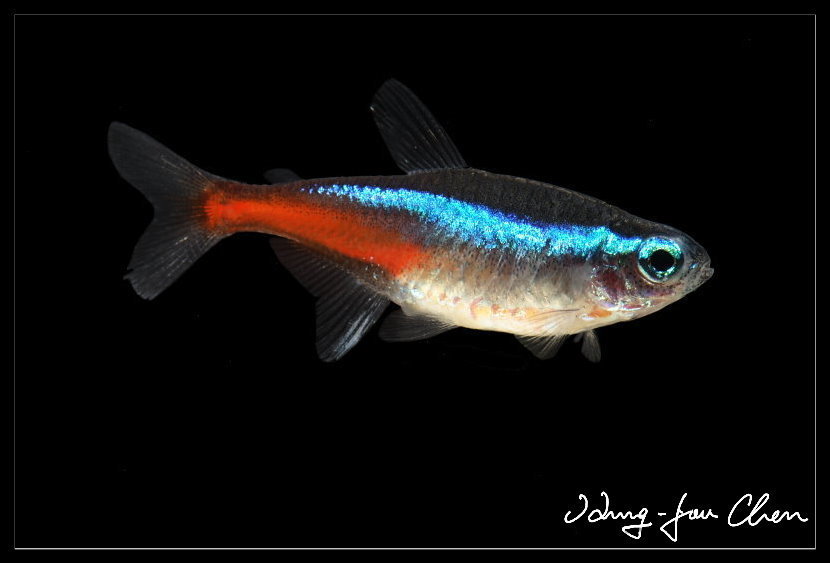
A tiny Amazonian schooling fish whose glowing blue-green stripe made it the most popular aquarium fish of the 20th century. Its iridescent colour comes from microscopic reflecting platelets in its skin, not from pigment.
The neon tetra is a species of freshwater fish belonging to the family Acestrorhamphidae, the American characins, of the order Characiformes. The type species of its genus, it is native to blackwater and clearwater streams in the Amazon basin of South America. Its bright colouring makes the fish visible to conspecifics in the dark blackwater streams, and is also the main reason for its popularity among freshwater fish hobbyists, with neon tetras being one of the most widely kept tropical fish in the world. Wikipedia
What it can do
- iIts blue stripe works like a living light filter: stacked guanine platelets tilt to shift the colour from green-blue in light to violet-blue in dimness
- iiSchools tightly, so the flashing stripes can confuse predators
- iiiLives in soft, very acidic water with almost no dissolved minerals
In the field
Field marks
- aTiny, slender body with an iridescent electric blue-green stripe from eye to adipose fin
- bRed stripe on the rear half of the lower body only
- cSilvery-white belly in front of the red area
- dSmall adipose fin
- Not to be confused with
- Cardinal tetra (P. axelrodi) has red along the whole length of the belly beneath the blue stripe. Green neon (P. simulans) is smaller, with a greener stripe and much less red.
- Where to see it
- Blackwater creeks of the Peruvian and Colombian Amazon near the Putumayo; aquaria worldwide
- When
- Resident; breeds at the start of the rainy season
Life & habits
- Diet
- Micropredator: small insects, larvae, crustaceans and worms
- Habitat
- Shaded, slow, tannin-stained forest streams with leaf litter and roots
- Size
- Up to about 3–4 cm
- Lifespan
- Usually 2–3 years in the wild; up to 8–10 in aquaria
Moves in schools among roots and leaf litter, and at night fades its colours to rest.
Where it lives
Recorded sightings
—
geo-referenced records in GBIF, from museums, herbaria and field observers.
Native range
Western Amazon blackwater and clearwater streams of Peru, Colombia and Brazil (Putumayo and upper Solimões area)
Drag the globe to turn it. Dots are where records exist, not a range map; darker means more records.
In the stacks
Searching the stacks…
Every page naming Paracheirodon innesi in the Biodiversity Heritage Library →
Marginalia
First collected by Auguste Rabaut in the 1930s and shipped to Europe in 1936, it was named after the American aquarist William T. Innes. Most neons in shops today come from fish farms in Southeast Asia and Florida, not the wild.
Curiosity
The neon's stripe changes colour without any change in pigment: in the dark the reflecting platelets tilt and the stripe shifts from cyan to deep blue-violet.
Kinship


Photographs: iNaturalist contributors under the licences shown. Records: GBIF.org. Historical plates: Source Library (CC BY-SA 4.0; originals public domain). Summary text: Nature Library editors and Wikipedia (CC BY-SA). Medicinal and edibility notes are historical and educational, not advice. iNaturalist taxon 172378.