- Fungi Including Lichens
- ›Ascomycete Fungi
- ›Sac Fungi and Lichens
- ›Common Lichens
- ›Shield Lichens, Sunburst Lichens, Rosette Lichens, and Allies
- ›Peltigerales
- ›Coccocarpiaceae
- ›Spilonema
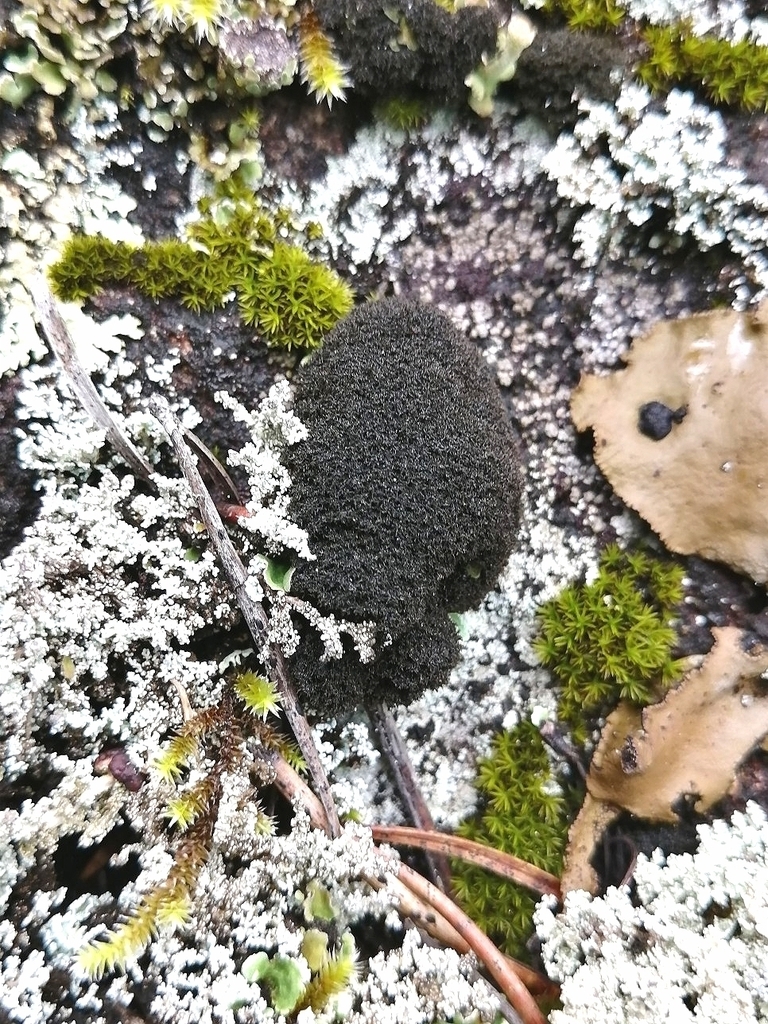
Rock Hairball Lichen
Spilonema revertens
Spilonema revertens, the rock hairball lichen, is a species of fruticose lichen in the family Coccocarpiaceae. This dark-coloured cyanolichen forms small, dense cushions on rocks across the Northern Hemisphere. Found in Europe, Asia, North America, Macaronesia, and Greenland, it typically grows on exposed rocks that experience alternating wet and dry periods. The species is most commonly found in lower mountain zones, particularly in open coniferous forests and rocky steppes, though it also occurs in coastal areas. First described in 1865 from specimens collected in Finland, it is distinctive for its minute, branching filaments that create cushion-like structures and for its role as the exclusive host of the parasitic lichen Psorula rufonigra. Unlike many other rock-dwelling lichens, it shows a preference for sheltered locations on rock faces and tends to grow in scattered, small patches rather than forming extensive coverage.
From the article Spilonema revertens on Wikipedia (CC BY-SA), quoted section by section
Description
The thallus of Spilonema revertens forms dense cushions composed of minute, dark filaments. These cushions feature a distinctive structure: a dense central mass of rhizine-like filaments supports an outer layer of actively growing lichenized branches, allowing continuous regeneration of the lichen's outer layer. Its growth form varies from somewhat shrub-like (subfruticose) to tree-like (dendroid), consisting of tiny, upright lobules that occasionally spread out along the substrate. These lobules bear numerous minute side branches, forming rounded to angular, convex cushion-like structures. In some cases, the thallus may fragment into small, crust-like (areolate) patches, giving it a more encrusting appearance. The lichen attaches to the rock surface via a hypothallus, a network of interwoven bluish-black fungal filaments, which becomes gelatinous when wet. The upper surface of the thallus is typically dark olive to blackish in colour, often appearing rough or granular, though it is rarely shiny. Internally, S. revertens has a uniform structure (homoiomerous) composed of densely packed thick-walled fungal filaments and lacks a distinct outer protective layer (ecorticate). Near the base, the tissue may adopt a more organized, paraplectenchymatous (brick-like) arrangement. …
Range & habitat
Spilonema revertens has a broad Holarctic distribution, occurring across Europe, Asia, North America, and Greenland. It has also been recorded from the Canary Islands. In Russia, it has been documented in the northern European part of the country, the Northern and Southern Urals, the North Caucasus, Southern and Eastern Siberia, and both the southern and northern regions of the Russian Far East, as well as in Mongolia. In Greenland, it typically occurs in association with Euopsis pulvinata and Lecanora chloroleprosa, especially on moist charnockitic rocks and siliceous gravel. The species generally grows on exposed siliceous rock that undergoes alternating dry and wet periods. It is often encountered in lower mountain zones, particularly in light coniferous forests and stony meadow-steppes, but has also been documented on serpentine rocks and soils derived from peridotite. Such substrates feature low calcium-to-magnesium ratios, elevated concentrations of heavy metals, and nutrient deficiencies; however, S. revertens is not considered serpentine-specific because it is recorded on a variety of rock types. Wave exposure influences its distribution in coastal environments. …
Wikipedia: “Habitat, distribution, and ecology”
Where it lives
Recorded sightings
—
geo-referenced records in GBIF, from museums, herbaria and field observers.
Drag the globe to turn it. Dots are where records exist, not a range map; darker means more records.
In the stacks
Searching the stacks…
Every page naming Spilonema revertens in the Biodiversity Heritage Library →
This page is assembled live from iNaturalist, GBIF, Wikipedia, the Source Library and the Internet Archive. It is not yet part of the hand-edited codex. iNaturalist taxon 174877.