- Fungi Including Lichens
- ›Ascomycete Fungi
- ›Sac Fungi and Lichens
- ›Thelocarpales
- ›Thelocarpaceae
- ›Sarcosagium
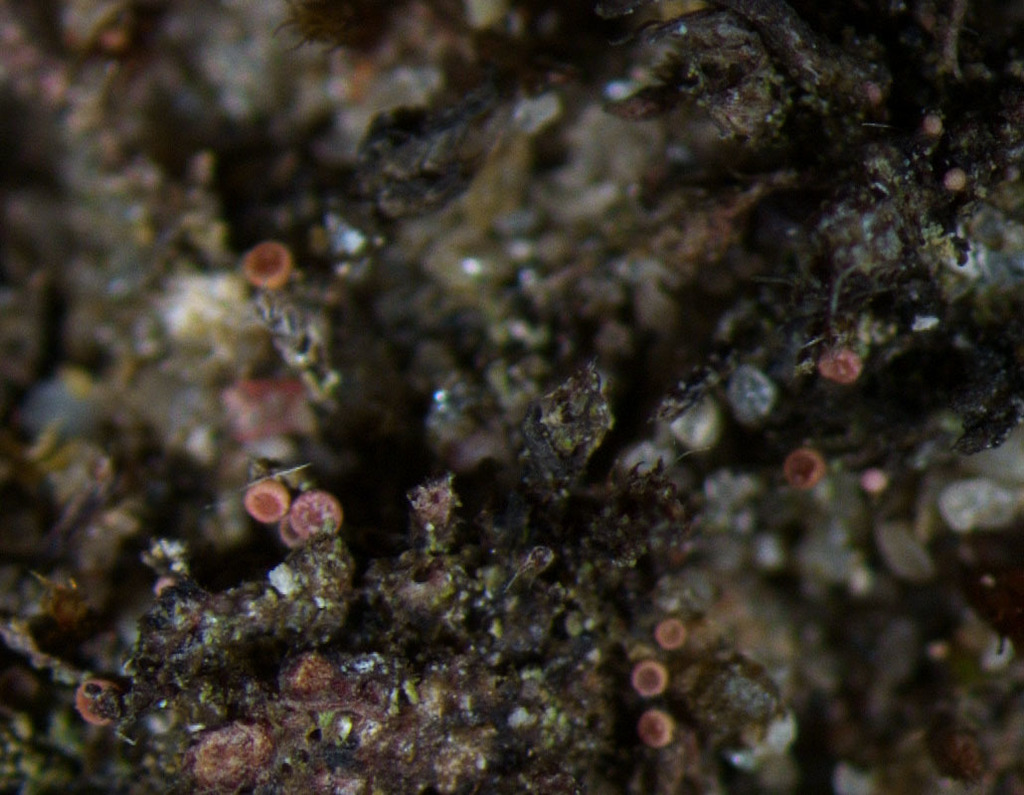
Sarcosagium campestre
Sarcosagium is a genus of crustose lichen-forming fungi in the family Thelocarpaceae. Established by the Italian lichenologist Abramo Bartolommeo Massalongo in 1856, it is currently regarded as a monotypic genus containing the single species Sarcosagium campestre. It is characterized by its inconspicuous, often gelatinous thallus and minute, reddish-brown, barrel-shaped apothecia. Its unusual morphology led to its placement in various groups historically, but genomic analyses have situated the genus within the Lichinomycetes, an ancient lineage of symbiotic ascomycetes. Its precise familial classification, however, remains a matter of ongoing discussion.
An ephemeral pioneer species, S. campestre typically colonizes transient or disturbed habitats such as acidic soils, decaying mosses, and urban wasteland across Europe and North America. It shows a high tolerance to heavy metals, frequently appearing on mine spoil heaps and tailings ponds enriched with zinc, lead, and copper. The species exhibits a distinct seasonal phenology, behaving as an autumn ephemerophyte (a species with short-lived fruiting bodies), with apothecia that emerge in late summer and disappear by winter. Because of its small size and preference for neglected anthropogenic sites, it is believed to be more widespread than current records suggest.
From the article Sarcosagium on Wikipedia (CC BY-SA), quoted section by section
Description
The thallus of Sarcosagium campestre is a thin, often inconspicuous crust, which ranges in colour from greenish or green-grey to blackish-brown. It may be more or less gelatinous when moist and can be reduced to scattered granules or an indeterminate dark crust in the field. In the protologue of S. biatorellum, the thallus was described as a very thin, spreading crust that became greenish-brown and semitranslucent when wet. The photobiont is chlorococcoid. The apothecia are 0.1–0.3 (sometimes up to 0.5) mm in diameter, sessile, barrel-shaped to convex, and dark red-brown, becoming translucent when wet. The disc is flat or slightly concave and opens with age to become cup-like, while the exciple is well developed, the same colour as the disc, and often thinly grey-pruinose. Massalongo described the young apothecia as punctiform (point-like) and flesh-coloured before they opened more fully and the disc became evident. The hymenium is 120–170 micrometres (μm) tall, and both the epithecium and hypothecium are colourless or pale yellow. The paraphyses are unbranched or sparingly branched, lax in K, with swollen apices. The asci (spore-bearing cells) are cylindrical and thin-walled. They lack an apical dome and turn blue when treated with iodine (K/I+). …
Range & habitat
Sarcosagium campestre is an ephemeral pioneer, colonizing temporary or disturbed habitats where there is little competition from other species. Typical substrates include base-rich or acidic soils, decaying mosses, walls, paths, quarry floors, urban wasteland, and mine spoil heaps. In Eastern and East-Central Europe it has been described as a characteristic lichen of neglected habitats such as roadside scarps, edges of dirt roads, and sand-, gravel-, and loam-pits, where its apparent rarity may partly reflect under-recording. It has also been recorded growing on decaying lichen thalli, including Peltigera didactyla and species of Collema, as well as on rotting wood and other detritus. The species is frequently associated with metalliferous habitats rich in heavy metals. In southern Poland, it has been recorded from abandoned zinc-lead mining areas on the Silesian-Kraków Upland, growing on soil and bryophytes on zinc- and lead-enriched substrates. In Maine, United States, it was collected from the fine-textured, metal-enriched, waterlogged soils of the tailings pond at the Callahan Mine, a copper- and zinc-enriched Superfund site, where it was treated as one of the indicator species for sites important for metal-tolerant lichens. …
Wikipedia: “Habitat and ecology”
Where it lives
Recorded sightings
—
geo-referenced records in GBIF, from museums, herbaria and field observers.
Drag the globe to turn it. Dots are where records exist, not a range map; darker means more records.
In the stacks
Searching the stacks…
Every page naming Sarcosagium campestre in the Biodiversity Heritage Library →
This page is assembled live from iNaturalist, GBIF, Wikipedia, the Source Library and the Internet Archive. It is not yet part of the hand-edited codex. iNaturalist taxon 174980.