- Animals
- ›Chordates
- ›Vertebrates
- ›Birds
- ›Woodpeckers and Allies
- ›Woodpeckers
- ›Typical woodpeckers
- ›Green Woodpeckers, Flickers, and Allies
- ›Piculus
On eBird ↗
Yellow-throated Woodpecker
Live sightings near you, the range map, bar charts of when it is seen, and Macaulay Library photos and recordings.
Yellow-throated Woodpecker
Piculus flavigula
The yellow-throated woodpecker (Piculus flavigula) is a species of bird in the family Picidae, the woodpeckers, piculets, and wrynecks. It is found in northern and central South America in Brazil and the entire Amazon Basin; also the Guianas, and Bolivia, Colombia, Ecuador, French Guiana, Guyana, Peru, Suriname, and Venezuela. Besides the Amazon Basin it is found in the southeast basin in the adjoining Tocantins-Araguaia River drainage; on the east at the edge of its range there,...
From the article Yellow-throated woodpecker on Wikipedia (CC BY-SA), quoted section by section
Description
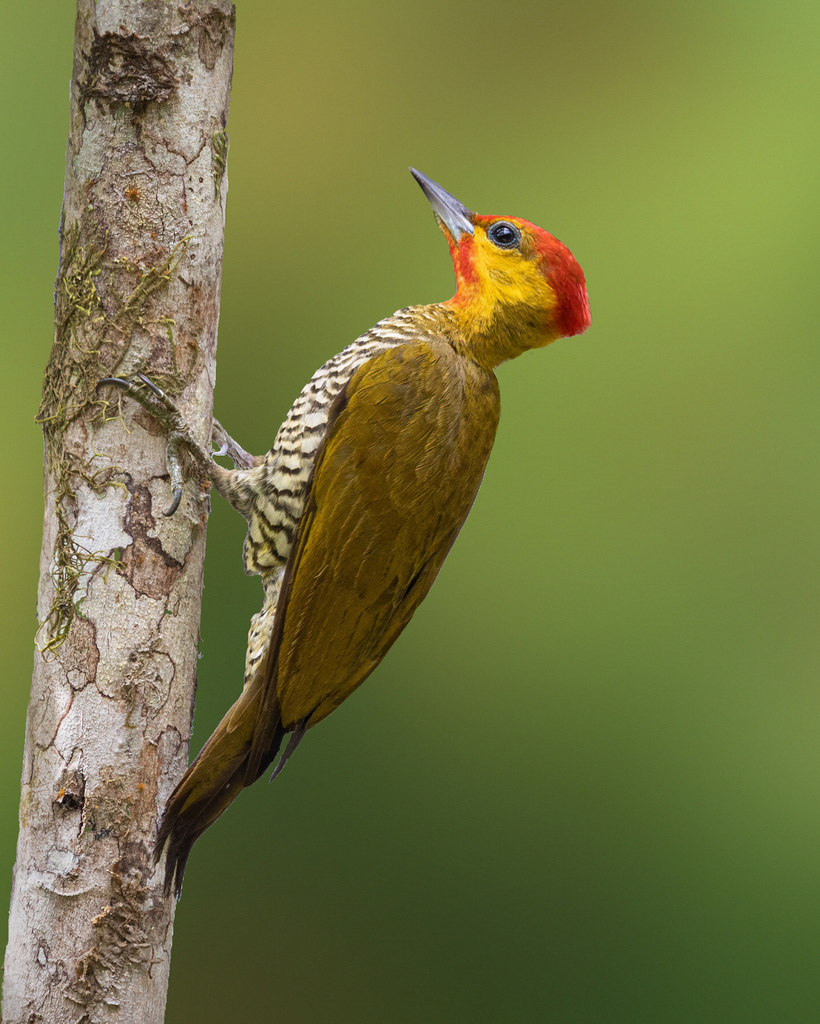
The yellow-throated woodpecker is 19 to 20 cm (7.5 to 7.9 in) long and weighs 44 to 63 g (1.6 to 2.2 oz). Males and females have the same plumage except on their heads. Males of the nominate subspecies P. f. flavigula are red from forehead to hindneck and on the malar (cheek); the former area has black feather bases showing through. The rest of the head including the chin and throat is bright golden-yellow. The female has red only on the nape and the rest of its crown is golden-yellow with green feather tips; its head is otherwise like the male's. Nominate adults have yellowish green upperparts that are brighter on the shoulders and back. Their flight feathers are mostly brownish black with cinnamon patches on the inner webs. Their tail is black with greenish edges on the feathers. Their underparts are green; the breast feathers have whitish centers and black tips while the belly and undertail coverts appear barred or scaly with black. Their shortish beak is black with a paler base, their iris brown, and the legs dark green-gray. Juveniles have duller and greener upperparts than adults and a yellow throat but are otherwise darker on their underparts. Males may have a small red patch on the crown and females have an entirely green crown. Subspecies P. f. magnus is identical to the nominate except that the male does not have a red malar area. P. f. …
Range & habitat
The subspecies of yellow-throated woodpecker are found thus:
P. f. flavigula (Boddaert, 1783), extreme eastern Colombia east through southern Venezuela and the Guianas and south into northern Brazil P. f. magnus (Cherrie & Reichenberger, 1921), southeastern Colombia south through eastern Ecuador and eastern Peru into northern Bolivia and east into western Brazil P. f. erythropis (Vieillot, 1818), separately in eastern Brazil's Pernambuco state and between the states of Bahia and São Paulo in southeastern Brazil The yellow-throated woodpecker inhabits the interior and edges of mature terra firme and várzea forests. Subspecies P. f. erythropis is mostly found in drier caatinga habitat. It is a species of the lowlands, ranging in elevation from sea level in the Guianas and Brazil to 300 m (1,000 ft) in Ecuador and 500 m (1,600 ft) in Peru.
Wikipedia: “Distribution and habitat”
What it does
The yellow-throated woodpecker forages from the forest's middle levels to the canopy, by itself, in pairs, or as part of a mixed species feeding flock. It seeks food vigorously by pecking, hammering, and flaking off bark; it less often probes. Its diet has not been studied but is known to include ants.
Wikipedia: “Feeding”
Listen
Looking for field recordings…
Where it lives
Recorded sightings
—
geo-referenced records in GBIF, from museums, herbaria and field observers.
Drag the globe to turn it. Dots are where records exist, not a range map; darker means more records.
In the stacks
Searching the stacks…
Every page naming Piculus flavigula in the Biodiversity Heritage Library →
This page is assembled live from iNaturalist, GBIF, Wikipedia, the Source Library and the Internet Archive. It is not yet part of the hand-edited codex. iNaturalist taxon 17744.