On eBird ↗
Orinoco Piculet
Live sightings near you, the range map, bar charts of when it is seen, and Macaulay Library photos and recordings.
Orinoco Piculet
Picumnus pumilus
The Orinoco piculet (Picumnus pumilus) is a species of bird in the family Picidae. It is found in Brazil, Colombia, and Venezuela. Its natural habitat is subtropical or tropical moist lowland forests.
From the article Orinoco piculet on Wikipedia (CC BY-SA), quoted section by section
Description
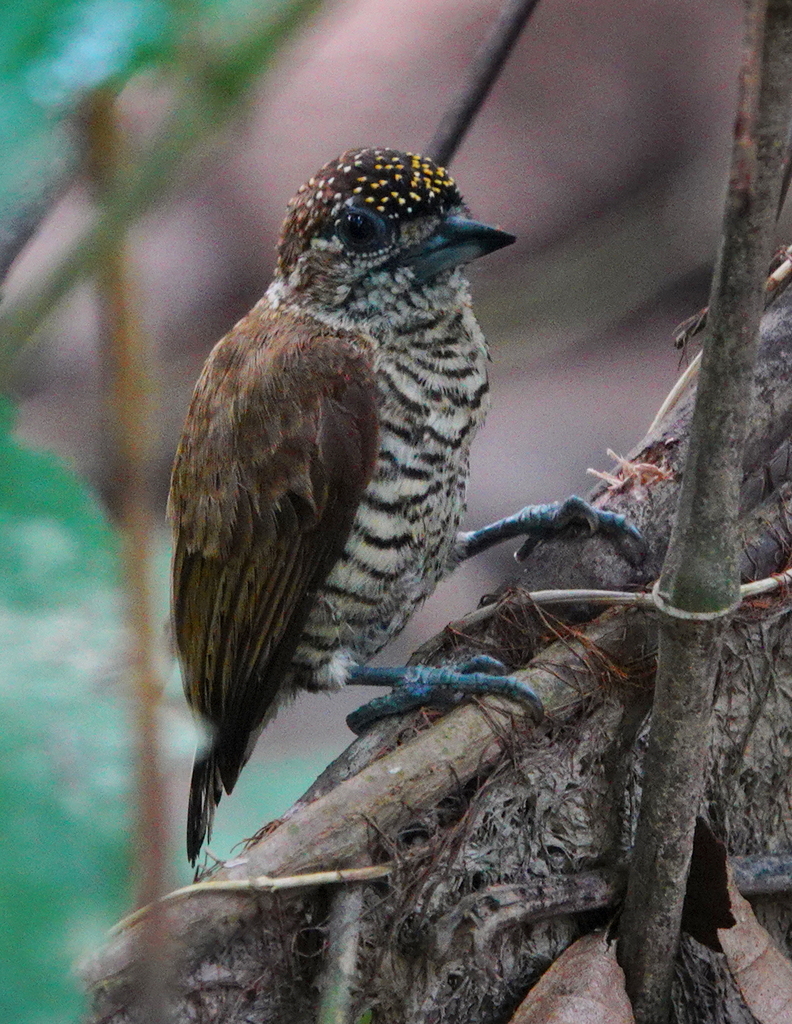
The Orinoco piculet is about 9 cm (3.5 in) long and weighs 9 to 10 g (0.32 to 0.35 oz). Adult males have a dark brown cap with yellow spots on the forehead and whiter ones on the rest of it. Their face is blackish with white spots, bare gray-blue skin around the eye, and a pale stripe behind the eye. Their upperparts are brownish green. Their primaries and secondaries are brown with greenish edges and tips. The upper side of their tail is black; the innermost pair of feathers have white inner webs and the outer three pairs have a white patch near the tip. Their chin, throat, and underparts are pale yellowish to buffy white with dark brown bars except in the center of the belly. The beak is blackish and the legs gray. Adult females are identical but for whitish spots on their entire crown. Juveniles are similar to adults but duller overall, greener above, and less evenly barred below.
Range & habitat
According to the Clements taxonomy the Orinoco piculet is found in eastern Colombia, northwestern Brazil, and adjacent southern Venezuela's Amazonas state. However, the South American Classification Committee of the American Ornithological Society has no records from Venezuela. The species inhabits the edges of humid mature forest, the edges of gallery forest, and dense thickets. In elevation it mostly ranges up to 300 m (980 ft) but occurs locally as high as 500 m (1,600 ft).
Wikipedia: “Distribution and habitat”
What it does
The Orinoco piculet forages from the forest's lower strata to the canopy. Its diet has not been detailed but is assumed to be ants and other small insects.
Wikipedia: “Feeding”
Listen
Looking for field recordings…
Where it lives
Recorded sightings
—
geo-referenced records in GBIF, from museums, herbaria and field observers.
Drag the globe to turn it. Dots are where records exist, not a range map; darker means more records.
In the stacks
Searching the stacks…
Every page naming Picumnus pumilus in the Biodiversity Heritage Library →
This page is assembled live from iNaturalist, GBIF, Wikipedia, the Source Library and the Internet Archive. It is not yet part of the hand-edited codex. iNaturalist taxon 17812.