- Animals
- ›Chordates
- ›Vertebrates
- ›Birds
- ›Woodpeckers and Allies
- ›Woodpeckers
- ›Typical woodpeckers
- ›Green Woodpeckers, Flickers, and Allies
- ›Dryocopus
On eBird ↗
Andaman Woodpecker
Live sightings near you, the range map, bar charts of when it is seen, and Macaulay Library photos and recordings.
Andaman Woodpecker
Dryocopus hodgei
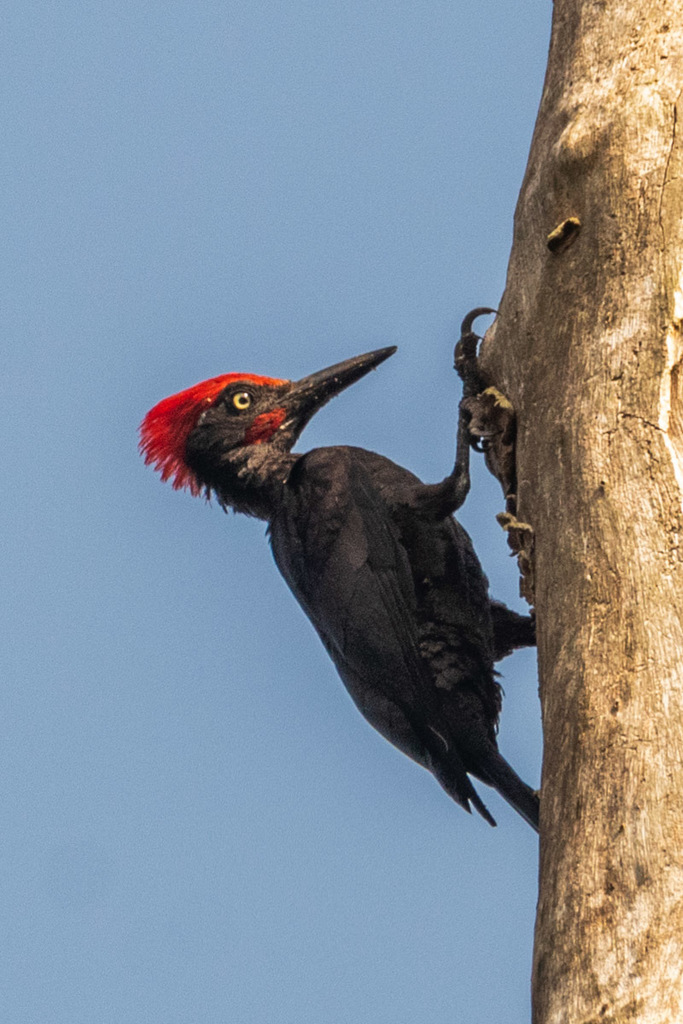
The Andaman woodpecker (Dryocopus hodgei) is a species of bird in the family Picidae. It is endemic to the Andaman Islands in India. Its natural habitat is subtropical or tropical moist lowland forests. It is threatened by habitat loss.
From the article Andaman woodpecker on Wikipedia (CC BY-SA), quoted section by section
Description
The Andaman woodpecker is around 38 cm (15 in) long and weighs between 156–255 g (5.5–9.0 oz). The plumage is mostly slate-grey to black, with a bright red crest. The male also has a red crown and malar area under the eye. The bare skin around the eye is grey, and the legs are slaty coloured, and the bill is black. The irises are pale yellow. Juvenile birds look like adults but have browner, duller plumage and brown eyes, and may have with feathers in the crown. The species differs from the white-bellied woodpecker in not having a white belly and having more slate-coloured plumage (as opposed to black).
Range & habitat
The Andaman woodpecker is endemic to the Andaman Islands, where it is found in the rain forests of the lowlands. The species is threatened by the loss of habitat, as the human population of the Andaman Islands increases and clears forests for agriculture. Because of this threat, the International Union for Conservation of Nature (IUCN) has assessed it as being vulnerable to extinction.
Wikipedia: “Habitat and threats”
What it does
Little is recorded about the behaviour of the Andaman woodpecker. It lives in pairs, but also associates in small flocks. It forages on large trunks and branches, but has also been recorded foraging on the ground for ants. It has been recorded breeding between January and March, and breeds in a nest hole 6–14 m (20–46 ft) off the forest floor, in a dead tree. Two eggs are laid.
Wikipedia: “Behaviour”
Listen
Looking for field recordings…
Where it lives
Recorded sightings
—
geo-referenced records in GBIF, from museums, herbaria and field observers.
Drag the globe to turn it. Dots are where records exist, not a range map; darker means more records.
In the stacks
Searching the stacks…
Every page naming Dryocopus hodgei in the Biodiversity Heritage Library →
This page is assembled live from iNaturalist, GBIF, Wikipedia, the Source Library and the Internet Archive. It is not yet part of the hand-edited codex. iNaturalist taxon 17865.