- Fungi Including Lichens
- ›Basidiomycete Fungi
- ›Higher Basidiomycetes
- ›Mushrooms, Bracket Fungi, Puffballs, and Allies
- ›Phallomycetidae
- ›stinkhorns and allies
- ›stinkhorns
- ›Mutinus
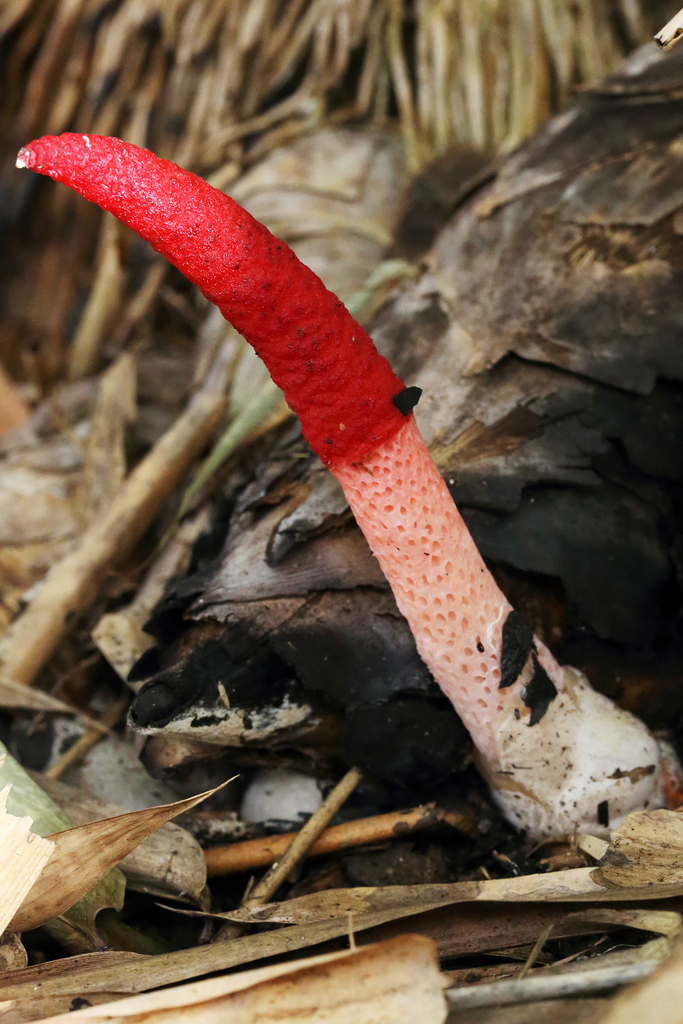
Bamboo Dipstick
Mutinus bambusinus
Mutinus bambusinus, the bamboo dipstick, is a fungus in the family phallaceae. It is found in the tropics most commonly in Asia where it grows in decaying wood, bamboo groves and such. Similar to other stinkhorns in the genus Mutinus, M. bambusinus appears not to feature a distinct cap. Instead, the gleba can be found covering parts of the upper stipe.
From the article Mutinus bambusinus on Wikipedia (CC BY-SA), quoted section by section
Description
Mutinus bambusinus is a saprobe, it gets its nutrients by decaying matter, most commonly decaying wood. The fruiting bodies appear as a red-white stalk that tapers evenly to the tip similar to Mutinus elegans. Likewise, Mutinus ravenelii is less 'pointy' compared to M. elegans and M. bambusinus. It generally reaches (6-10 cm) tall and is usually covered in gleba in newly erupted ones. Flies and other insects will become attracted to the smell and feed on the gleba, inadvertently becoming covered in spores and carrying them away.
Range & habitat
It is typically found in the tropics of Asia but there are reports in the Caribbean, American tropics and rarely in Africa.
== References ==
Wikipedia: “Range”
Where it lives
Recorded sightings
—
geo-referenced records in GBIF, from museums, herbaria and field observers.
Drag the globe to turn it. Dots are where records exist, not a range map; darker means more records.
In the stacks
Searching the stacks…
Every page naming Mutinus bambusinus in the Biodiversity Heritage Library →
This page is assembled live from iNaturalist, GBIF, Wikipedia, the Source Library and the Internet Archive. It is not yet part of the hand-edited codex. iNaturalist taxon 179111.