- Fungi Including Lichens
- ›Basidiomycete Fungi
- ›Higher Basidiomycetes
- ›Mushrooms, Bracket Fungi, Puffballs, and Allies
- ›Agaricomycetidae
- ›Common Gilled Mushrooms and Allies
- ›Agaricineae
- ›Field Mushrooms and Allies
- ›Agariceae
- ›Agaricus
- ›Flavoagaricus
- ›Arvenses
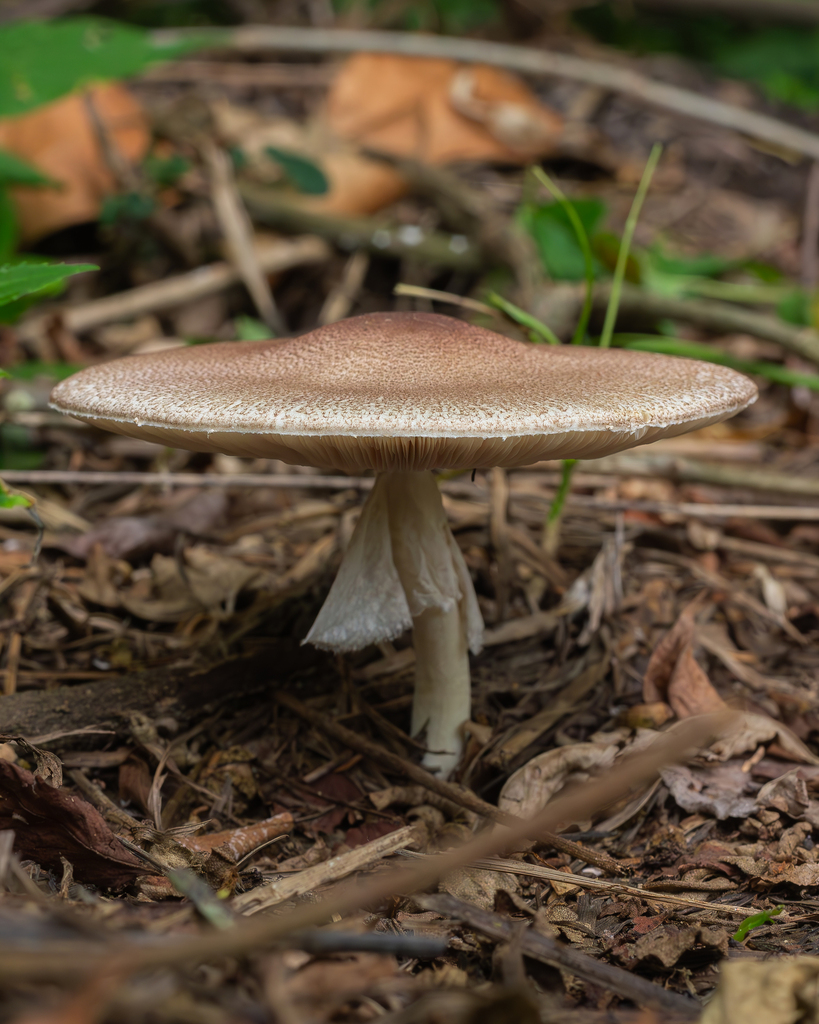
almond mushroom
Agaricus subrufescens
Agaricus subrufescens (syn. Agaricus blazei, Agaricus brasiliensis or Agaricus rufotegulis) is a species of mushroom, commonly known as almond mushroom, mushroom of the sun, God's mushroom, mushroom of life, royal sun agaricus, jisongrong, or himematsutake (Chinese: 姬松茸, Japanese: 姫まつたけ, "princess matsutake") and by a number of other names. Agaricus subrufescens is edible, with a somewhat sweet taste and a fragrance of almonds.
From the article Agaricus subrufescens on Wikipedia (CC BY-SA), quoted section by section
Description
The cap is initially hemispherical, later becoming convex, with a diameter of 5 to 25 centimetres (2 to 10 inches). The color of the cap may range from white to grayish or dull reddish brown; it stains yellow in KOH. Its surface is covered with silk-like fibers, although in maturity it develops small scales (squamulose). The cap margin typically splits with age. The flesh is white, and has the taste of "green nuts", with the odor of almonds. The gills are not attached to the stalk (free), narrow, and crowded closely together. They start out whitish in color, then later pinkish, and finally black-brown as the spores mature. The spore print is brown. The spores are ellipsoid, smooth, dark purplish-brown when viewed microscopically, with dimensions of 5.5–7 by 4–5 μm. The stipe is 6 to 15 cm (2+1⁄2 to 6 in) long and 1 to 4 cm (1⁄2 to 1+1⁄2 in) thick, and sometimes bulbous at the base. Initially solid, the stipe becomes hollow with age; it is cottony (floccose) to scaly toward the base. The annulus is abundant and double-layered; it is bent downward toward the stem, smooth and whitish on the upper side, and covered with cottony scales on the lower side. A type of ergostane-type compounds called blazeispirols have been isolated from A. subrufescens.
Range & habitat
A. subrufescens forms fruit bodies singly or in clusters in leaf litter in rich soil, often in domestic habitats. Originally described from the northeastern U.S. and Canada, it has been found growing in California, Hawaii, Great Britain, the Netherlands, Taiwan, Japan, Philippines, Iran, Australia, Brazil, and Uruguay.
Wikipedia: “Distribution and habitat”
At the table
The mushroom is edible for most people, with a somewhat sweet almond-like aroma and flavor resulting from benzaldehyde, benzyl alcohol, benzonitrile, and methyl benzoate. Used in traditional and alternative medicine for supposed anti-cancer effects, Agaricus mushrooms have not been assessed by sufficient high-quality clinical research to define safety and biological properties upon consumption as a food, dietary supplement, or drug.
Wikipedia: “Uses”
Toxicity
Preliminary research indicates Agaricus subrufescens may have toxic effects on liver function marked by increased serum level of liver enzymes, especially in people with ovarian cancer, and may cause allergic reactions. Contrary to concerns about possible hepatotoxicity, multiple peer-reviewed studies suggest that A. subrufescens (A. blazei Murill) exhibits hepatoprotective effects rather than toxicity in both human and animal models.
Clinical Study in Hepatitis B Patients: A 12-month open-label clinical study observed that 1,500 mg/day of A. blazei extract significantly reduced serum liver enzyme levels (ALT and AST) in chronic hepatitis B patients, indicating improved liver function without any adverse effects. No liver toxicity or renal abnormalities were reported in the patients throughout the study period. Animal Studies on Alcohol and CCl4-Induced Liver Injury: Experimental models in rats demonstrated that ABM extract has protective and antioxidant effects against liver injury caused by alcohol and carbon tetrachloride (CCl4). These studies reported normalization of liver enzymes, increased antioxidant levels (GSH, vitamins C and E), and reduced lipid peroxidation, without evidence of liver toxicity. The U.S. …
Where it lives
Recorded sightings
—
geo-referenced records in GBIF, from museums, herbaria and field observers.
Drag the globe to turn it. Dots are where records exist, not a range map; darker means more records.
In the stacks
Searching the stacks…
Every page naming Agaricus subrufescens in the Biodiversity Heritage Library →
This page is assembled live from iNaturalist, GBIF, Wikipedia, the Source Library and the Internet Archive. It is not yet part of the hand-edited codex. iNaturalist taxon 179249.