- Animals
- ›Arthropods
- ›Hexapods
- ›Insects
- ›Winged and Once-winged Insects
- ›Grasshoppers, Crickets, and Katydids
- ›Grasshoppers, Locusts, and Allies
- ›Grasshoppers
- ›Short-horned Grasshoppers and Locusts
- ›Short-horned Grasshoppers
- ›Spur-throated Grasshoppers
- ›Dactylotini
- ›Dactylotum
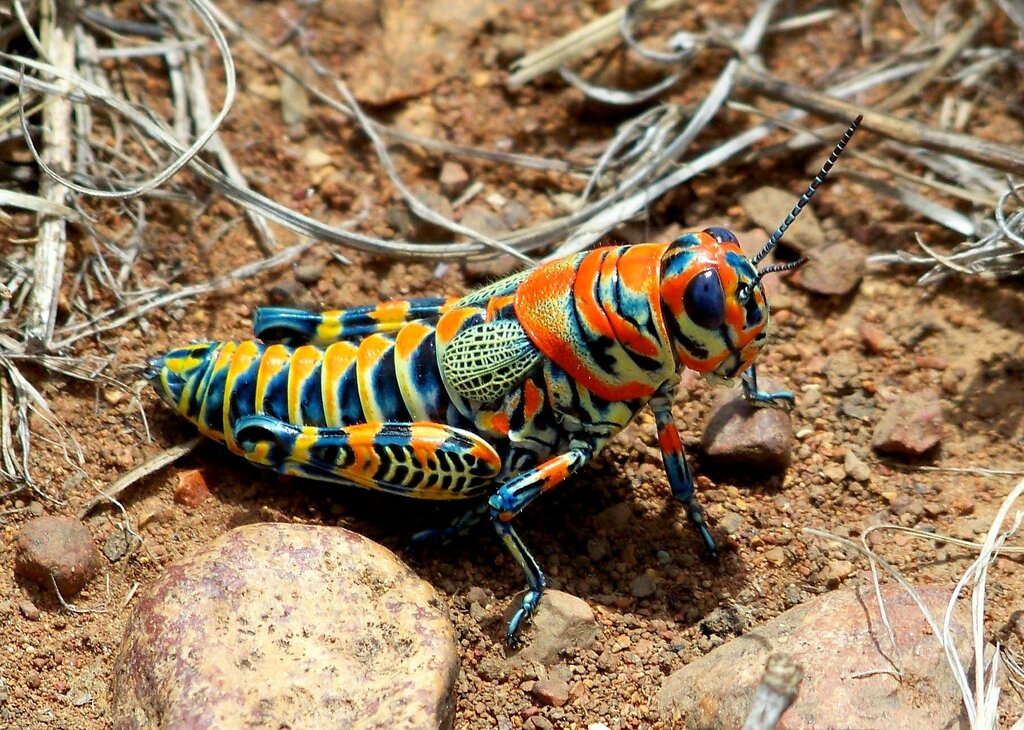
Rainbow Grasshopper
Dactylotum bicolor
Dactylotum bicolor, also known as the rainbow grasshopper, painted grasshopper, pictured grasshopper, or the barber pole grasshopper, is a species of grasshopper in the family Acrididae. It is native to the United States, Canada and northern Mexico and exhibits aposematism (warning coloration). It was first described by the German entomologist Toussaint de Charpentier in 1843.
From the article Dactylotum bicolor on Wikipedia (CC BY-SA), quoted section by section
Description
Dactylotum bicolor grows to an average length of about 20 mm (0.8 in) for males and 35 mm (1.4 in) for females. It is mainly black with distinctive reddish and yellowish markings, a pale green prothorax and pale green wingpads. The tibia of the hind leg bears six to eight spines. This species does not develop wings and is unable to fly. Three subspecies are recognised:
D. b. bicolor – Northern Texas, New Mexico and Mexico D. b. pictum – Northern and eastern part of range D. b. variegatum – Southern Arizona and western part of range The coloring varies across the insect's range, with D. b. pictum being black with little red, D. b. variegatum having distinct red markings, and D. b. bicolor having a purplish or violet sheen to the background black color. Before the discovery of Dichroplus silveiraguidoi in Uruguay in 1956, Dactylotum bicolor had the lowest known number of chromosomes among grasshopper species, with seventeen acrocentric chromosomes.
Range & habitat
It is found in shortgrass prairie, desert grasslands, thinly vegetated areas and alfalfa fields throughout the western Great Plains of the United States (and southern Canada), southward to Arizona, New Mexico, Texas, and into northern Mexico.
Wikipedia: “Distribution and habitat”
Listen
Looking for field recordings…
Where it lives
Recorded sightings
—
geo-referenced records in GBIF, from museums, herbaria and field observers.
Drag the globe to turn it. Dots are where records exist, not a range map; darker means more records.
In the stacks
Searching the stacks…
Every page naming Dactylotum bicolor in the Biodiversity Heritage Library →
This page is assembled live from iNaturalist, GBIF, Wikipedia, the Source Library and the Internet Archive. It is not yet part of the hand-edited codex. iNaturalist taxon 179324.