- Animals
- ›Chordates
- ›Vertebrates
- ›Birds
- ›Woodpeckers and Allies
- ›Woodpeckers
- ›Typical woodpeckers
- ›Pied woodpeckers and allies
- ›Dendrocopos
On eBird ↗
Sind Woodpecker
Live sightings near you, the range map, bar charts of when it is seen, and Macaulay Library photos and recordings.
Sind Woodpecker
Dendrocopos assimilis
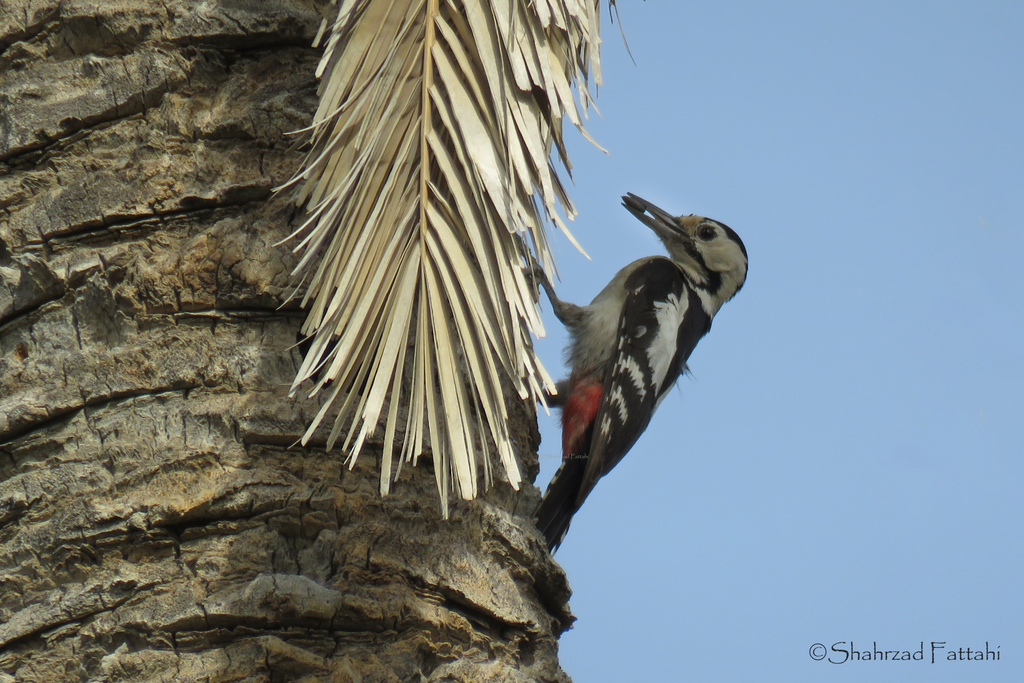
The Sind woodpecker (Dendrocopos assimilis) is a species of bird in the family Picidae. It is found in India, Iran, and Pakistan. Its natural habitat is subtropical or tropical dry forests.
From the article Sind woodpecker on Wikipedia (CC BY-SA), quoted section by section
Description
Sind woodpeckers are similar to Syrian woodpecker in appearance, but is slightly smaller (20–22 cm, versus 23 cm), with a thin moustachial stripe, and extensive white feathers on their back and smaller beak. Sind woodpeckers have large white shoulder patches and white bars on its black feathers. The males have a red crown with a fine black line at the sides, females an all-black crown; both have a white forehead. As with most other Dendrocopos woodpeckers, it has red under-tail coverts. In most of its range it is the only black and white woodpecker, except for parts of east-central Pakistan and westernmost India, where it overlaps with yellow-crowned woodpecker (Leiopicus mahrattensis).
Range & habitat
The woodpecker is a resident bird and native to Sindh in Pakistan, India and southern Iran. They have moderate forest reliance and can be found up to the altitude of 2,200 metres, but are also found in rural gardens and plantations. Naturally they are found in tropical and subtropical dry forests, riverine forests, thorny shrub-lands, dry scrub-lands and wetlands like freshwater springs and oases. They are non-migratory birds, with mostly population dispersing after breeding locally. The diet mostly consist of insects, including woodboring beetles, larvae, spiders and ants.
Wikipedia: “Distribution and diet”
What it does
The breeding season occurs between March and April. These species are monogamous, with both the parents raising the young ones; they nest in tree holes excavated by the breeding pair. They lay about 3 to 5 eggs, with both the parents incubating them. The chicks hatch after 12 days of incubation and fledgling occurs after 20 days. The juvenile disperse to new location.
Wikipedia: “Reproduction”
Listen
Looking for field recordings…
Where it lives
Recorded sightings
—
geo-referenced records in GBIF, from museums, herbaria and field observers.
Drag the globe to turn it. Dots are where records exist, not a range map; darker means more records.
In the stacks
Searching the stacks…
Every page naming Dendrocopos assimilis in the Biodiversity Heritage Library →
This page is assembled live from iNaturalist, GBIF, Wikipedia, the Source Library and the Internet Archive. It is not yet part of the hand-edited codex. iNaturalist taxon 17964.