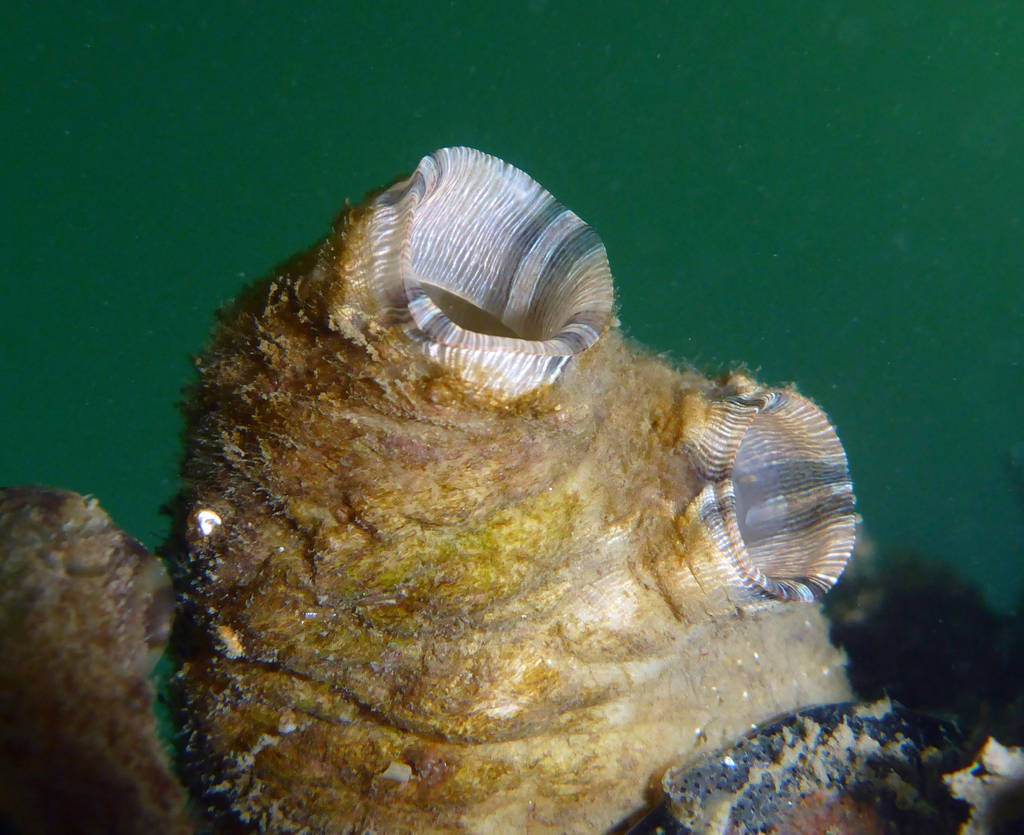
Pleated Sea Squirt
Styela plicata
Styela plicata is a tropical to temperate tunicate that has invaded the Gulf of Mexico by hitching a ride on ships' hulls. This sessile filter feeder can expel water when threatened, leading to the name “sea squirt.” This species is rather hardy; “able to tolerate changes in seawater between 10°-30°C and salinites between 22%-34%” (Thiyagarajan & Qian, 2003) as well as pollution and brackish water. This species is difficult to manage because of the large amount...
From the article Styela plicata on Wikipedia (CC BY-SA), quoted section by section
Description
Styela plicata is a solitary tunicate. Tadpole larvae measure around 1.3 millimetres (0.051 in). Adults become sexually mature at around 40 millimetres (1.6 in), and were observed to reach this stage in laboratory after around two months in summer and five months in winter. Individuals live for three to four months after sexual maturity, independently of seasonal variations, and grow to a maximum size of 60 to 80 millimetres (2.4 to 3.1 in). The adults are a grayish or tannish-white color with red or purple stripes on the siphon. Unlike the similar species in the genus, such as Styela clava and Styela montereyensis, S. plicata does not have a stalk in its adult form.
Wikipedia: “Description and life cycle”
Range & habitat
In spite of Styela plicata's broad geographical distribution, its native range is still unclear. In 2021, an analysis of 368 individuals for the COI marker genes and 315 for the ANT marker gene from 17 worldwide locations revealed that S. plicata has been present in all studied oceans for a long time. Recurrent colonization events and occasional shuffling among populations have determined the actual genetic structure of this species. Though the native range of S. plicata is unclear, the prevailing hypothesis is that they originated in the Northwest of the Pacific Ocean and then spread to other warm-water and tropical water bodies by ship fouling. As of 2021, genetic analyses remained inconclusive to either support or refute this hypothesis. The range of Styela plicata has greatly expanded due to its ability to hitch a ride on ships' hulls. Long-distance dispersal of S. plicata most likely takes place through international shipping, while short-distance local dispersals take place through recreational boating and local traffic. Preventative measures include anti-fouling paints, wood preservation, and slime control containing tributyltin.
Wikipedia: “Distribution”
Where it lives
Recorded sightings
—
geo-referenced records in GBIF, from museums, herbaria and field observers.
Drag the globe to turn it. Dots are where records exist, not a range map; darker means more records.
In the stacks
Searching the stacks…
Every page naming Styela plicata in the Biodiversity Heritage Library →
This page is assembled live from iNaturalist, GBIF, Wikipedia, the Source Library and the Internet Archive. It is not yet part of the hand-edited codex. iNaturalist taxon 179830.