- Animals
- ›Chordates
- ›Vertebrates
- ›Birds
- ›Woodpeckers and Allies
- ›Woodpeckers
- ›Typical woodpeckers
- ›Pied woodpeckers and allies
- ›Veniliornis
On eBird ↗
Scarlet-backed Woodpecker
Live sightings near you, the range map, bar charts of when it is seen, and Macaulay Library photos and recordings.
Scarlet-backed Woodpecker
Veniliornis callonotus
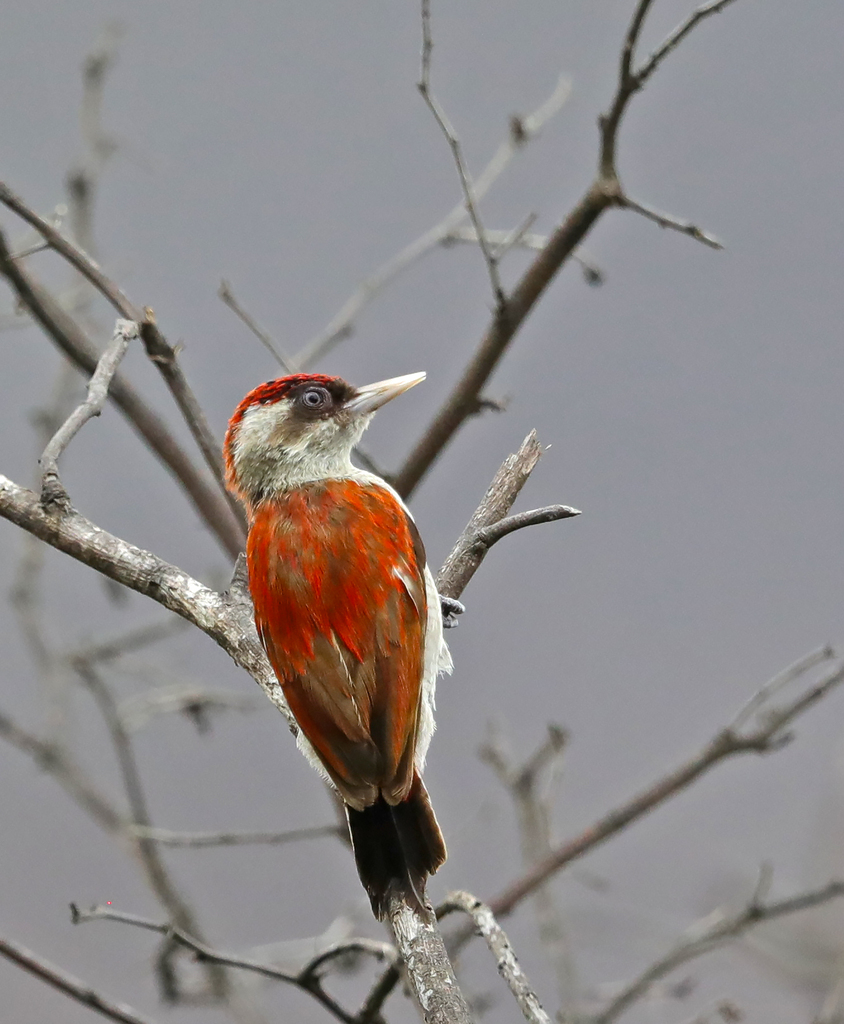
The scarlet-backed woodpecker (Veniliornis callonotus) is a species of bird in the family Picidae. It is found in Colombia, Ecuador and northern Peru where its natural habitats are subtropical or tropical dry forests and subtropical or tropical dry shrubland. It is listed by the International Union for Conservation of Nature as being a species of "least concern".
From the article Scarlet-backed woodpecker on Wikipedia (CC BY-SA), quoted section by section
Description
The scarlet-backed woodpecker is about 13 cm (5.1 in) long and weighs 23 to 33 g (0.81 to 1.2 oz). Males and females have the same plumage except on their heads. Adults of both sexes of the nominate subspecies have a generally grayish brown and white face. Males are red from forehead to nape with black tips on many feathers. The female is entirely black there. Both sexes' upperparts are brownish-scarlet. Their flight feathers are dark brown with redder secondaries and tertials. Their tail is blackish-brown whose central pair of feathers is blacker and the outer pair whitish yellow with black bars. Their underparts are white with a very light buff wash and sometimes darker but faint vermiculation. The iris is deep brown (occasionally deep red), the beak yellowish with darker base and tip, and the legs are greenish gray. Juveniles have heavy olive or grayish mottling on their upperparts and are buffier white on their underparts. Their head pattern is more diffuse than the adults'. Adults of subspecies V. c. major have a darker face and darker vermiculation on the underparts than the nominate.
Range & habitat
The nominate subspecies of scarlet-backed woodpecker is found from Colombia's Nariño Department south through western Ecuador to Guayas Province. V. c. major is found from El Oro and Loja provinces in Ecuador south into Peru as far as La Libertad Department. The species inhabits arid scrublands, dry deciduous woodland, semi-humid forest, dense riparian forest, and sometimes partially cleared areas. In elevation it mostly occurs from near sea level to 1,000 m (3,300 ft), less frequently to 1,500 m (4,900 ft) in Peru, and locally as high as 1,800 m (5,900 ft) in Ecuador.
Wikipedia: “Distribution and habitat”
What it does
The scarlet-backed woodpecker forages at all levels of the forest, usually on small branches and thin twigs, and often in pairs. No details of its diet are known.
Wikipedia: “Feeding”
Listen
Looking for field recordings…
Where it lives
Recorded sightings
—
geo-referenced records in GBIF, from museums, herbaria and field observers.
Drag the globe to turn it. Dots are where records exist, not a range map; darker means more records.
In the stacks
Searching the stacks…
Every page naming Veniliornis callonotus in the Biodiversity Heritage Library →
This page is assembled live from iNaturalist, GBIF, Wikipedia, the Source Library and the Internet Archive. It is not yet part of the hand-edited codex. iNaturalist taxon 18026.