- Animals
- ›Arthropods
- ›Crustaceans
- ›Typical Crustaceans
- ›Malacostracans
- ›Decapods, Isopods, and allies
- ›Decapods and Krill
- ›Decapods
- ›Crabs, Lobsters, Shrimps, and Allies
- ›Caridean Shrimps
- ›Pandaloidea
- ›Pandalid Shrimp
- ›Pandalus
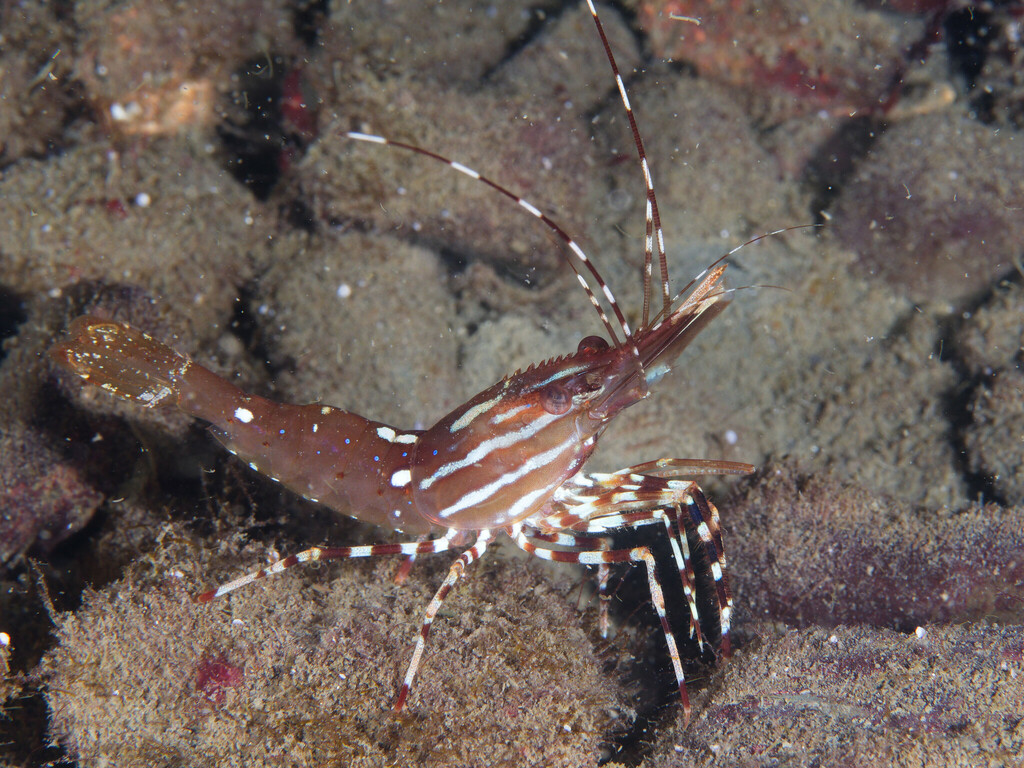
California Spot Prawn
Pandalus platyceros
Pandalus platyceros, commonly known as the spot prawn or spot shrimp), is a species of true shrimp in the family Pandalidae. Spot prawns are sometimes referred to by regionally qualified names such as BC spot prawn, California spot prawn, and Alaskan prawn among others.
From the article Pandalus platyceros on Wikipedia (CC BY-SA), quoted section by section
Description
Spot prawn reach up to 27 centimeters in length, with females often longer than their male counterparts. Spot prawn have a translucent, reddish carapace with white stripes and pereopods and antennae which are banded dark and light red. Their first and fifth abdominal segments have white spots. They are protandric hermaphrodites, meaning they first turn into males, with their appendix masculina lengthening while maturing and then gradually shortening until they turn into females.
Range & habitat
The spot prawn ranges throughout the northern Pacific Ocean, (Unalaska Island, Alaska to San Diego, California), and also from the Sea of Japan to Korea Strait. While found in depths of 3.7 meters to 457.2 meters, spot prawn are most often found around 109.7 meters below sea level.
Wikipedia: “Distribution”
At the table
Spot prawns are renowned around the world for their flavour, freshness, and quality. Their meat has a sweet delicate flavour and firm texture.
They are often sold in Japan as 'Botan ebi' despite not being one of the 2 traditional domestic shrimp (Toyama ebi and Humpback Shrimp). This is because the spot prawn is a close relative of domestic Botan ebi and they can only be told apart by examining the head closely. Furthermore, one does not taste better than the other.
== References ==
Wikipedia: “In cuisine”
Where it lives
Recorded sightings
—
geo-referenced records in GBIF, from museums, herbaria and field observers.
Drag the globe to turn it. Dots are where records exist, not a range map; darker means more records.
In the stacks
Searching the stacks…
Every page naming Pandalus platyceros in the Biodiversity Heritage Library →
This page is assembled live from iNaturalist, GBIF, Wikipedia, the Source Library and the Internet Archive. It is not yet part of the hand-edited codex. iNaturalist taxon 180394.