- Animals
- ›Chordates
- ›Vertebrates
- ›Birds
- ›Woodpeckers and Allies
- ›Woodpeckers
- ›Typical woodpeckers
- ›Green Woodpeckers, Flickers, and Allies
- ›Celeus
On eBird ↗
Kaempfer's Woodpecker
Live sightings near you, the range map, bar charts of when it is seen, and Macaulay Library photos and recordings.
Kaempfer's Woodpecker
Celeus obrieni
The Kaempfer's woodpecker (Celeus obrieni), also known as Piauí woodpecker, is a species of woodpecker from Brazil. The type specimen, a female, was collected in the Brazilian state of Piauí in 1926. No other individuals were collected or seen and the bird was feared extinct, until a male was captured by Advaldo Dias do Prado during mist netting in 2006 in the state of Tocantins. It was known as the Caatinga woodpecker for some time, but...
From the article Kaempfer's woodpecker on Wikipedia (CC BY-SA), quoted section by section
Description
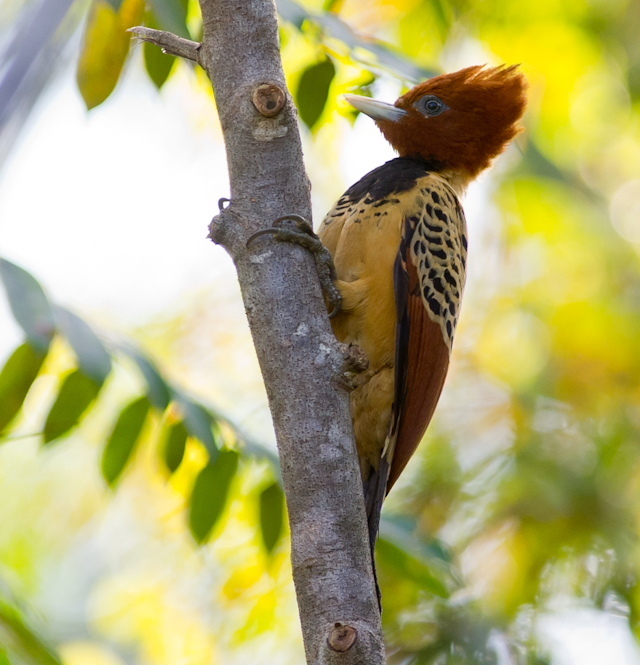
Kaempfer's woodpecker is 26.5 to 38 cm (10 to 15 in) long and weighs 85 to 105 g (3.0 to 3.7 oz). Both sexes have a rufous-red head with a bushy crest. Adult males have a bright red malar patch and some red behind the eye and onto the crest; females do not have any bright red. Both sexes' hindneck and upperparts are yellow to creamy buff with a few black bars on the mantle and scapulars. Their flight feathers are chestnut to reddish chestnut except the tertials, which are pale yellowish buff with a rufous tinge and a few dark bars. Their tail is black. Their throat and breast are black and the rest of their underparts pale yellowish buff, with usually a few black bars or spots just below the breast. Their bill is pale yellow or creamy, their iris black, and their legs grayish. Juveniles are overall duller, have a mostly chocolate-brown head, a reddish brown crest, and a light buffish mantle with no dark bars.
Range & habitat
Between the 1926 collection and 2006, no other individuals of Kaempfer's woodpecker were seen and the bird was feared extinct. In October of 2006 a male was captured during mist netting in the state of Tocantins, about 350 km (220 mi) from the 1926 site. Since then at least 25 individuals have been documented and at least three overlooked specimens have been discovered. The sightings and specimens are scattered throughout an area of about 800,000 km2 (310,000 sq mi) in the northeastern Brazilian states of Maranhão, Piauí, Tocantins, Goiás, and Mato Grosso. Little is known about the habitat preference of Kaempfer's woodpecker, but it appears to be associated with bamboo (specifically Guadua paniculata) growing in Cerrado and babassu palm forest.
Wikipedia: “Distribution and habitat”
What it does
The diet of Kempfer's woodpecker appears to be mostly ants, especially those like Camponotus depressus and Azteca fasciata which are found in bamboo. It has been noted foraging singly, in pairs, and in family groups. It captures its prey by drilling holes in dry bamboo to access ant nests inside.
Wikipedia: “Feeding”
Listen
Looking for field recordings…
Where it lives
Recorded sightings
—
geo-referenced records in GBIF, from museums, herbaria and field observers.
Drag the globe to turn it. Dots are where records exist, not a range map; darker means more records.
In the stacks
Searching the stacks…
Every page naming Celeus obrieni in the Biodiversity Heritage Library →
This page is assembled live from iNaturalist, GBIF, Wikipedia, the Source Library and the Internet Archive. It is not yet part of the hand-edited codex. iNaturalist taxon 18062.