- Animals
- ›Chordates
- ›Vertebrates
- ›Birds
- ›Woodpeckers and Allies
- ›Woodpeckers
- ›Typical woodpeckers
- ›Green Woodpeckers, Flickers, and Allies
- ›Celeus
On eBird ↗
Waved Woodpecker
Live sightings near you, the range map, bar charts of when it is seen, and Macaulay Library photos and recordings.
Waved Woodpecker
Celeus undatus
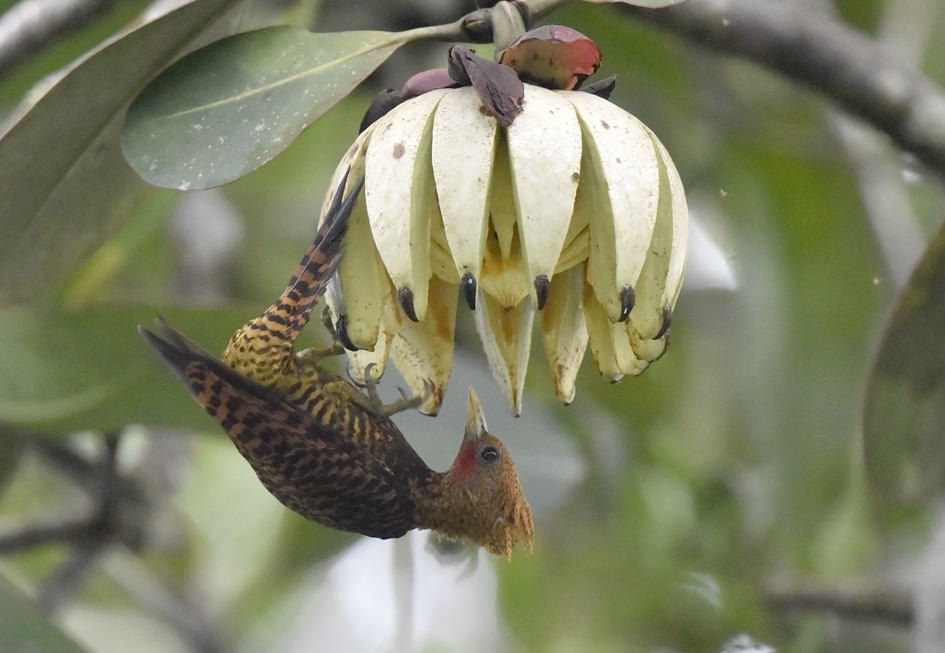
The waved woodpecker (Celeus undatus) is a species of bird in the family Picidae, the woodpeckers. It is found in the Guianas of Guyana, Suriname and French Guiana; also eastern border regions of Venezuela and the northeast Amazon Basin of northern Brazil including Marajo Island, Ilha de Marajo. Its natural habitat is subtropical or tropical moist lowland forests.
From the article Waved woodpecker on Wikipedia (CC BY-SA), quoted section by section
Description
The waved woodpecker is about 23 to 26 cm (9.1 to 10.2 in) long and weighs 61 to 87 g (2.2 to 3.1 oz). In the nominate subspecies C. u. undatus, both sexes' heads are light chestnut-rufous with a bushy crest; the crest is sometimes paler with black bars, and the ear coverts and the sides of the neck have black streaks. Males have a wide red band from behind the bill to the ear coverts; females lack it. Both sexes of adults have a cinnamon-buff chin and throat with black spots or bars. They have rufous-chestnut upperparts with wide black bars, though the rump is usually paler and yellower. Their flight feathers are black with cinnamon-rufous bars. The top side of their tail is black with rufous bars and the underside similar but duller and sometimes with a yellowish tinge. Their underparts are rufous, lighter on the belly than the breast. Their breast has irregular wavy black bars and the belly and flanks more regular bars. Both sexes have some variation in the intensity of their barring, but the female's is generally heavier than the male's. The adult's shortish bill is dull yellow to yellow-green, their iris red-brown to red, and their legs green-gray. Juveniles are very similar to adults but duller overall and have lighter barring above. Subspecies C. u. amacurensis is darker and more chestnut than the nominate. …
Range & habitat
The subspecies of the waved woodpecker are found thus:
C. u. amacurensis, northeastern Venezuela's Delta Amacuro state C. u. undatus, eastern Venezuela, Guyana, Suriname, French Guiana and northeastern Brazil north of the Amazon and west of the Rio Negro C. u. multifasciatus, northeastern Brazil south of the Amazon between central Pará and Maranhão C. u. verreauxii, from south-central Colombia into eastern Ecuador C. u. grammicus, from southeastern Colombia and southern Venezuela south to northeastern and eastern Peru and western Brazil as far east as the lower Rio Negro and Rio Purus; also French Guiana C. u. subcervinus, Brazil south of the Amazon between the Rio Purus and the Rio Tapajós and south into Mato Grosso C. u. latifasciatus, southeastern Peru, southwestern Brazil, and northern Bolivia The waved woodpecker primarily inhabits a variety of wooded landscapes including the interior and edges of rainforest, terra firme and várzea forest, secondary forest, and treed savannah. In most of its range it occurs between 100 and 900 m (300 and 3,000 ft) but is found locally as high as 1,140 m (3,700 ft); in Ecuador it reaches only 500 m (1,600 ft).
Wikipedia: “Distribution and habitat”
What it does
The waved woodpecker's primary food is ants and termites; it also eats sap, seeds, fruits, and berries. It usually forages singly, in pairs, or in small family groups, but does join mixed-species feeding flocks. In the forest interior it forages on tree trunks, branches, and vines from the mid-level to the canopy. It captures prey by pecking, probing, and gleaning.
Wikipedia: “Feeding”
Listen
Looking for field recordings…
Where it lives
Recorded sightings
—
geo-referenced records in GBIF, from museums, herbaria and field observers.
Drag the globe to turn it. Dots are where records exist, not a range map; darker means more records.
In the stacks
Searching the stacks…
Every page naming Celeus undatus in the Biodiversity Heritage Library →
This page is assembled live from iNaturalist, GBIF, Wikipedia, the Source Library and the Internet Archive. It is not yet part of the hand-edited codex. iNaturalist taxon 18063.