- Animals
- ›Chordates
- ›Vertebrates
- ›Birds
- ›Woodpeckers and Allies
- ›Woodpeckers
- ›Typical woodpeckers
- ›Green Woodpeckers, Flickers, and Allies
- ›Celeus
On eBird ↗
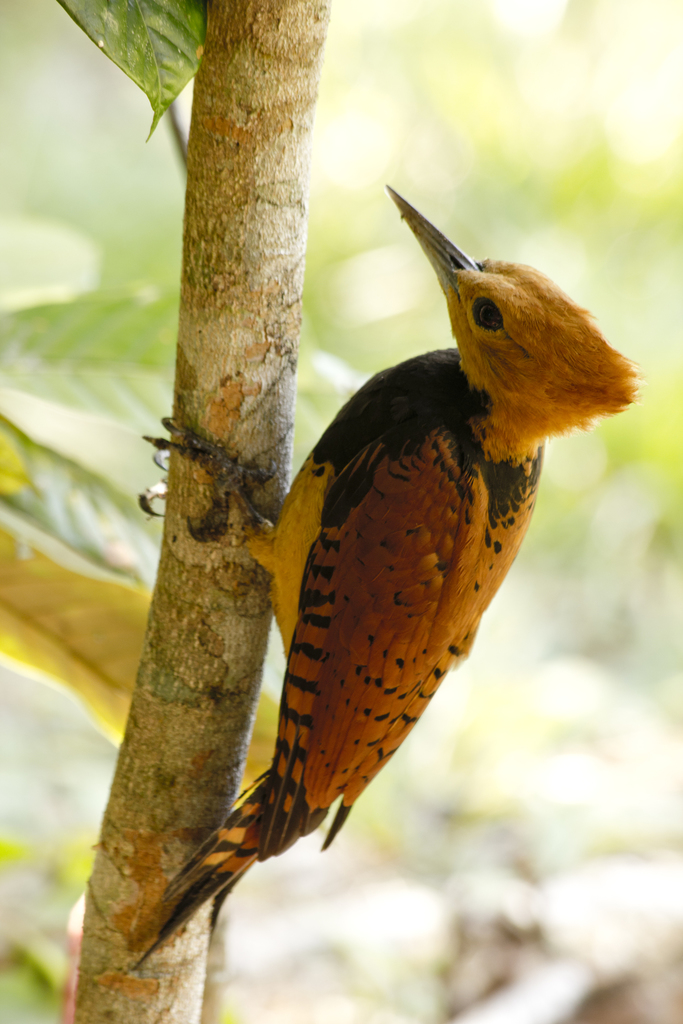
Ringed Woodpecker
Live sightings near you, the range map, bar charts of when it is seen, and Macaulay Library photos and recordings.
Ringed Woodpecker
Celeus torquatus
The ringed woodpecker (Celeus torquatus) is a species of bird in the family Picidae, the woodpeckers, piculets, and wrynecks. It is found in northern Brazil, French Guiana, Guyana, Suriname, and western Venezuela. Its natural habitats are subtropical or tropical moist lowland forests and subtropical or tropical swamps.
From the article Ringed woodpecker on Wikipedia (CC BY-SA), quoted section by section
Description
The ringed woodpecker is 26 to 29 cm (10 to 11 in) long. The nominate subspecies C. t. torquatus weighs 107 to 124 g (3.8 to 4.4 oz) and C. t. occidentalis weighs 122 to 135 g (4.3 to 4.8 oz); weight data are lacking for C. t. tinnunculus. Both sexes of all subspecies have a pale cinnamon head with a rufous tinge and a moderately bushy crest. The sexes differ only on their faces: Adult males of all subspecies have a red patch from the malar area to under the ear coverts, and sometimes have some red elsewhere on the head; females have no red on the head. Adults of the nominate subspecies have a black lower throat, breast, and upper mantle. Their upperparts from the lower mantle to the uppertail coverts are rufous brown. There are usually a few black feathers on the lower mantle and black marks and bars on the wing coverts. Their flight feathers are barred black and rufous, with blackish brown tips on the primaries and more rufous on the secondaries. Their tail is rufous with narrow black bars and a wide black tip. They have unmarked cinnamon-buff underparts. All subspecies' bills are long with a maxilla that is various shades of gray or brown and a grayish white or greenish yellow mandible. Their iris is red to red-brown and their legs gray brown or dark gray. Juveniles resemble adults but have more black on their face and more barring on their upperparts. Subspecies C. t. …
Range & habitat
The subspecies of the ringed woodpecker are found thus:
C. t. torquatus, northeastern Venezuela, the Guianas, and northern Amazonian Brazil (The map shows only this subspecies' range) C. t. occidentalis, southeastern Colombia, southern Venezuela, northeastern Ecuador, eastern Peru, northern Bolivia, and western and central Amazonian Brazil C. t. tinnunculus, eastern Brazil's states of Bahia and Espírito Santo Subspecies C. t. torquatus and C. t. occidentalis mostly inhabit tall humid tropical forest, especially terra firme. They also occur in várzea and secondary forest, gallery forest, and cerrado. In elevation they range from about 100 m (300 ft) to 725 m (2,400 ft) in Peru, to 750 m (2,500 ft) in Bolivia, to 800 m (2,600 ft) in Amazonian Brazil, and 950 m (3,100 ft) in Venezuela. Subspecies C. t. tinnunculus is found only in large tracts of closed canopy Atlantic Forest between sea level and 100 m (300 ft).
Wikipedia: “Distribution and habitat”
What it does
The ringed woodpecker seems to have various foraging strategies in different parts of its range. In most it typically forages from the forest understorey to below the canopy, but in the west of its range appears to prefer from the mid-level up. It usually forages singly or in pairs, but also in small groups. In the north is sometimes joins mixed species feeding flocks. Its diet is not known in detail but includes ants, seeds, and fruit. It takes prey by gleaning, chiseling small holes into wood, and hammering to open arboreal termitaria.
Wikipedia: “Feeding”
Listen
Looking for field recordings…
Where it lives
Recorded sightings
—
geo-referenced records in GBIF, from museums, herbaria and field observers.
Drag the globe to turn it. Dots are where records exist, not a range map; darker means more records.
In the stacks
Searching the stacks…
Every page naming Celeus torquatus in the Biodiversity Heritage Library →
This page is assembled live from iNaturalist, GBIF, Wikipedia, the Source Library and the Internet Archive. It is not yet part of the hand-edited codex. iNaturalist taxon 18108.