- Plants
- ›Vascular Plants
- ›flowering plants
- ›Dicots
- ›Woodsorrels, Quandongs, and Allies
- ›quandong family
- ›Aristotelia
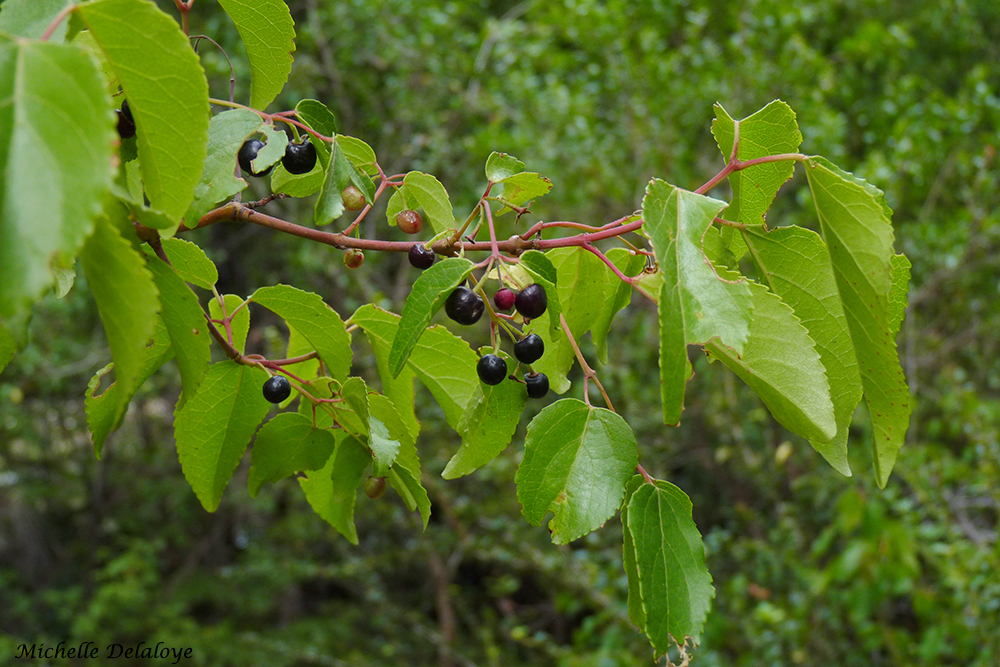
Chilean Wineberry
Aristotelia chilensis
Aristotelia chilensis, known as maqui or Chilean wineberry, is a tree species in the Elaeocarpaceae family native to South America in the Valdivian temperate forests of Chile and adjacent regions of southern Argentina. Limited numbers of these trees are cultivated in gardens for their small edible fruits. Wild-harvested fruits are commercially marketed.
The species has drawn attention for its forensic potential as it is reported to be among the first plants to grow around pig carcasses, which are experimental substitutes for human corpses, in southern Chile.
From the article Aristotelia chilensis on Wikipedia (CC BY-SA), quoted section by section
Range & habitat
Aristotelia chilensis is native to Chile and Argentina near the southwest coast of South America. It is found naturally in Chilean rainforests. Its native range spans the area between the Coquimbo and Aysén regions of Chile, and is 170,000 hectares (420,000 acres) in total.
Wikipedia: “Distribution”
What it does
Maqui berries are a favored food for birds at the end of summer. Deforestation of the Valdivian temperate forests in Chile suppresses seed dispersal by birds and leads to inbreeding depression. It is viewed as an invasive species in the Juan Fernandez Islands.
Wikipedia: “Ecology”
In medicine
Polyphenol research on maqui berries showed anthocyanin content to include eight glucoside pigments of delphinidin and cyanidin, with the principal anthocyanin being delphinidin 3-sambubioside-5-glucoside (34% of total anthocyanins). The average total anthocyanin content was 138 milligrams (2.13 gr) per 100 grams (3.5 oz) of fresh fruit, or 212 milligrams (3.27 gr) per 100 grams (3.5 oz) of dry fruit, ranking maqui berries low among darkly pigmented fruits for anthocyanin content (see table at anthocyanins). One study found that anthocyanins are also present in maqui leaves. Other phytochemicals extracted from the leaves were the alkaloids aristoteline, aristoquinoline, and aristone.
Wikipedia: “Phytochemicals”
How it is grown
The berries of A. chilensis are collected from wild plants from December to March of each year by families, mainly Mapuche, who collect their harvest near the Andes Mountains. The harvesting process involves collecting the side branches of trees, shaking them to separate the berries and leaves from the branches, and then employing a mechanical process to separate the berries from the leaves. In the Juan Fernandez Islands, the Juan Fernandez Women's Group has led efforts to reduce the presence of the species by encouraging local women to harvest to berries and create products for sale with them. The stored fruits are sold in local markets, with prices ranging from $6.5 to $15 per kilogram ($2.9 to $6.8/lb). The average area yield is about 220 kilograms (490 lb) per hectare annually, with an estimated yearly total of only 90 short tons (180,000 lb), due to remote access and difficulty of transportation. Aristotelia chilensis is planted in home gardens and is not grown on an orchard scale. Most of the fruits on the market have been gathered from the wild. Maqui is frost sensitive and fairly tolerant of seaside conditions. It prefers a well-drained soil in full sun, with some protection against cold, drying winds. The soil should be slightly acidic, with moderate fertility. Aristotelia chilensis can be planted in USDA zones 8 to 12. …
Wikipedia: “Harvesting and cultivation”
Where it lives
Recorded sightings
—
geo-referenced records in GBIF, from museums, herbaria and field observers.
Drag the globe to turn it. Dots are where records exist, not a range map; darker means more records.
In the stacks
Searching the stacks…
Every page naming Aristotelia chilensis in the Biodiversity Heritage Library →
This page is assembled live from iNaturalist, GBIF, Wikipedia, the Source Library and the Internet Archive. It is not yet part of the hand-edited codex. iNaturalist taxon 181593.