- Animals
- ›Chordates
- ›Vertebrates
- ›Birds
- ›Woodpeckers and Allies
- ›Woodpeckers
- ›Typical woodpeckers
- ›Pied woodpeckers and allies
- ›Melanerpes
On eBird ↗
Lewis's Woodpecker
Live sightings near you, the range map, bar charts of when it is seen, and Macaulay Library photos and recordings.
Lewis's Woodpecker
Melanerpes lewis
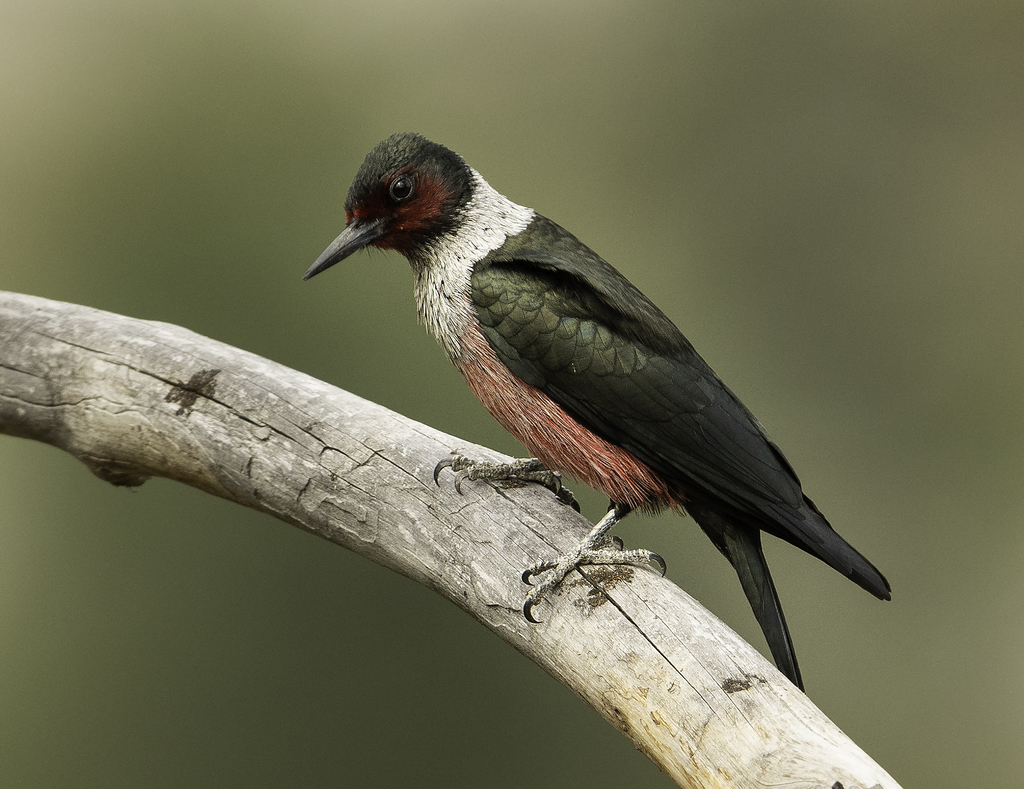
Lewis's woodpecker (Melanerpes lewis) is a large North American species of woodpecker which ornithologist Alexander Wilson named after Meriwether Lewis. Lewis was one of the explorers who surveyed the areas bought by the United States of America as part of the Louisiana Purchase and first described this species of bird.
From the article Lewis's woodpecker on Wikipedia (CC BY-SA), quoted section by section
Description
One of the largest species of American woodpeckers, Lewis's woodpecker can measure up to 10–11 inches (25–28 cm) in length. It is mainly reddish-breasted, blackish-green in color, with a black rump. It has a gray collar and upper breast, with a pinkish belly, and a red face. The wings are much broader than those of other woodpeckers, and it flies at a much more sluggish pace with slow, but even flaps similar to those of a crow. Its calls have a harsh sound relative to other woodpeckers', and it may use a repertoire of several phrases. They are one of the three largest Melanerpes woodpeckers in the world, being similar in size to the white woodpecker and the Jamaican woodpecker. Measurements:
Length: 10.2–11.0 in (26–28 cm) Weight: 3.1–4.9 oz (88–139 g) Wingspan: 19.3–20.5 in (49–52 cm)
Range & habitat
Lewis's woodpecker is locally common to the northwestern United States, dwelling mostly in open pine woodlands, and other areas with scattered trees and snags. Unlike other American woodpeckers, it enjoys sitting in the open as opposed to sitting in heavy tree cover. The migration patterns of the Lewis's Woodpecker are unclear due to their nomadic lifestyle and feeding habits. It ranges mostly in the western to central United States, but in the winter it can be found as far south as Southern California and the US border with Mexico. In the summer, it can be found as far north as Canada. It has been seen in five Midwestern states: South Dakota, Michigan, Illinois, Minnesota, and Wisconsin. Additionally, the woodpecker has been seen in California, Oregon, Washington, Idaho, Montana, Nevada, Colorado, New Mexico and Utah.
Wikipedia: “Range and Habitat”
What it does
Lewis's woodpecker engages in some rather un-woodpecker-like behavior in its gregarious feeding habits. Although it does forage for insects by boring into trees with its chisel-like bill, the bird also catches insects in the air during flight (typical insect hawking). This is a habit that only a few other woodpeckers, such as the acorn woodpecker, the red-headed woodpecker, and the northern flicker, engage in. Lewis's woodpecker also feeds on berries and nuts, and will even shell and store nuts in cracks and holes in wood to store until winter. It will also feed at flat, open bird feeders, where it might act aggressively toward other birds.
Wikipedia: “Feeding”
Listen
Looking for field recordings…
Where it lives
Recorded sightings
—
geo-referenced records in GBIF, from museums, herbaria and field observers.
Drag the globe to turn it. Dots are where records exist, not a range map; darker means more records.
In the stacks
Searching the stacks…
Every page naming Melanerpes lewis in the Biodiversity Heritage Library →
This page is assembled live from iNaturalist, GBIF, Wikipedia, the Source Library and the Internet Archive. It is not yet part of the hand-edited codex. iNaturalist taxon 18160.