- Plants
- ›Vascular Plants
- ›flowering plants
- ›Dicots
- ›saxifrages, stonecrops, and allies
- ›stonecrop family
- ›Sempervivoideae
- ›Sedeae
- ›Dudleya
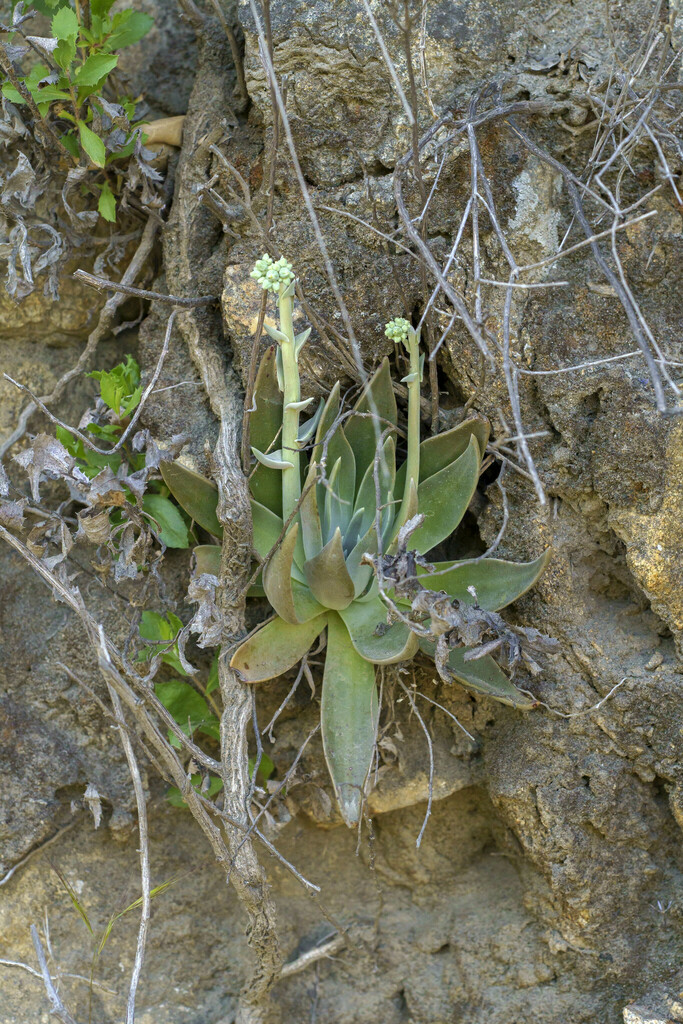
Banner dudleya
Dudleya alainae
Dudleya saxosa subsp. aloides is a species of perennial succulent plant in the family Crassulaceae known by the common names desert dudleya or desert savior. It is a rosette-forming species widely distributed throughout the Peninsular Ranges and desert mountains of California in the United States. It is characterized by bright-yellow or greenish-yellow flowers, and can be found in shaded crevices and slopes. Plants in western half of the range may grade into Dudleya lanceolata.
From the article Dudleya saxosa subsp. aloides on Wikipedia (CC BY-SA), quoted section by section
Description
A rosette-forming succulent that may be evergreen or summer deciduous. It typically has bright yellow or green flowers. This plant's basal rosette is formed on top of a caudex (stem), which is 1 to 3 cm in diameter. There are 1 to 4 rosettes, and they may be 6 to 23 cm wide. The leaves are typically 4 to 15 cm long, and 6 to 25 mm wide, 2 to 5 mm thick, and their base is 10 to 25 mm wide.
The inflorescence has a peduncle 10 to 51 cm tall, and 1 to 9 mm wide. The lower internodes are spaced over 5 mm. The peduncle then branches 3 times, with the floral shoots colored red or green. The terminal branches (cincinni) are wavy, 1 to 12 cm long, and have 2 to 20 flowers. The sepals are around 4 to 6 mm long. The petals are 8 to 15 mm long, and are fused 1.5 to 3 mm. The petals are colored bright yellow or green, but rarely they are tinged with red. Flowering is from April to June
Range & habitat
This species is found primarily in the Peninsular Ranges and on desert mountains in the Mojave and Sonoran deserts in California, USA. It likely does not occur in Mexico. Plants in the northernmost section of the distribution tend to be smaller, while plants near the type locality of Dudleya grandiflora, near Banning, are larger. Plants in western portion of the distribution in the Peninsular Ranges approach Dudleya lanceolata, and hybrids are expected. This species is found growing in rocky, shaded slopes and crevices.
== References ==
Wikipedia: “Distribution and habitat”
In human culture
This species was described as Dudleya aloides in 1903, based on a specimen collected from San Diego County by Townshend Brandegee and examined by Nathaniel Lord Britton and Joseph Nelson Rose during their revision of North American Crassulaceae species. The two also described Dudleya grandiflora, from Whitewater near Banning, California, also collected by Brandegee. A third taxon, the comparatively diminutive Dudleya delicata, was also described by Britton and Rose, collected by LeRoy Abrams near Julian. W.L. Jepson placed the species as Echeveria lanceolata var. composta. Reid Moran placed it as Dudleya lanceolata ssp. aloides in 1951. Moran eventually combined Dudleya aloides as a subspecies of Dudleya saxosa, forming the current combination in 1957. Dudleya grandiflora was recognized as synonymous with subspecies aloides, although the plants called grandiflora are slightly larger than typical subsp. aloides.
Dudleya alainae. In 1984, botanist Craig H. Reiser recognized a number of Dudleya occurring on the eastern side of the Cuyamaca Mountains as Dudleya alainae, commonly known as the Banner dudleya. He recognized them as distinct based on diagnostic criteria that included sulphur-yellow flowers, (as opposed to bright yellow or greenish-yellow) a smaller inflorescence, and a montane coniferous forest habitat compared to the desert-dwelling subsp. …
Wikipedia: “Taxonomic history”
Where it lives
Recorded sightings
—
geo-referenced records in GBIF, from museums, herbaria and field observers.
Drag the globe to turn it. Dots are where records exist, not a range map; darker means more records.
In the stacks
Searching the stacks…
Every page naming Dudleya alainae in the Biodiversity Heritage Library →
This page is assembled live from iNaturalist, GBIF, Wikipedia, the Source Library and the Internet Archive. It is not yet part of the hand-edited codex. iNaturalist taxon 181626.