- Animals
- ›Chordates
- ›Vertebrates
- ›Birds
- ›Woodpeckers and Allies
- ›Woodpeckers
- ›Typical woodpeckers
- ›Pied woodpeckers and allies
- ›Melanerpes
On eBird ↗
Golden-cheeked Woodpecker
Live sightings near you, the range map, bar charts of when it is seen, and Macaulay Library photos and recordings.
Golden-cheeked Woodpecker
Melanerpes chrysogenys
The golden-cheeked woodpecker (Melanerpes chrysogenys) is a species of bird in the family Picidae. It is endemic to Mexico, in the western, and southwestern coastal strip on the Pacific Ocean, and the western bordering regions of mountains of the Trans-Mexican Volcanic Belt. They are distributed in the coast from Sinaloa to Colima.
From the article Golden-cheeked woodpecker on Wikipedia (CC BY-SA), quoted section by section
Description
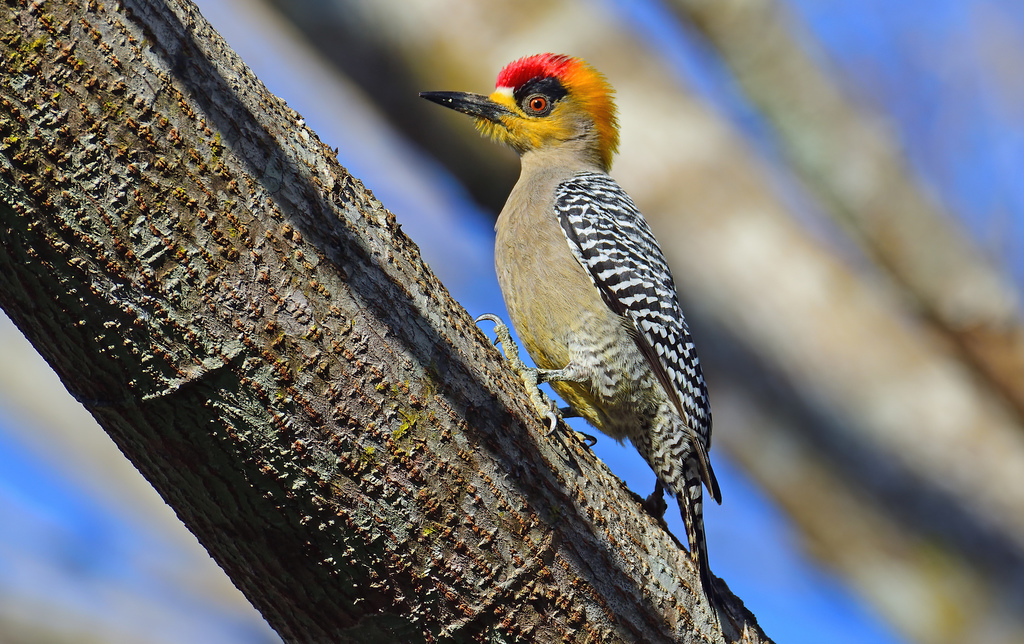
The golden-cheeked woodpecker is about 19 to 22 cm (7.5 to 8.7 in) long and weighs 55 to 88 g (1.9 to 3.1 oz). The sexes' plumage is alike except for their head pattern. Adult males of the nominate subspecies have a whitish forehead, a red crown, and a yellow-gold nape and hindneck. Adult females have the same whitish forehead but a grayish-buff crown and an orange-red nape. In both sexes a wide black area surrounds the eye. Their upperparts are barred black and white; the black is widest on the rump and uppertail coverts. Their flight feathers are black with white bars throughout. Their tail is black with white bars on the central pair of feathers and progressively more white on each pair out from them. Their lores and under the eye are deep golden-yellow and their cheeks, chin, and throat are golden-buff. Their underparts are mostly gray-brown to brownish-buff with a strong olive-yellow wash and a yellowish orange patch on the central belly. Their lower flanks and undertail coverts are grayer with dark bars. Their bill is longish and black, their iris is reddish to orange-brown, the bare skin around the eye blackish, and the legs green-gray. Juveniles have grayer or browner upperparts with less contrasting barring than adults, and paler and grayer underparts with a strong yellow cast and obscure bars. …
Range & habitat
The nominate subspecies of golden-cheeked woodpecker is found in western Mexico between Sinaloa and Nayarit. M. c. flavinuchus is found from Jalisco in west central Mexico south along the coast to Oaxaca and east to Puebla. The species inhabits the interior and edges of mesophytic to xeric forest and more open landscapes like patches of forest, savanna with trees, and plantations. In elevation it ranges from sea level to about 1,500 m (4,900 ft).
Wikipedia: “Distribution and habitat”
What it does
The golden-cheeked woodpecker feeds both on insects like ants and adult and larval beetles, and also on fruits and seeds. It forages on trees from their middle to upper levels, singly or in pairs, and gleans, probes, and pecks for its food.
Wikipedia: “Feeding”
Listen
Looking for field recordings…
Where it lives
Recorded sightings
—
geo-referenced records in GBIF, from museums, herbaria and field observers.
Drag the globe to turn it. Dots are where records exist, not a range map; darker means more records.
In the stacks
Searching the stacks…
Every page naming Melanerpes chrysogenys in the Biodiversity Heritage Library →
This page is assembled live from iNaturalist, GBIF, Wikipedia, the Source Library and the Internet Archive. It is not yet part of the hand-edited codex. iNaturalist taxon 18206.